
A Closer Look at the Delta 15 Scroll Saw
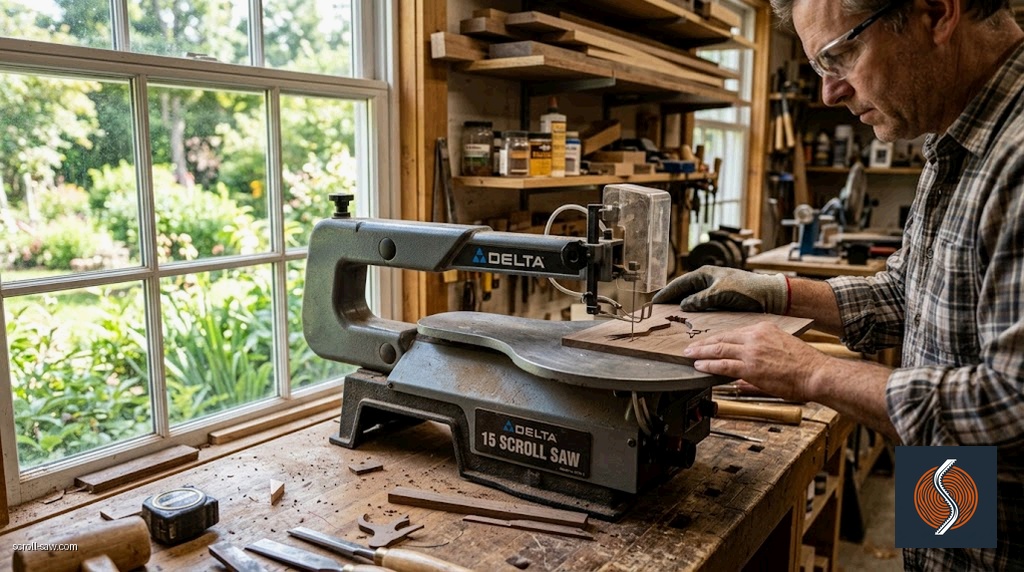
A Closer Look at the Delta 15 Scroll Saw
The Delta 15 scroll saw is not a single model. It is a family of 15-inch-class scroll saws that Delta sold under a handful of names over the years, including older Rockwell-branded units and later Delta Shopmaster variants. The common feature is the 15-inch throat measurement (a hair short of the standard 16-inch class), a light-to-medium weight cast base, and standard 5-inch scroll saw blades. If someone said “I have a Delta 15,” this is what they probably mean and what you probably want to know about it.
What the saw is
Delta 15-inch scroll saws are hobby-tier machines. Throat depth around 15 inches. Cutting capacity typically 1-1/2 to 2 inches at 90 degrees. Cast aluminum table on most variants, cast iron on some older Rockwell units. Two-speed or variable-speed drive depending on the specific model. Every one of them uses standard 5-inch scroll saw blades, pin-end in factory configuration on most models.
These saws sat below the Delta 40-540 (a 16-inch variable speed) and well below the current Delta 40-694 (a 20-inch variable speed) in the lineup. They were entry-level Delta scroll saws aimed at hobbyists who wanted a Delta name without the mid-tier price.
Where they typically show up
Delta 15 scroll saws come up on Craigslist, at estate sales, and in family workshops that got them as gifts in the 1990s and 2000s. Most surviving examples were used lightly, which means the motor is generally healthy and the wear items (blade holders, tension spring, cord, switch) are the parts that most often need attention.
The ten-minute inspection
Power it up. The motor should come up to speed smoothly and settle into a steady rhythm. A motor that stutters or hums without spinning freely is either a switch, a speed board, or worn brushes issue.
Watch the arm stroke. Vertical and even is right. A wobble or a rhythmic tap points to worn arm bushings.
Feel the blade holders. Small stroke-direction play is normal. Side-to-side rock is worn clamps.
Test tension. Install a blade if one is present, tension it, and pluck it. A clear ring means the tension mechanism works.
Check the table. Cracks or bent inserts are terminal for daily use. Deep scratches are cosmetic.
Sight the arm. Upper and lower blade holders should be in the same vertical plane.
Cord and switch. Age-hardened cords and pitted switches are safety issues.
Blade fit
Every Delta 15 scroll saw in the family uses standard 5-inch blades. Most are pin-end in factory configuration. Universal pin-end blades from Olson or Pégas fit the factory clamps.
A working blade set:
-
General work: Olson FR49400 skip-tooth pin-end assortment.
-
Cleaner underside: Olson FR49202 reverse-tooth pin-end assortment.
-
Fine detail: Olson FR44802 fine reverse-tooth blades.
If your Delta 15 accepts pinless blades or you add a pin-to-pinless conversion adapter, the plain-end catalog opens up including Olson SP46500 spiral blades for 360-degree cutting.
What it will and will not do
Will do well: Christmas ornaments, small toys, hobby signage, puzzle pieces, general hobby scrolling in softwood and thin hardwood.
Will do adequately: Intarsia in 3/4 inch hardwood if the saw is set up right and the blade is fresh.
Will not do well: Portrait scrolling with sub-#1 detail blades, production runs, thick hardwood cutouts over 1 inch.
Speed and setup
On a two-speed Delta 15, use low speed for hardwood over 1/2 inch and high speed for softwood and general scrolling. On variable-speed variants, run 900 to 1,200 SPM for hardwood and 1,200 to 1,500 SPM for softwood.
Setup notes are the same as for any 15 or 16-inch scroll saw:
Bolt it down. These saws are light enough to walk on rubber feet.
Square the table to the blade. Engineer’s square, adjust tilt lock, mark true zero.
Set tension by ear. Pluck test, clear ring is right.
Wax the table. Feed becomes noticeably smoother.
Add real light. A Neatfi XL magnifying lamp at the bench edge changes how the saw feels to use.
Comparison against alternatives
Against a WEN 3922, a healthy Delta 15 has slightly more mass and a somewhat smoother stroke, and a less refined blade change. The WEN’s side-panel access makes blade changes noticeably faster and its native pinless-plus-spiral clamp skips the adapter step.
Against a Delta 40-540 or 40-694, the 15-inch Delta is a class below in mass, motor, and refinement. If you find a healthy Delta 20 (40-694) at a reasonable price, spend the money there instead.
Against a used DeWalt DW788, the DeWalt is a step up in every measurable way.
Who should skip a Delta 15 entirely: anyone whose specific example needs blade holders, tension spring, cord, and switch all at once. The parts bill approaches the price of a new WEN, and the WEN is a nicer saw to use.
FAQ
What is a Delta 15 scroll saw? A family of 15-inch-class hobby scroll saws Delta sold over the years, including older Rockwell units and Delta Shopmaster variants.
What blades does the Delta 15 take? Standard 5-inch scroll saw blades, pin-end on most variants, plain-end on a few later models.
How thick can it cut? Typically 1-1/2 to 2 inches at 90 degrees. Comfortable working thickness is 3/4 inch softwood and 1/2 inch hardwood.
Are parts still available? Some Delta 15 parts are still stocked. Older Rockwell parts are increasingly rare and often need aftermarket cross-references.
Is a Delta 15 better than a Delta 16? The 16-inch Delta variants are generally a class up, though condition matters more than class.
Can I convert to pinless blades? Yes, with a universal pin-to-pinless adapter on most Delta 15 models.
What speed for hardwood? 900 to 1,200 SPM on variable speed. Low speed on two-speed variants.
Why does my Delta 15 wander off the line? Usually a dull blade or worn blade holder. Change one variable at a time.
Should I bolt the saw down? Yes. Delta 15 scroll saws vibrate on rubber feet.
Is a Delta 15 worth buying used? If it passes the ten-minute inspection and the price is fair, yes. If it needs multiple structural repairs, no.
References
-
Delta Machinery service portal manufacturer parts and service reference.
-
Olson Saw scroll saw blade selection chart blade sizing reference.
-
OWWM archived Delta and Rockwell scroll saw threads, field notes from long-time owners.


