
1671 Dremel Scroll Saw: Speed Range, Arm Design, and Ownership Notes
1671 Dremel Scroll Saw: Speed Range, Arm Design, and Ownership Notes
The Dremel 1671 landed in a lot of American basements in the 1980s and 1990s. It was sold as a hobby-tier tool alongside the Dremel Moto-Tool, aimed at woodworkers who wanted to cut curves without buying a full-size cabinet saw. The 1671 is a 15-inch throat table-top scroll saw with a two-speed drive, a cast base, and pin-end blade holders. Most of them still run, and the surprise for new owners is how well a well-set-up 1671 still cuts.
Speed range
The 1671 is a two-speed saw. Low speed is approximately 850 SPM. High speed is approximately 1,720 SPM. There is no variable speed control, no potentiometer, and no way to fine-tune within either range without adding one aftermarket. The two speeds are chosen with a belt position on some variants and with a switch on others.
What that means in practice: use low speed for hardwood over 1/2 inch, plastic, and thin non-ferrous metal. Use high speed for softwood and general scrolling. The saw does not have the fine control of a modern variable-speed machine, but between the two speeds it covers most hobby scrolling material.
Arm design
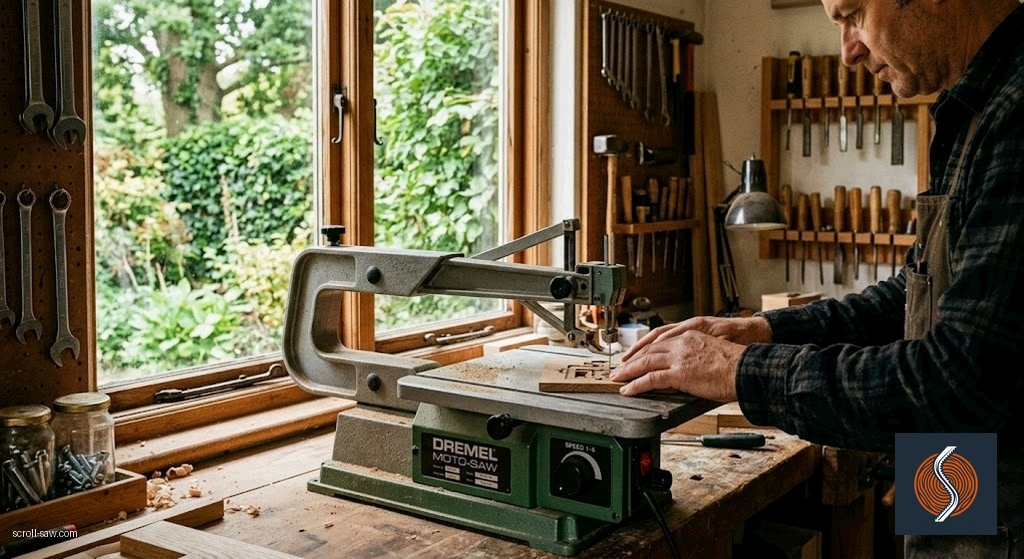
The 1671 uses a C-arm design. The upper and lower blade holders are mounted on a single cast arm that pivots at the rear of the machine. This gives a slightly angled stroke rather than the perfectly vertical stroke of a parallel-arm scroll saw. On a well-set-up 1671, the stroke is straight enough for hobby work. On a worn 1671 with tired bushings, the angled stroke amplifies alignment problems.
The practical implication: cuts on a 1671 can drift slightly more than on a modern parallel-arm saw at the same tension and feed. Skilled scrollers work around this. Beginners sometimes blame the blade.
Blade fit
The 1671 uses standard 5-inch pin-end blades. Any universal pin-end blade fits, including Olson, Pégas, and Flying Dutchman. There is nothing proprietary about the blade format.
A working blade shelf for a 1671:
-
General work: Olson FR49400 skip-tooth pin-end assortment.
-
Cleaner underside: Olson FR49202 reverse-tooth pin-end assortment.
-
Fine detail: Olson FR44802 fine reverse-tooth blades.
If you want to run plain-end blades or spiral blades on a 1671, a universal pin-to-pinless conversion adapter fits into the existing clamps. Once installed, the saw runs Olson SP46500 spiral blades for 360-degree cutting.
Ownership notes
Motor. The 1671 motor is famously durable. Even units that have sat in a basement for twenty years usually start after cleaning.
Belt. The internal belt between the motor and the drive stiffens and cracks over time. A cracked belt makes the saw stroke unevenly or refuse to run at high speed. Belt replacement is the single most common 1671 repair after blade holder work.
Blade holders. Pin slots wear out of round after decades. Symptoms are cuts that lean and blades that snap early.
Cord and switch. Age issues, safety issues. Replace both if the original is brittle or pitted.
Rubber feet. Crumbled on most surviving units. Trivial to replace.
Original work light. The clip-on lamp on most 1671 saws has aged out. Replace with a bench-mounted Neatfi XL magnifying lamp.
Parts availability. Dremel-branded 1671 parts are largely out of production. Bosch service parts network stocks a few. Third-party parts specialists cross-reference many wear items to universal equivalents. Belt and motor brushes are standard sizes.
Setup that makes a 1671 cut cleanly
Bolt it down. The 1671 is light. Bolt or clamp the base to a solid bench.
Square the table. Fresh blade, engineer’s square, adjust the tilt lock, mark true zero.
Tension by ear. Pluck the blade. Clear ring is right. The 1671’s tension mechanism is not the strongest, so under-tensioned blades are more common than over-tensioned ones on this saw.
Wax the table. Feed becomes noticeably smoother.
Update the light. The stock lamp has almost certainly aged out.
Comparison against modern alternatives
Against a WEN 3922, the WEN is a step up in blade change convenience (side-panel access), native pinless capability, and variable speed. A healthy 1671 has more mass and a slightly quieter drive. If you already own a working 1671, keep it. If you are choosing between a project 1671 and a new WEN at similar cost, the WEN is the more useful daily saw.
Against a Shop Fox W1872, the Shop Fox is a step up in dust blower quality and includes a factory foot switch.
Against a used DeWalt DW788, the DeWalt is a considerable step up in every measurable way. A DW788 in decent used condition is the successor to a 1671 for owners who want more capability.
Who should skip 1671 restoration: someone whose specific saw has a cracked C-arm or a scored table. Those are terminal problems. Someone whose 1671 needs blade holders, belt, cord, switch, and tension spring all at once is competing with a new WEN 3922 on total cost, and the WEN wins on convenience.
FAQ
What is the speed range of the Dremel 1671? Two speeds, approximately 850 and 1,720 SPM. No variable speed control.
What blades does the 1671 use? Standard 5-inch pin-end scroll saw blades from any quality maker.
Can I convert the 1671 to pinless blades? Yes, with a universal pin-to-pinless adapter.
How thick can the 1671 cut? Rated to about 1-3/4 inch. Comfortable working thickness is 3/4 inch softwood and 1/2 inch hardwood.
Is the Dremel 1671 the same as the Dremel Moto-Saw MS20? No. The 1671 is a full-size 15-inch table-top scroll saw. The Moto-Saw MS20 is a modern compact tool using proprietary short blades.
Are parts still available for the 1671? Some through Bosch service, more through third-party specialists and universal cross-references. Belts and brushes are standard sizes.
What speed for hardwood on a 1671? Low speed for hardwood over 1/2 inch. High speed for softwood and general scrolling.
Why does my 1671 stroke unevenly? Usually a stretched or cracked drive belt. Belt replacement is the fix.
Should I restore a Dremel 1671 or buy a new saw? If the motor, arm, and table are healthy and only wear items need replacement, restore. If multiple structural repairs are needed, a new WEN or Shop Fox is the better spend.
Is a 1671 collectible? In good condition with original accessories, yes, on a modest scale. Working examples change hands regularly on the secondary market.
References
-
Dremel manufacturer support current parts and service reference.
-
Olson Saw scroll saw blade selection chart blade sizing reference.
-
Scroll Saw Village and Sawmill Creek archived Dremel 1671 threads, restoration and setup notes from long-time owners.


