
Antique Craftsman Scroll Saw: Identification, Condition, and Parts Availability
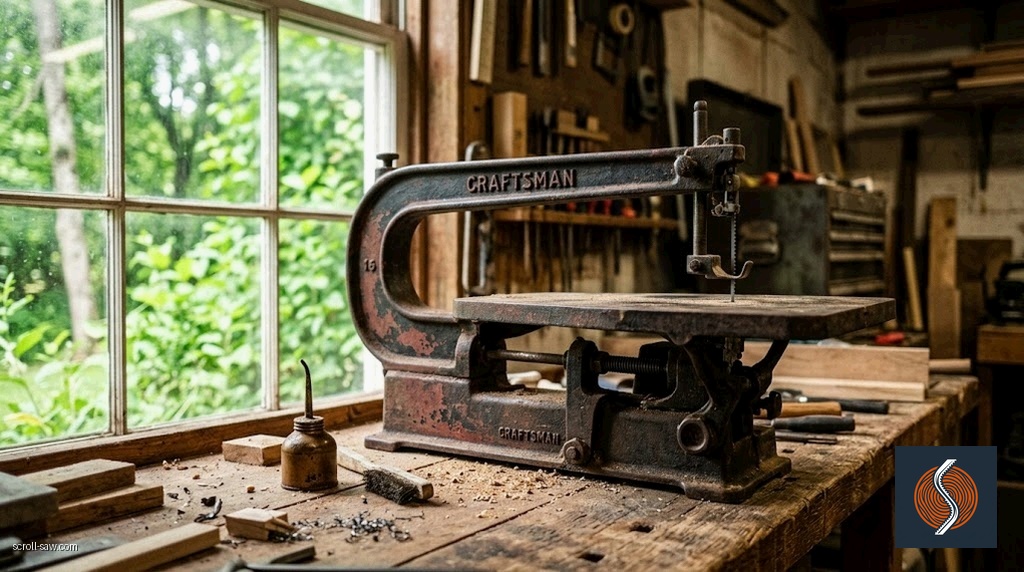
Antique Craftsman Scroll Saw: Identification, Condition, and Parts Availability
Craftsman scroll saws sold in North America for most of the 20th century, mostly through Sears. The ones that turn up now at estate sales, in family basements, and on Craigslist span from cast iron machines from the 1940s to the plastic-cased Ryobi-made Craftsman saws of the 2000s. “Antique” is a loose term here. For most buyers the useful question is: is this specific saw worth bringing home, and if so how much is it worth. This is the plain guide.
Identifying what you have
The model plate. Every Craftsman scroll saw carries a Sears model number. On older saws, look on the motor housing or the front of the base. The number typically starts with a three-digit prefix (like 103, 113, 315, or 572) followed by a period and a longer number. The prefix tells you who actually built the saw:
-
103: King-Seeley. Older Craftsman scroll saws from the 1940s and 1950s.
-
113: Emerson Electric. Craftsman scroll saws from the 1960s and 1970s.
-
315: Ryobi. Craftsman scroll saws from the late 1980s onward.
-
137 or 572: Various later contract manufacturers.
Once you have the full model number, Sears Parts Direct’s archive is the first place to check for a parts diagram.
The blade format. Older Craftsman scroll saws use standard 5-inch pin-end blades. A handful of very old machines use proprietary blade lengths, but these are rare. If the machine takes 5-inch pin-end blades (measure the current blade if one is installed), universal blades from Olson or Pégas fit.
The arm design. C-arm or parallel-arm. Look at whether the upper and lower blade holders sit on a single cast piece (C-arm) or on two arms that pivot at the rear (parallel-arm). C-arm saws produce a slightly angled stroke. Parallel-arm saws produce a vertical stroke.
The motor type. Most older Craftsman scroll saws use small universal motors. Some higher-end models use induction motors, which are quieter and longer-lived.
Judging condition
Work through the ten-minute inspection.
Power it up. Motor should spin smoothly. Stuttering, humming without spinning, or refusing to start points to switch, brushes, or motor issues.
Watch the stroke. Vertical and even is right for parallel-arm saws. C-arm saws will have a slight angle, but the stroke should still be smooth and even.
Feel the blade holders. Small stroke-direction play is normal. Side-to-side rock is worn clamps and the most common repair on antique Craftsman scroll saws.
Sight the arm. Upper and lower blade holders should be in the same vertical plane.
Table condition. Cracks or bent inserts are bad. Deep scratches are cosmetic.
Cord and switch. Age-hardened cords and pitted switches are safety issues and need replacement.
Base and stand. Cast iron bases are stable. Sheet metal stands on older Craftsman saws sometimes crack at weld points.
Rust. Surface rust cleans off. Deep pitting on the table or arm bushings is a problem.
Motor mount. On some older Craftsman scroll saws, the motor mounts to a sliding plate that also tensions the drive belt. Check for cracks and secure mounting hardware.
Parts availability
Sears Parts Direct still lists many Craftsman scroll saw parts by model number, though inventory has shrunk over the years. Third-party parts specialists cross-reference many Craftsman items to universal equivalents. Belt sizes, motor brush sizes, and cord and switch dimensions are all standard.
Blade holders are the hardest single part to find as original Craftsman replacements. Universal aftermarket blade holder assemblies work as substitutes on most models. On some older 103-prefix saws, machining a replacement holder is easier than finding an original.
Blades are the easiest part to find. Any standard 5-inch pin-end blade fits. A working blade shelf:
-
General work: Olson FR49400 skip-tooth pin-end assortment.
-
Cleaner underside: Olson FR49202 reverse-tooth pin-end assortment.
-
Fine detail: Olson FR44802 fine reverse-tooth blades.
For plain-end blade capability on an older Craftsman, a universal pin-to-pinless conversion adapter fits into the existing pin clamps.
Value
Working, complete, clean. A working antique Craftsman scroll saw in good cosmetic condition sells for the same range as a new budget scroll saw. Not more. If someone is asking mid-tier saw money for an antique Craftsman, walk away.
Working but tired. Fair price for a Craftsman scroll saw that runs but needs blade holders, cord, switch, and rubber feet is the price of a modest dinner. The parts bill will bring the total up.
Not working, unknown condition. If the seller cannot power it up, the price should be scrap value. If it needs a motor, walk away.
Collectible originals. A few pre-1960 Craftsman scroll saws in original condition with all accessories sell above their working value to collectors. This is a small market and most casual buyers are not competing in it.
What to actually do with one
If you have an antique Craftsman scroll saw that passes the ten-minute inspection, spend an evening with the following:
Clean it. Wire brush the cast surfaces, wipe the motor housing, degrease the table.
Replace consumables. New cord and switch if the originals are aged. New rubber feet.
Wax the table. Paste furniture wax.
Fresh blade. New Olson or Pégas.
Bolt it down. Every hobby scroll saw benefits.
Add real light. A bench-mounted Neatfi XL magnifying lamp changes how the saw feels to use.
After that evening, the saw will cut better than it has in decades.
Comparison against a new saw
Against a new WEN 3922, a working antique Craftsman scroll saw is not as convenient. Blade changes take longer. Variable speed is not always available. Dust collection is often absent. What the older saw has is mass, character, and often a better motor.
For a hobbyist who values working with a machine that outlived its original owner, an antique Craftsman is worth keeping. For a hobbyist who wants the fastest path to a finished project, a new WEN or Shop Fox is the more direct choice.
Who should skip an antique Craftsman scroll saw entirely: someone who needs to buy blade holders, tension mechanism, cord, switch, motor brushes, and rubber feet at once. Parts bill approaches the price of a new WEN, and the WEN is easier to use.
FAQ
What makes a Craftsman scroll saw antique? Loose term. Anything pre-1990 typically qualifies. The oldest surviving Craftsman scroll saws date to the 1940s.
Who made antique Craftsman scroll saws? Various contract manufacturers. Sears sold them under the Craftsman name. Model number prefixes identify the actual builder: 103 (King-Seeley), 113 (Emerson), 315 (Ryobi).
Are parts available for antique Craftsman scroll saws? Some through Sears Parts Direct, more through third-party parts specialists. Universal cross-references cover most wear items.
What blades does an antique Craftsman scroll saw take? Standard 5-inch pin-end blades on almost all models.
Is an antique Craftsman scroll saw worth restoring? If it passes the inspection and the parts bill is reasonable, yes. If it needs a motor, no.
Can I convert an antique Craftsman to pinless blades? Yes, with a universal pin-to-pinless adapter.
What is the best antique Craftsman scroll saw? Depends. Later Emerson-built 113-prefix models are generally considered the strongest. King-Seeley-built 103 models have devoted followings.
How much should I pay for an antique Craftsman scroll saw? Working and complete, price of a new budget scroll saw or less. Not more.
Should I use my antique Craftsman scroll saw daily? Yes, if it is set up and maintained. These machines were built to last.
What speed for antique Craftsman scroll saws? Two-speed on most old Craftsman saws. Use low speed for hardwood and plastic, high speed for softwood.
References
-
Sears Parts Direct parts diagrams and stock lookup by model number.
-
Olson Saw scroll saw blade selection chart blade sizing reference.
-
OWWM (Old Woodworking Machines) archived Craftsman scroll saw threads, restoration notes and identification guides from long-time collectors.


