
DeWalt 20 Inch Variable Speed Scroll Saw: What to Change When the Cut Quality Drops
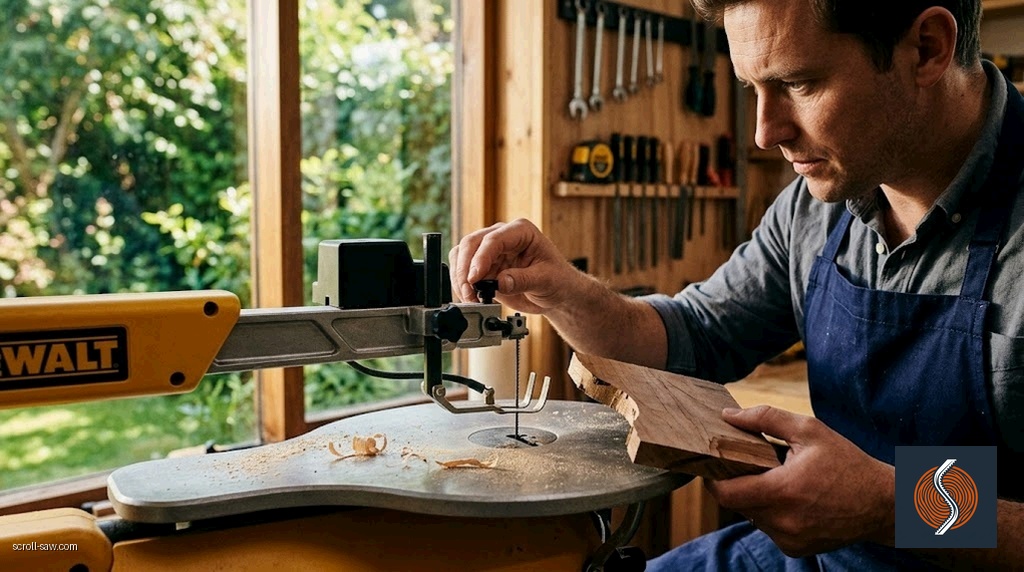
DeWalt 20 Inch Variable Speed Scroll Saw: What to Change When the Cut Quality Drops
The DeWalt 20 inch variable speed scroll saw is the DW788. It has been the reference upper-mid-tier scroll saw in North America for more than two decades, and most examples in current use have cut thousands of feet of hardwood without complaint. When a DW788 starts cutting poorly, the cause is almost always mechanical or setup-related rather than terminal. This is the plain diagnostic guide.
What the saw is
The DeWalt DW788 is a 20-inch throat double parallel-link scroll saw with a variable speed range of roughly 400 to 1,750 SPM, a 1.3 amp motor, a cast iron table, and tool-free blade clamps that accept standard 5-inch plain-end scroll saw blades. Bevel is 45 degrees left and 45 degrees right on this saw, unlike many scroll saws that only tilt one direction. Front-mounted speed and tension controls put every adjustment within reach without walking around the saw.
Rated cutting capacity is 2 inches at 90 degrees. The saw is common on rolling stands and with an optional flex light.
Diagnosing declining cut quality, in order
1. The blade. Change the blade first. A dull, bent, or wrong-material blade is the cause of the majority of “the saw is broken” complaints. Install a fresh Olson FR49202 reverse-tooth plain-end blade or a Pégas #7 blade and cut again. If the problem disappears, the blade was the issue.
2. The tension. Pluck the tensioned blade. On a DW788, a properly tensioned #5 or #7 blade rings clearly at a high pitch. If the note is dull, tension more. If the note is shrill and blades keep snapping at the clamps, back off. The DW788’s tension mechanism supports real tension, and blades under-tensioned on this saw wander more visibly than on lighter machines.
3. The clamps. With the saw unplugged, wiggle both blade clamps. Small stroke-direction play is normal. Side-to-side rock is worn clamps. Replacement clamp assemblies are stocked through DeWalt service. This is the most common DW788 repair after a decade of use.
4. The tension lever detent. The single-lever tension release on the DW788 has a detent that can wear over time, letting tension drift down mid-cut. If tension checks fine when set but drops during cutting, the detent is worn.
5. The arm alignment. Sight the arm from the front. Upper and lower blade holders should sit in the same vertical plane. Shipping damage, a drop, or a bent arm shows here.
6. The table square. Fresh blade, engineer’s square. Adjust the tilt lock if the blade is not flush along the square at nominal zero. Mark true zero with a paint pen.
7. The speed control board. After 10+ years, speed control boards on some DW788 variants develop dead zones or start jumping speed. If motor speed does not track smoothly across the full dial range, the board is the issue. Replacement boards are stocked.
8. The motor brushes. Very late-stage wear item. Rare on DW788 in expected service life. Brushes are replaceable if needed.
9. The stand and mounting. A DW788 that sits on a stand with worn rubber isolators, or that is not bolted firmly to a solid bench, will produce cuts that lean and wander. Tighten the mounting, replace the isolators if degraded.
Setup that keeps a DW788 cutting cleanly
Bolt or clamp the saw solidly. Even the DW788’s mass and dual parallel-link design benefit from a firm mount.
Square the table. As above.
Wax the cast iron table. Paste furniture wax makes feed noticeably smoother.
Aim the dust blower. The DW788 flex blower keeps its aim well but can be knocked out of alignment. Aim it at the cut line on the near side of the blade.
Add real light. The optional DeWalt flex light works. A bench-mounted Neatfi XL magnifying lamp adds full-spectrum light and magnification.
Use the foot switch if you have one. Running the saw hands-free changes how you scroll.
Speed by material
-
Softwood under 3/4 inch: 1,300 to 1,500 SPM. #5 skip-tooth.
-
Softwood 3/4 to 1-1/2 inch: 1,200 to 1,400 SPM. #5 or #7 skip-tooth.
-
Hardwood under 1/2 inch: 1,000 to 1,200 SPM. #5 reverse-tooth.
-
Hardwood 1/2 to 1 inch: 900 to 1,100 SPM. #7 skip-tooth.
-
Hardwood over 1 inch: 800 to 1,000 SPM. #7 or #9.
-
Plywood: 1,000 to 1,300 SPM. #5 reverse-tooth.
-
Acrylic: 600 to 800 SPM. #5 skip-tooth.
-
Non-ferrous metal sheet: 400 to 700 SPM. Metal-cutting blade.
Blade choice for the DW788
The DW788’s tool-free clamps accept standard 5-inch plain-end blades. Universal blades from any quality maker fit. A working blade shelf:
-
General: Olson FR49400 skip-tooth assortment in the plain-end format.
-
Cleaner underside: Olson FR49202 reverse-tooth blades.
-
Fine detail: Olson FR44802 fine reverse-tooth blades.
-
Hardwood finish: Olson DT49300 double-tooth blades.
-
Spiral cutting: Olson SP46500 spiral blades.
-
Premium detail: Pégas #7 regular blades.
Comparison against alternatives
Against a Delta 40-694, the DW788 is a close peer. DW788 has a slightly smoother stroke. Delta 40-694 has a slightly larger table.
Against a Pégas 21, the Pégas is a step up in blade tension and chuck refinement at meaningfully higher cost. The DW788 remains excellent value.
Against a WEN 3922, the DW788 is a considerable step up in every measurable way.
Who should skip the DW788 entirely: a beginner unsure whether scroll sawing will stick. A WEN answers that question at a fraction of the price. A serious hobby scroller who has outgrown a budget saw is exactly who the DW788 is for.
FAQ
What is the speed range of the DW788? Approximately 400 to 1,750 SPM.
What blades does the DW788 use? Standard 5-inch plain-end scroll saw blades.
How thick can it cut? 2 inches at 90 degrees.
Why do my DW788 blades keep breaking? Over-tension. Pluck test.
Why does my DW788 wander mid-cut? Usually tension drift from a worn detent, or a dull blade.
Are DW788 parts available? Yes, through DeWalt service and third-party specialists.
Does the DW788 tilt both directions? Yes. 45 degrees left and 45 degrees right.
Should I use pin-end blades on a DW788? The DW788 is designed for plain-end blades. Pin-end blades will not seat properly in the tool-free clamps.
Where is the DW788 made? Manufacturing has moved over the years. Check the plate on your specific unit for country of origin.
Is the DW788 still in production? Yes, at time of writing.
References
-
DeWalt service center manufacturer parts and service reference.
-
Olson Saw scroll saw blade selection chart blade sizing and material match reference.
-
Sawmill Creek archived DW788 threads, long-term ownership impressions and setup notes.


