
Choosing DeWalt Dw788 Scroll Saw Blades for Clean Curves and Controlled Feed
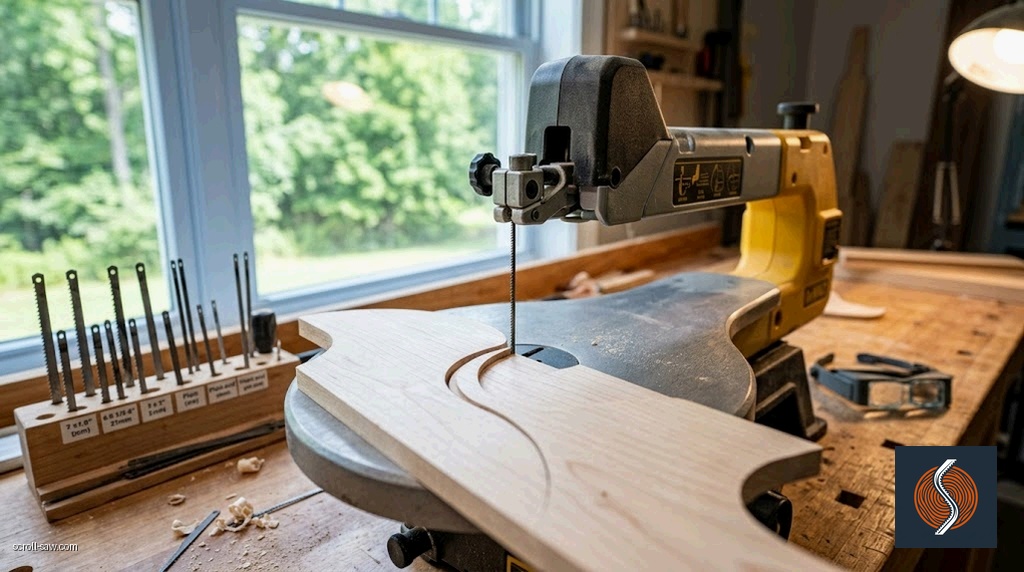
Choosing DeWalt Dw788 Scroll Saw Blades for Clean Curves and Controlled Feed
The DeWalt DW788 is one of the few hobby scroll saws where blade choice makes a large visible difference in cut quality. The saw’s tool-free plain-end clamps hold real tension, its double parallel-link arm produces a very vertical stroke, and its cast iron table stays flat. Put a premium blade on this saw and the difference from a budget blade is not subtle. Put a bad blade on it and you are wasting the saw. This is the plain guide to picking blades for the DW788.
What the DW788 supports
Plain-end blades only. The DW788’s tool-free upper and lower clamps grip flat plain-end blade ends. Pin-end blades do not seat correctly. Standard 5-inch plain-end blades from any quality maker fit.
Real tension. The single-lever tension mechanism supports higher tension than lighter hobby saws. Blade steel that would flex on a WEN or a Central Machinery holds straight on a DW788.
Precise stroke. The dual parallel-link arm keeps the blade very vertical through the stroke. Fine blades track along the line rather than deflecting to one side.
Wide speed range. Approximately 400 to 1,750 SPM. Covers every material a hobby scroller cuts.
These four characteristics together mean the DW788 rewards better blades in a way that lighter saws do not.
Blade sizes to keep on hand
#3 to #5: Fine detail. Portrait scrolling, small ornaments, thin hardwood, tight curves.
#5 to #7: The everyday size. Most hobby projects in wood 1/2 to 1 inch thick.
#7 to #9: Thick hardwood. Oak, maple, and other hardwoods over 1 inch.
#12: Fast cuts in thick softwood. Coarse finish.
Spiral #0 to #4: 360-degree cutting. No workpiece rotation needed.
Metal-cutting: Non-ferrous sheet at slow speed.
The blade shelf for a DW788
Everyday work
Olson FR49400 skip-tooth assortment (plain-end). #5, #7, and #9 in one box. General-purpose. This is the blade you reach for when the project does not demand anything special.
Olson FR49202 reverse-tooth assortment (plain-end). The single upgrade that most changes how your work looks. Reverse teeth on the lower portion of the blade eliminate bottom-edge tearout. Once you use these on a DW788, going back to standard skip-tooth for plywood or veneered work feels like a step backward.
Fine detail
Olson FR44802 fine reverse-tooth blades. For sub-#5 detail work. Portrait scrolling, tight fret work.
Pégas #7 regular blades. Swiss precision blades from a company that specializes in scroll saw blades. Sharper teeth, longer life, tighter tolerances. On a DW788 at proper tension, Pégas blades show their advantage clearly. Cost more per pack but cut longer per blade.
Hardwood finish
Olson DT49300 double-tooth blades. Two teeth between each gullet slow the feed and produce a very clean cut in oak, maple, and other hardwoods.
360-degree cutting
Olson SP46500 spiral #4 blades. General spiral cutting.
Olson SP46300 spiral #2 blades. Finer spiral.
Olson SP46100 spiral #0 blades. The finest spiral Olson makes. Portrait spiral cutting.
Fret work and fine detail
Pégas SK7 fret saw blades. For the finest work the DW788 can do.
Blade by material and thickness on the DW788
-
Softwood under 3/4 inch: #5 skip-tooth. 1,300 to 1,500 SPM.
-
Softwood 3/4 to 1-1/2 inch: #5 or #7 skip-tooth. 1,200 to 1,400 SPM.
-
Hardwood under 1/2 inch: #5 reverse-tooth. 1,000 to 1,200 SPM.
-
Hardwood 1/2 to 1 inch: #7 skip-tooth or double-tooth. 900 to 1,100 SPM.
-
Hardwood over 1 inch: #7 or #9. 800 to 1,000 SPM.
-
Plywood: #5 or #7 reverse-tooth. 1,000 to 1,300 SPM.
-
Acrylic and plastic: #5 skip-tooth. 600 to 800 SPM. Leave protective film on.
-
Non-ferrous metal sheet: metal-cutting blade. 400 to 700 SPM with wax lubricant.
Tension by ear
On a DW788, the tension mechanism supports real tension. A properly tensioned #5 blade rings at a clear, high note when plucked. #7 rings a bit lower but still clearly. #9 lower still.
Under-tensioned blades wander, deflect around knots, and cut angled edges. Over-tensioned blades snap at the clamps.
On a DW788, most blade breakage traces to over-tension rather than under-tension. Back off the lever if blades keep failing at the clamps.
Blade change on the DW788
The tool-free single-lever design is one of the DW788’s main advantages. To change a blade:
-
Drop tension with the front lever.
-
Squeeze the upper clamp release.
-
Pull the old blade up and out.
-
Insert the new blade teeth-down, seat both ends in the clamps.
-
Release the clamp mechanism to close.
-
Restore tension with the lever.
The first few times take a minute. After a few dozen blade changes, the process is well under 30 seconds.
What not to run on a DW788
Pin-end blades. Wrong format for the DW788 clamps.
Off-brand no-name blades from bargain sites. Inconsistent pin tolerance, inconsistent steel, inconsistent tooth spacing. On a DW788 these blades waste the saw.
Old blades that sat in a damp shop. Rust weakens blade steel.
Metal-cutting blades in wood. They cut wood slowly and clog. Use wood-cutting blades for wood.
PGT blades on a saw with worn clamps. PGT blades want tension. Worn clamps do not deliver it. Fix the clamps first.
FAQ
What size blades does the DW788 take? Standard 5-inch plain-end scroll saw blades.
Can I use pin-end blades on a DW788? No. The clamps are designed for plain-end blades.
What is the best blade for the DW788? Depends on the material. For general work, a #5 reverse-tooth. For hardwood, a Pégas #7. For 360-degree cuts, an Olson spiral.
Why do my DW788 blades keep breaking? Almost always over-tension. Pluck test the blade after tensioning.
Are Pégas blades worth the extra cost on a DW788? Yes. The DW788 is one of the saws where premium blade steel and precision-ground teeth show their advantage most clearly.
How long should a DW788 blade last? Depends on material. A #5 blade in softwood may cut for hours. In plywood, less. In oak with a Pégas #7, longer than most Olson blades of the same size.
Can I cut metal with a DW788? Yes. Thin non-ferrous sheet with a metal-cutting blade at the lowest speed and wax lubricant.
What is the best blade for portrait scrolling on a DW788? Spiral #0 or #2/0.
Does the DW788 have a foot switch? Not standard. An optional foot switch is available.
Are DW788 blades interchangeable with Delta 40-694 blades? Yes, both use standard 5-inch plain-end blades.
References
-
DeWalt service center manufacturer product references.
-
Olson Saw scroll saw blade selection chart blade sizing and material match reference.
-
Sawmill Creek archived DW788 blade threads, field notes from long-time DW788 owners on blade choice and setup.


