
How to Evaluate and Restore a Vintage Dremel Scroll Saw
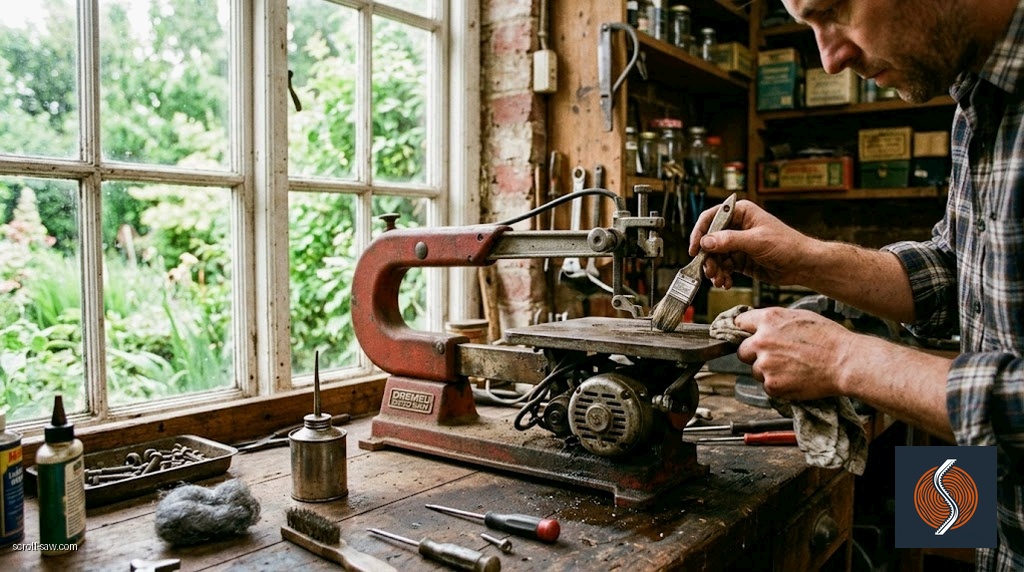
How to Evaluate and Restore a Vintage Dremel Scroll Saw
Vintage Dremel scroll saws come out of basements, estates, and garages in surprising numbers. The Dremel 1671 alone sold in tens of thousands of units through the 1980s and 1990s, and most of those saws still exist. A vintage Dremel scroll saw that has been sitting for twenty years is not necessarily dead. Most are one evening of restoration away from cutting again. This is the plain walk-through.
Identifying what you have
Most vintage Dremel scroll saw listings are one of these:
Dremel 1671. 15-inch throat, two-speed C-arm, universal motor, pin-end blade holders. The most common vintage Dremel scroll saw.
Dremel 1680 and 1671 successors. Similar layout, minor updates.
Dremel Moto-Shop. Older multi-tool that included a scroll saw attachment. Small throat, limited capacity.
Very early Dremel scroll saw units. Rare. Small format, sometimes powered by belt-driven motors external to the saw.
The model plate is usually on the base or the motor housing. If it is missing, comparing the shape of the arm and the location of the switches against reference photos identifies the family within a few minutes.
Evaluating condition
Power it up if possible. A running motor is worth much more than a project machine. Stuttering, humming without spinning, or a tripped breaker point to specific fixable failures.
Watch the stroke. Even the C-arm angled stroke should be smooth. Wobble or a rhythmic tap is worn bushings.
Feel the blade holders. Small stroke-direction play is normal. Side-to-side rock is worn clamps.
Test tension. Install a blade. Tension it. Pluck. Clear ring means the mechanism works.
Look at the table. Cracks are terminal. Deep pitting is bad. Scratches are cosmetic.
Cord and switch. Age-hardened cords and pitted switches are safety issues.
Belt (internal drive). On the 1671, an internal belt connects motor to eccentric. Cracked or stretched belts cause uneven stroke.
Brushes. If the saw has never had a brush service and the motor has been used for decades, brushes are wearing.
Rubber feet. Crumbled on almost every surviving unit.
Rust. Surface rust cleans off. Deep pitting on machined surfaces is a problem.
The restoration evening
Step 1. Clean it.
Wire brush cast surfaces. Wipe the motor housing. Degrease the table with mineral spirits or degreaser. Wipe out the arm interior with a rag.
Step 2. Address safety-critical items.
Replace the cord if it is age-hardened or cracked. Replace the switch if it is pitted or intermittent. New cord and switch are standard sizes, available at any hardware store.
Step 3. Replace consumables.
New rubber feet. New drive belt if the original is cracked. Motor brushes if the saw has never had a service and looks like it has run for decades.
Step 4. Fresh blade.
Discard the blade that came with the saw. Old blades that sat in a damp basement are rusted and dull. Install a fresh Olson FR49202 reverse-tooth pin-end blade.
Step 5. Set up.
Bolt the saw to a solid bench. Square the table to the blade with an engineer’s square. Set blade tension by ear (pluck test, clear high note). Wax the table with paste furniture wax.
Step 6. Light it.
The original clip-on lamp has almost certainly aged out. A bench-mounted Neatfi XL magnifying lamp replaces it and adds magnification for detail work.
Step 7. First cut.
A scrap of 3/4 inch pine. Draw a curve. Cut. If the saw produces a clean, tracked cut, the restoration is complete.
Parts sourcing
Bosch service (Dremel owner). Some original 1671 parts still available. Coverage is thin.
Third-party parts specialists. Belts, brushes, cord, switches, blade holders, tension springs. Many cross-referenced to universal equivalents.
Hardware store. Cord, switch, rubber feet, fasteners.
Blade suppliers. Standard 5-inch pin-end blades. Any quality maker.
Machine shop, as last resort. For rare 1671 blade holders that no aftermarket source stocks, a machinist can turn replacements from stock. This is rarely economical for a $50 saw but sometimes done by owners who value the original machine.
What to actually cut with a restored vintage Dremel
General hobby projects. Ornaments, small toys, hobby signage, puzzle pieces.
Softwood. Any thickness up to about 3/4 inch feeds well at high speed.
Thin hardwood. Up to 1/2 inch at low speed with a fresh blade.
Plywood. Up to 3/4 inch with a reverse-tooth blade.
Not portrait scrolling with sub-#1 blades. The clamp tension is not up to it.
Not thick hardwood cutouts. Rated to 1-3/4 inch but happier below 1 inch.
Blade shelf for a restored vintage Dremel
-
Cleaner underside: Olson FR49202 reverse-tooth pin-end assortment.
-
Fine detail: Olson FR44802 fine reverse-tooth blades.
For plain-end capability, install a universal pin-to-pinless conversion adapter.
When restoration does not make economic sense
If the vintage Dremel scroll saw needs all of the following at once:
-
Blade holders
-
Belt
-
Brushes
-
Cord
-
Switch
-
Tension spring
-
Table repair
Total parts and labor typically approach or exceed the price of a new WEN 3922. The WEN is more convenient to use daily. Restoration in this case is a decision about sentiment and satisfaction, not economics.
FAQ
What is a vintage Dremel scroll saw? Usually a Dremel 1671 or 1680 series from the mid-1980s through the 1990s. Occasionally an older Moto-Shop attachment or a very early Dremel scroll saw.
Are parts available for vintage Dremel scroll saws? Some through Bosch service, more through third-party specialists. Belts and brushes are standard sizes.
What blades does a vintage Dremel scroll saw take? Standard 5-inch pin-end scroll saw blades.
How much should I pay for a vintage Dremel scroll saw? Working and complete, the price of a modest dinner. Non-working with unknown condition, scrap value.
Can I convert a vintage Dremel to pinless blades? Yes, with a universal pin-to-pinless adapter.
Should I restore a vintage Dremel or buy a new saw? If the motor, arm, and table are healthy and only wear items need replacement, restore. If everything needs replacement, a new WEN is the better economic choice.
How long does a restored vintage Dremel scroll saw last? Decades, if maintained. Many 1671s have run for 30+ years in hobby service.
What speed for hardwood on a vintage Dremel? Low speed (approximately 850 SPM) on the two-speed variants.
Are vintage Dremel scroll saws collectible? Working examples in original condition have modest collectible value. The 1671 family is not rare enough to command premium prices.
Why does my restored Dremel stroke unevenly? Almost always a stretched or cracked internal drive belt.
References
-
Dremel manufacturer support current parts and service reference.
-
Olson Saw scroll saw blade selection chart blade sizing reference.
-
Scroll Saw Village archived Dremel 1671 restoration threads, step-by-step notes from long-time owners.


