
Craftsman 16 Scroll Saw Blades: Match Blade Number to Material and Thickness
Craftsman 16 Scroll Saw Blades: Match Blade Number to Material and Thickness
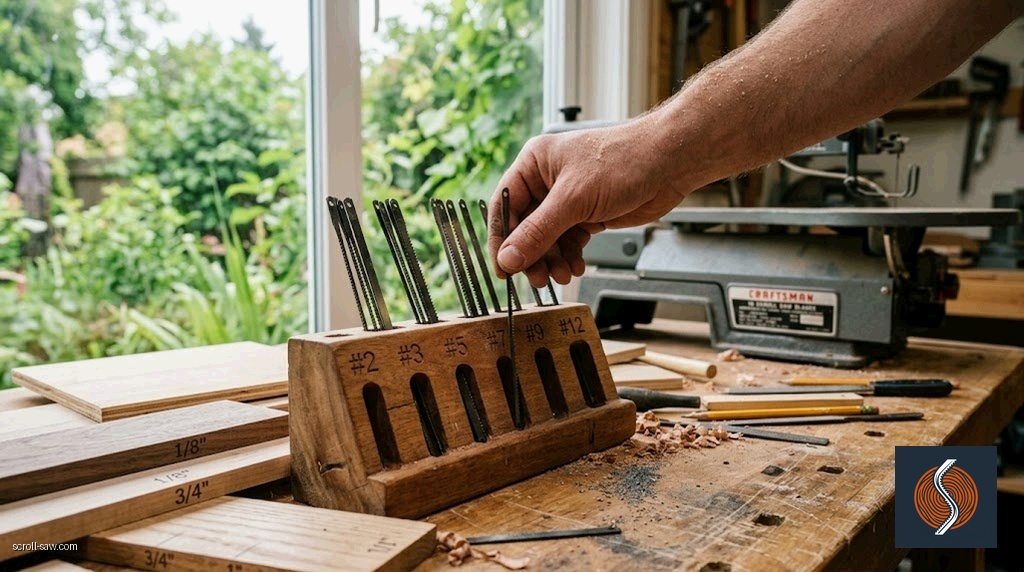
Craftsman 16 inch scroll saws (Sears-era and modern) take standard 5-inch scroll saw blades. There is nothing proprietary about the blade format. That means the entire universal blade catalog from Olson, Pégas, and Flying Dutchman is available. The trick is picking the right blade for the material and thickness in front of you. This is the plain match guide.
Blade numbering, briefly
Scroll saw blades are numbered by size, from very fine (#3/0, #2/0) up through coarse (#12). Smaller number, finer teeth, smaller kerf, slower cut, smoother finish. Larger number, coarser teeth, faster cut, rougher finish.
-
#3/0 to #1: portrait scrolling, fine detail.
-
#3 to #5: most hobby projects.
-
#7 to #9: thick hardwood.
-
#12: fast cuts in thick softwood.
-
Spiral #0 to #4: 360-degree cutting.
-
Metal-cutting: non-ferrous sheet.
Blade type, briefly
Skip-tooth. Standard hobby blade. Every other tooth omitted. Good chip clearance. General-purpose.
Reverse-tooth. Lower portion of the blade has reversed teeth to cut cleanly on both up and down strokes. Best for plywood and veneered work.
Double-tooth. Two teeth between each gullet. Smoother cut in hardwood.
Spiral. 360-degree teeth. Cuts in any direction without workpiece rotation. Rougher edge, most useful for portrait scrolling.
Precision Ground Tooth (PGT). Precision-ground teeth. Cuts on both push and pull strokes. Long life. Higher cost.
Match blade number to material and thickness
Softwood (pine, cedar, poplar)
-
Under 1/4 inch: #3 skip-tooth or #3 reverse-tooth.
-
1/4 to 3/4 inch: #5 skip-tooth.
-
3/4 to 1-1/2 inch: #5 or #7 skip-tooth.
-
Over 1-1/2 inch: #7 or #9 skip-tooth.
Hardwood (oak, maple, walnut, cherry)
-
Under 1/4 inch: #3 or #5 reverse-tooth.
-
1/4 to 1/2 inch: #5 reverse-tooth or #5 double-tooth.
-
1/2 to 1 inch: #7 skip-tooth or #7 double-tooth.
-
Over 1 inch: #7 or #9 skip-tooth.
Plywood and veneered stock
-
1/8 to 1/4 inch: #5 reverse-tooth.
-
1/4 to 1/2 inch: #5 or #7 reverse-tooth.
-
1/2 to 3/4 inch: #7 reverse-tooth.
Acrylic and plastic
- Any thickness up to Craftsman capacity: #5 skip-tooth at low speed (600 to 800 SPM). Leave protective film on.
Non-ferrous metal sheet
- Up to 1/16 inch: metal-cutting blade at very low speed (400 to 700 SPM) with wax lubricant.
Spiral cutting
-
Portrait scrolling: spiral #0 or #2/0.
-
General spiral: #2 spiral.
-
Faster spiral: #4 spiral.
The blade shelf for a Craftsman 16 scroll saw
Most Craftsman 16 scroll saws take pin-end blades in factory configuration. Older Sears-era units also take plain-end blades on some variants via a thumbscrew adapter. Modern Craftsman scroll saws with foot-lock adapters accept both formats.
A working shelf:
-
Cleaner underside: Olson FR49202 reverse-tooth pin-end assortment.
-
Fine detail: Olson FR44802 fine reverse-tooth blades.
-
Hardwood finish: Olson DT49300 double-tooth blades.
For spiral cutting, install a universal pin-to-pinless conversion adapter and add:
-
General spiral: Olson SP46500 spiral #4.
-
Finer spiral: Olson SP46300 spiral #2.
-
Portrait spiral: Olson SP46100 spiral #0.
For premium hardwood work, Pégas #7 regular blades cut cleaner and last longer per blade than budget alternatives.
Speed by material on a Craftsman 16
-
Softwood under 3/4 inch: 1,300 to 1,500 SPM.
-
Hardwood under 1/2 inch: 1,000 to 1,200 SPM.
-
Hardwood 1/2 to 1 inch: 900 to 1,100 SPM.
-
Plywood: 1,000 to 1,300 SPM.
-
Acrylic: 600 to 800 SPM.
-
Non-ferrous metal: 400 to 700 SPM.
On two-speed Craftsman scroll saws (older Sears-era), use low speed for hardwood, plastic, and metal, and high speed for softwood.
Common blade problems and fixes
Blade wanders. Too small a blade for the material, or dull, or under-tensioned.
Blade burns wood. Too fast for the material, or too fine a blade, or dull.
Blade tears out the bottom face. Switch to a reverse-tooth blade.
Blade breaks at the clamp. Over-tensioned, or worn clamp holding the blade crooked.
Blade breaks in the cut. Feed rate too high, or blade too fine for the material.
Blade dulls quickly. Cutting too hot (too fast), or hitting knots or foreign objects, or using a budget blade for tough work.
Blade storage
Blades store best in a dry location. Damp basements rust scroll saw blades quickly. A small drawer or plastic case in a heated shop keeps blades sharp until use.
Do not reuse a blade that has sat in a damp environment for years. Rusted blades are weaker than fresh blades and can snap unpredictably under tension.
FAQ
What blades does a Craftsman 16 scroll saw take? Standard 5-inch scroll saw blades. Pin-end in factory configuration on most models. Plain-end via thumbscrew adapter or with a universal conversion adapter.
Are Craftsman-branded scroll saw blades still available? Some, through Craftsman and Sears Parts Direct. Universal blades from Olson or Pégas cost less per blade and cut cleaner.
What is the best blade for a Craftsman 16 scroll saw? Depends on the material. #5 skip-tooth is the everyday size for hobby work. #5 reverse-tooth is the upgrade for plywood.
How thick can a Craftsman 16 scroll saw cut? Approximately 2 inches at 90 degrees, depending on the specific model.
What is a reverse-tooth blade? A blade with the lower teeth reversed to cut cleanly on the return stroke. Reduces bottom-face tearout in plywood and veneered stock.
Can I use spiral blades in a Craftsman 16 scroll saw? Yes, if the clamp accepts plain-end blades. Older pin-end Craftsman saws need a conversion adapter.
What blade for cutting metal on a Craftsman scroll saw? A metal-cutting blade at very low speed with wax lubricant.
How often should I change blades? When the blade starts wandering or burning wood. A fresh blade always cuts better than a dull one at the same tension.
Why does my Craftsman scroll saw blade keep breaking? Usually over-tension. Pluck test after tensioning: clear high note is right.
Where do I find Craftsman scroll saw blade replacement guides? Sears Parts Direct hosts manuals and diagrams for older Craftsman models. Craftsman’s current portal covers modern ones.
References
-
Olson Saw scroll saw blade selection chart blade sizing and material match reference.
-
Sears Parts Direct manuals for older Sears-era Craftsman scroll saws.
-
Craftsman product support current Craftsman product references.


