
Tree of Life Scroll Saw Pattern: A Project Plan That Anticipates Fragile Cuts
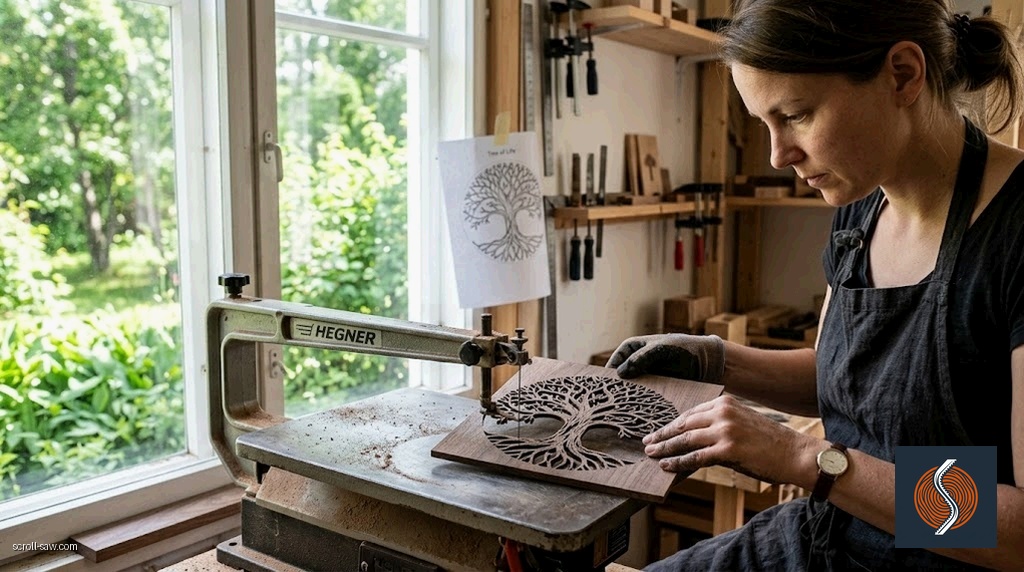
Tree of Life Scroll Saw Pattern: A Project Plan That Anticipates Fragile Cuts
A Tree of Life scroll saw pattern is a fretwork pattern featuring a stylized tree with interlaced roots and branches, often within a circular or rectangular frame. The design has ancient origins across cultures—Celtic, Norse, Christian, Kabbalistic, Buddhist. Every tradition has produced its own interpretation.
The technical challenge: dense fretwork with hundreds of interior cuts and branches that narrow toward the tips.
Short answer: 1/4-inch stock (Baltic birch plywood or hardwood), #3 reverse-tooth blade for most work with #5 for perimeter, plan every entry hole before cutting, work interior-out with clean blades throughout.
Understanding what makes Tree of Life difficult
A typical Tree of Life pattern contains 50-200+ separate interior cuts, depending on complexity. Each cut requires:
-
A drilled entry hole
-
Threading the blade through the hole
-
Cutting the interior shape
-
Removing the waste
-
Repeating
Multiply that by the pattern’s interior count. Then account for the fact that as the pattern gets cut away, the remaining wood becomes progressively more fragile.
A Tree of Life is not a project to rush.
Stock selection
1/4-inch Baltic birch plywood. The default. Excellent cross-grain strength for fretwork. Takes stain acceptably. Best for painted finishes or dark stains.
1/4-inch cherry or walnut. Reads as heirloom. Grain direction critical—orient with tree’s vertical axis. Solid wood shows through clear finish.
1/8-inch stock. Some designers cut Tree of Life at 1/8 inch for extremely delicate ornament versions. Substantially harder to cut cleanly; use #3 blade throughout.
For a first Tree of Life, use Baltic birch plywood. The cross-grain construction forgives more mistakes than solid wood.
Blade choice and blade budget
Budget multiple blades for a single Tree of Life. A dense fretwork pattern will dull or break blades faster than the pattern can excuse.
Primary blade: #3 reverse-tooth for most interior cuts. Tight turning radius. Olson FR49202.
Perimeter blade: #5 reverse-tooth for the outer frame and larger cuts.
Long production runs: Pegas Regular Scroll #7 or Pegas Modified Geometry #12 run cooler and hold edge longer.
Expect to change blades several times during a complex Tree of Life. A dull blade generates heat, which weakens fretwork, which breaks bridges. Change blades when cut quality degrades—don’t push through.
Pattern attachment and preparation
3M Super 77 light spray on the pattern, ninety-second wait, apply to stock. For clear-finish hardwood, first apply ScotchBlue Painter’s Tape 2090 to the stock.
Mark every entry hole location before drilling. A pilot mark with a fine pencil at each interior gap. This is tedious but critical—drilling entry holes as you go leads to mistakes.
Drill all entry holes at once. 1/16-inch bit. Work systematically across the pattern. Vacuum sawdust between passes.
Cutting sequence
A Tree of Life must be cut from the inside out. Cutting the perimeter first creates a fragile frame that flexes during interior cuts.
-
Innermost interior cuts first. The tightest, most fragile fretwork.
-
Work outward. As each ring of interior cuts completes, move to the next.
-
Save the outer frame for last. Cut the frame perimeter last, when interior work is fully complete.
-
Support fragile sections. As cuts progress, portions of the pattern become unsupported. A backing board underneath the pattern reduces flex.
Budget time. A complex Tree of Life takes 6-15 hours of cutting time, sometimes more. Don’t try to finish in one session; fatigue produces mistakes.
Managing bridge fragility
As you cut, bridges become the pattern’s only structure. Once a bridge cracks or breaks, the pattern’s integrity is compromised.
Mitigations:
-
Keep a clean blade (fresh, not dull)
-
Feed slowly; don’t force the blade
-
Support unsupported sections with a hand or backing board
-
Vacuum sawdust periodically to see the pattern clearly
-
Take breaks; fatigued cutting breaks bridges
If a bridge breaks mid-cut, options: superglue the break (visible on unfinished wood, less visible under stain or paint), splice a small piece of matching wood, or start over. The choice depends on how visible the repair will be after finishing.
Finishing
Before removing the pattern, do the primary sanding. 220-grit paper works around fretwork with a fine folded edge. Don’t apply pressure to unsupported sections.
Remove pattern by peeling or with gentle heat. Do not scrape—scraping stresses bridges.
After pattern removal, careful final sanding with 320-grit if the piece will get a fine finish.
Finish options:
-
Clear satin polyurethane over hardwood—shows the grain, reads as fine woodworking.
-
Dark walnut stain over Baltic birch—dramatic contrast with the fretwork gaps.
-
Ebony stain or black paint—reads as graphic art.
-
White paint—modern, minimalist reading.
-
Metallic paint (gold, copper)—decorative religious or spiritual piece.
Where to source Tree of Life patterns
Steve Good’s blog has multiple Tree of Life patterns across different cultural traditions.
Sue Mey has several Tree of Life designs, including Celtic knotwork variants.
Big Book of Scroll Saw Woodworking includes Tree of Life patterns in the fretwork section.
Dedicated books on Celtic scroll saw design have extensive Tree of Life pattern libraries.
Cultural variations
-
Celtic Tree of Life: interlaced roots and branches forming an infinite knot pattern.
-
Norse/Viking Yggdrasil: the world tree, often with animals in the branches.
-
Christian: simpler tree with fruits or scriptural references.
-
Kabbalistic: the ten Sephirot arranged as spheres connected by paths.
-
Buddhist Bodhi tree: heart-shaped leaves, often stylized.
Each tradition has its own visual conventions. If you’re making a piece for someone whose tradition matters, verify the pattern reflects that tradition’s iconography.
Common problems and fixes
Bridge broke during cutting. Blade heat, feed pressure, or blade dullness. Change blade, slow feed, and consider whether the bridge was too thin in the pattern.
Piece flexes during cut. Add backing board support or clamp piece to the table around the working area.
Multiple bridges failing in the same area. Pattern has been over-cut; the section can’t structurally support itself. Reinforce with backing or start over with a redrawn pattern.
Pattern lines hard to follow. Sawdust accumulation. Vacuum frequently.
Finish pooled in fretwork gaps. Apply thinner coats. Wipe excess with a lint-free cloth before it dries.
Piece cracked along a grain line. Solid wood with grain running wrong direction. Baltic birch plywood is more forgiving.
Frequently asked questions
How long does a Tree of Life pattern take to cut? 6-15 hours typical for a complex fretwork design. Simpler versions cut in 3-4 hours. Very complex versions can take 20+ hours across multiple sessions.
Can I stack-cut two Tree of Life patterns at once? Generally no. Fretwork this dense doesn’t stack cleanly; the second layer’s cuts drift from the pattern. Cut individually.
What size stock produces the best result? 1/4-inch is the standard. Thicker stock (1/2 inch) reads as more substantial but is harder to cut cleanly for dense fretwork.
Can I paint a Tree of Life after cutting? Yes. Spray paint in the fretwork gaps first from behind, then paint the front. Multiple thin coats. Prevents pooling in the gaps.
What if I make a Tree of Life pattern larger? Bridges become thicker relative to blade width, making cutting easier. A larger piece is more forgiving.
Can I use a laser cutter for Tree of Life instead? Yes. Laser cutting handles dense fretwork faster and cleaner. But it loses the hand-crafted character. Many builders prefer scroll saw for the tactile result.
What’s the smallest Tree of Life I should attempt on scroll saw? Below 8 inches diameter, fretwork detail becomes too fine for reliable cutting. Above 8 inches gives room for readable fretwork.
References
-
Fox Chapel Publishing, Big Book of Scroll Saw Woodworking.
-
Steve Good, Scrollsaw Workshop (blog).
-
Sue Mey, Scroll Saw Artist.


