
Olson Saw Sp46500 Spiral Scroll Saw Blade: Size, Tooth Geometry, and Material Guide
Olson Saw Sp46500 Spiral Scroll Saw Blade: Size, Tooth Geometry, and Material Guide
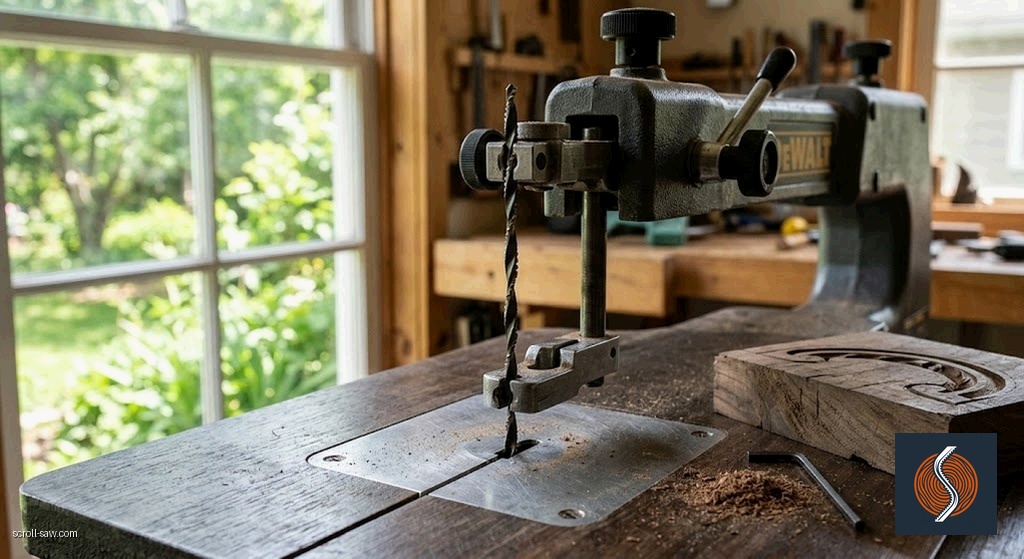
The Olson SP46500 is a spiral scroll saw blade with teeth arranged in a 360-degree pattern around the blade shaft. It is one of the workhorse spiral blades in Olson’s plain-end catalog. If you have never used a spiral blade before, this is the plain guide to what the SP46500 is and what it cuts.
Specifications
-
Blade number: #4 spiral.
-
Length: 5 inches (standard scroll saw blade length).
-
End type: plain end.
-
Teeth per inch: approximately 36 TPI.
-
Diameter: approximately 0.023 inch.
-
Tooth pattern: spiral, 360 degrees around the blade.
-
Package: 12 blades per pack in standard retail.
-
Manufacturer: Olson Saw Company, USA.
What makes a spiral blade different
A regular scroll saw blade has teeth on one edge only. To cut a curve, you rotate the workpiece as the blade cuts. This works well for most scroll saw work.
A spiral blade has teeth wrapped 360 degrees around the blade shaft. It cuts in every direction at once. You can move the workpiece in any direction (left, right, forward, backward, diagonally) without rotating it. The blade cuts wherever the workpiece pushes into it.
The advantage: workpieces that would require awkward rotation on a regular blade cut easily on a spiral. Portrait scrolling is the classic case. A face has features going in every direction (eyes, nose, mouth, hair). Cutting a face with a regular blade requires constant workpiece rotation. Cutting it with a spiral means the workpiece stays fixed and you drive the cut with hand pressure.
The disadvantage: kerf is wider than a comparable regular blade (because the blade cuts on all sides), edge is rougher, and cut lines are harder to follow precisely (because the blade drifts as easily as it tracks).
What the SP46500 (#4 spiral) is good for
General spiral work. The #4 size is the middle of Olson’s plain-end spiral range. Fine enough for reasonable detail, coarse enough for reasonable cutting speed.
Portrait scrolling in 1/4 to 3/4 inch hardwood. The classic use case.
Puzzle cutting. Interlocking puzzle piece patterns cut faster with spirals than with regular blades because rotation is not required.
Fret work. Cutout patterns with tight interior curves.
Wood inlay. Cutting mating pieces from thin stock.
Freehand hobby cutting. Signs, ornaments, letter shapes where speed matters more than perfect edge finish.
What the SP46500 is not good for
Straight cuts. A spiral blade wanders on a straight line because it cuts equally in all directions. Use a regular skip-tooth or reverse-tooth for straight cuts.
Perfectly precise cut lines. Spirals drift more than regular blades. If the line must be followed exactly, use a regular blade with workpiece rotation.
Clean edge finish without sanding. Spirals produce a rougher edge than skip-tooth or double-tooth blades. Plan for edge sanding on finished work.
Thick hardwood. The #4 size struggles above 3/4 inch hardwood. Use a #5 or #7 regular skip-tooth for thick hardwood.
Metal. Spirals are wood blades. Use a dedicated metal-cutting blade for non-ferrous sheet.
Material guide
-
Softwood 1/4 to 3/4 inch: works well. 900 to 1,200 SPM.
-
Hardwood 1/4 to 3/4 inch: works well. 800 to 1,000 SPM.
-
Hardwood over 3/4 inch: possible but slow. Switch to #5 or #7 regular blade instead.
-
Plywood under 1/2 inch: works well. 900 to 1,100 SPM.
-
Acrylic: avoid. Spirals melt plastic more than regular blades.
-
Non-ferrous metal: avoid. Use a dedicated metal-cutting blade.
Related Olson spiral blades
Olson makes spiral blades in several sizes to cover the full detail range:
-
SP46100 spiral #0. 46 TPI. Finest spiral. Portrait scrolling in thin hardwood.
-
SP46300 spiral #2. 41 TPI. Fine spiral. Detail work.
-
SP46500 spiral #4. 36 TPI. Middle spiral. General work.
-
SP46700 spiral #6. 30 TPI. Coarse spiral. Faster cutting, rougher edge.
Compatibility
Standard 5-inch plain-end scroll saw blade. Fits every plain-end-capable scroll saw including:
-
Delta 40-694 and 40-695
-
WEN 3921 and 3922 with the thumbscrew adapter in plain-end mode
-
Pégas 21
-
RBI Hawk
-
Any older pin-end scroll saw with a universal pin-to-pinless conversion adapter
Setup tips for using the SP46500
Tension carefully. Spirals are more fragile than regular blades. Pluck test: clear ring is right, do not over-tension.
Feed slowly. Spirals cut in all directions. Aggressive feed causes drift.
Use light hand pressure. Let the blade cut. Do not push the workpiece hard.
Plan for edge sanding. Spiral edges are rougher than regular blade edges.
Change blades often. Spirals dull faster than regular blades because all sides of the blade are cutting.
Do not use for straight cuts. Switch to a regular blade for straight work.
FAQ
What is the Olson SP46500? A #4 spiral scroll saw blade, 5 inches long, plain end, 36 TPI, approximately 0.023 inch diameter.
What size is the SP46500? #4 spiral. The 4 refers to Olson’s spiral sizing scale.
How many blades are in a pack? 12 in standard retail.
Is the SP46500 plain end or pin end? Plain end. Fits scroll saws with tool-free or thumbscrew plain-end clamps.
Can I use the SP46500 in a WEN 3922? Yes. Set the thumbscrew adapter to plain-end mode.
Can I use the SP46500 in an older pin-end scroll saw? Yes, with a universal pin-to-pinless adapter.
What material does the SP46500 cut? Softwood, hardwood, and thin plywood. Not acrylic. Not metal.
What is the difference between the SP46500 and a regular scroll saw blade? The SP46500 has teeth 360 degrees around the shaft. It cuts in all directions. A regular blade has teeth on one edge only.
Is the SP46500 good for portrait scrolling? Yes, it is one of the classic uses.
Is the SP46500 good for straight cuts? No. Use a regular skip-tooth or reverse-tooth blade for straight cuts.
References
-
Olson Saw scroll saw blade selection chart blade sizing, TPI, and material match reference.
-
Olson Saw product portal manufacturer product references.
-
Scroll Saw Village archived spiral blade threads, field notes and technique tips from long-time spiral scrollers.


