
Delta Scroll Saw 40 130: Specifications, Blade System, and Parts Support
Delta Scroll Saw 40 130: Specifications, Blade System, and Parts Support
The Delta scroll saw 40-130 is a vintage Delta 15-inch scroll saw, part of Delta’s older scroll saw lineup that predates the current 40-694. Owners today are mostly people who inherited one, bought one used, or dug one out of a shop that closed decades ago. This is the plain look at what the 40-130 is, how its blade system works, and what parts support looks like now.
Specifications
-
Throat depth: 15 inches.
-
Cutting capacity at 90 degrees: approximately 1-3/4 to 2 inches.
-
Speed: two-speed on most 40-130 variants, roughly 850 and 1,725 SPM.
-
Motor: universal motor, approximately 1/6 to 1/4 horsepower.
-
Table: cast iron on early variants, die-cast aluminum on later.
-
Table bevel: typically 45 degrees left.
-
Stroke: approximately 3/4 inch.
-
Blade system: pin-end blade holders in factory configuration.
-
Arm design: C-arm on earlier 40-130 variants, parallel-arm on later.
-
Base: cast base with rubber feet.
The 40-130 was a mid-tier Delta at time of sale, positioned above hobby-grade saws and below Delta’s professional-grade variants of the era.
Blade system
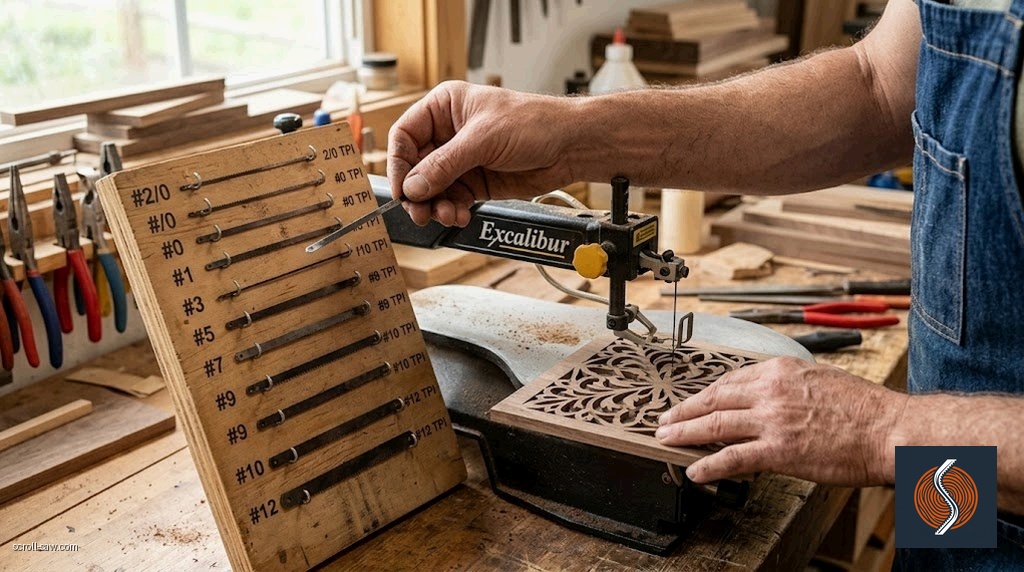
The 40-130 uses standard 5-inch pin-end scroll saw blades in factory configuration. Any universal pin-end blade from Olson, Pégas, or Flying Dutchman fits. The blade format is not proprietary.
Upper clamp. Small thumb wheel or key, depending on variant.
Lower clamp. Same style as upper.
Tension mechanism. Spring-loaded, adjustable via a lever or knob at the arm.
Blade change on the 40-130 is slower than on modern tool-free saws. Reach the upper and lower clamps, loosen, remove old blade, insert new blade teeth-down, tighten, tension.
For plain-end blade capability, a universal pin-to-pinless conversion adapter fits into the existing pin clamps. Once installed, the saw runs plain-end blades including Olson SP46500 spiral blades.
A working blade shelf for the 40-130:
-
Cleaner underside: Olson FR49202 reverse-tooth pin-end assortment.
-
Fine detail: Olson FR44802 fine reverse-tooth blades.
Parts support
Delta service portal. Some 40-130 parts still available, though coverage is thinner than for current Delta models. Manual downloads and parts diagrams are typically available even when specific parts are not stocked.
Third-party parts specialists. Cross-references for most 40-130 wear items exist through parts specialists.
Hardware store. Cord, switch, rubber feet, fasteners.
Universal aftermarket. Blade holder assemblies, tension springs, and speed switches (on two-speed variants) cross-reference for many Delta 40-series scroll saws.
Blades. The easiest part of ownership.
Common wear items and where to find them
Blade holders. Universal aftermarket assemblies cross-reference for most 40-130 variants.
Drive belt (on belt-driven variants). Standard sizes. Belt specialists carry crosses.
Motor brushes. Standard sizes on universal motors.
Cord and switch. Standard, available anywhere.
Tension spring. Standard part. Third-party available.
Rubber feet. Standard sizes.
Table insert. Wooden zero-clearance replacements are trivial to make.
Speed switch (two-speed variants). Standard multi-position switches cross-reference.
Setup that makes a 40-130 cut cleanly
Bolt the saw down. Every 15-inch scroll saw benefits from a solid mount.
Square the table to the blade. Fresh blade, engineer’s square, adjust the tilt lock, mark true zero.
Tension by ear. Pluck the blade. Clear high note is right. The 40-130 tension mechanism has a modest upper limit.
Set the pressure foot. Touch at the top of the stroke.
Wax the table. Feed becomes noticeably smoother.
Aim the dust blower. Where one exists. Some early 40-130 variants have no dust blower and benefit from a shop-added aquarium-tubing setup.
Add real light. A bench-mounted Neatfi XL magnifying lamp improves visibility.
Fresh blades. Discard whatever came with the saw. Old blades that sat in a shop for years are rusted and dull.
Speed by material on a two-speed 40-130
Low speed (approximately 850 SPM): hardwood, plastic, thin non-ferrous metal.
High speed (approximately 1,725 SPM): softwood, general scrolling, thin plywood.
Limits worth accepting
Two-speed drive. No fine-grained variable speed control.
Blade tension range. Modest.
Slower blade changes. The pin-end clamp design predates tool-free access.
Universal motor noise. Louder than induction-motor premium saws.
15-inch throat. Smaller than a 20-inch DW788 or Delta 40-694.
Fair prices for a used 40-130
Working, complete, clean 40-130. Roughly the price of a modest dinner or a bit more. Not much.
Working but needing service. Discount by the parts cost.
Non-working, unknown. Scrap value.
When restoration does not make economic sense
If the 40-130 needs blade holders, motor brushes, cord, switch, tension spring, and rubber feet at once, total parts and labor approach a new WEN 3922. The WEN is more convenient for daily use. Restoration in this case is about wanting to work with the vintage machine, not economics.
Comparison
Against a new WEN 3922, a working 40-130 is not more convenient. The WEN has variable speed, side-panel blade access, and modern dust collection. Cut quality with a fresh blade is close between the two.
Against a Delta Shopmaster SM600, the 40-130 is a modest step up in mass on early cast-iron-table variants.
Against a current Delta 40-694 (which is Delta’s current 20-inch DW788-tier scroll saw), the 40-130 is a class below.
Who should skip a Delta 40-130 entirely: someone whose specific unit needs multiple service items at once. The parts bill approaches a new saw.
FAQ
What is the Delta 40-130 scroll saw? A vintage Delta 15-inch scroll saw from Delta’s older scroll saw lineup, predating the current 40-694.
What is the speed of the 40-130? Two-speed on most variants: approximately 850 and 1,725 SPM.
What blades does the 40-130 take? Standard 5-inch pin-end scroll saw blades.
How thick can the 40-130 cut? Approximately 1-3/4 to 2 inches at 90 degrees, depending on the specific variant.
Are 40-130 parts still available? Some through Delta service, more through third-party specialists.
Can I convert the 40-130 to plain-end blades? Yes, with a universal pin-to-pinless conversion adapter.
Where do I find a manual for the 40-130? Delta’s service portal hosts many older Delta scroll saw manuals as free downloads.
Is the 40-130 worth restoring? If only one or two wear items need replacement, yes. If everything is worn, a new WEN is the better economic choice.
What is the difference between the 40-130 and the 40-540? The 40-540 is a later mid-tier Delta with variable speed. The 40-130 is earlier, two-speed.
Are Delta 40-130 blade holders interchangeable with other Delta scroll saws? Some 40-series Delta scroll saws share blade holder designs. Verify by measuring pin diameter and mounting geometry before installing cross-referenced parts.
References
-
Delta Machinery service portal manufacturer parts, manuals, and service reference for older Delta scroll saws.
-
Olson Saw scroll saw blade selection chart blade sizing reference.
-
Sawmill Creek archived Delta 40-130 threads, field notes and restoration impressions from long-time owners.


