
Religious Scroll Saw Patterns: Material, Blade, and Finishing Notes
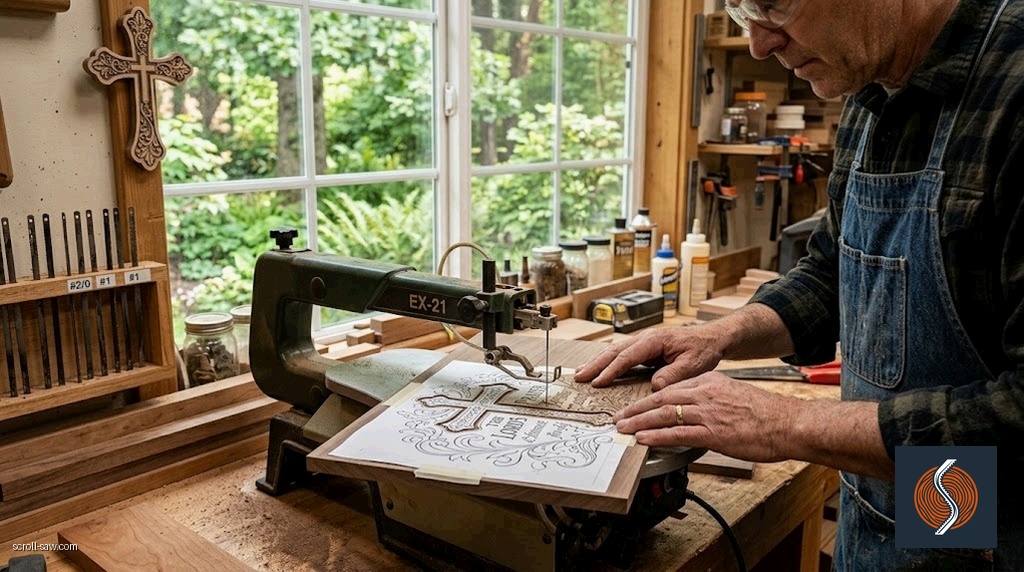
Religious Scroll Saw Patterns: Material, Blade, and Finishing Notes
A religious scroll saw pattern is a scroll saw pattern with religious subject matter—crosses, prayers, saints, scripture verses, iconography, or spiritual symbols. These pieces frequently become gifts marking significant life events: baptisms, weddings, ordinations, memorials.
Because the pieces carry meaning, the craft quality matters more than for casual decorative work. A wobbly cut on a birdhouse is a mistake; a wobbly cut on a memorial cross is disappointment for someone in grief.
Short answer: 1/4-inch to 1/2-inch hardwood (oak, walnut, cherry) for heirloom pieces or Baltic birch plywood for painted versions, #3 or #5 reverse-tooth blades depending on detail, careful pattern verification before cutting, and finishing that honors the piece’s purpose.
Common religious pattern categories
Crosses. Simple silhouettes to elaborate fretwork Celtic knots. The largest single category.
Prayers and scripture. The Lord’s Prayer, Psalm 23, wedding vows, memorial verses. Lettering-heavy pieces.
Saints and biblical figures. Silhouettes and detailed portraits.
Nativity scenes. Christmas-focused religious pieces. Often stand-up or shadow-box format.
Marian imagery. Rosary designs, Madonna and Child, Immaculate Heart.
Denominational symbols. IHS, Chi-Rho, dove of the Holy Spirit, Star of David, crescent, various denominational emblems.
Life event pieces. Baptism, First Communion, Confirmation, wedding, memorial.
Stock choice for religious pieces
The stock choice signals what the piece is meant to be.
Solid hardwood (cherry, walnut, oak, maple): heirloom pieces. Reads as fine woodworking. Ages beautifully. Best for pieces intended to last generations.
Baltic birch plywood: more forgiving to cut, takes paint or stain well. Best for pieces that will be painted, or for cost-sensitive multiple production (church craft fairs, group orders).
Cedar or exterior plywood: outdoor crosses (memorial markers, garden crosses). Requires exterior finish.
Basswood or butternut: softwood alternatives that carve and cut easily but are less durable than hardwood.
For a memorial cross that will pass through generations, cherry or walnut. For a Sunday school craft fair piece, Baltic birch. Match the wood to the purpose.
Blade selection
Religious patterns cover the full range of complexity, from simple silhouette crosses to dense fretwork Celtic designs.
Simple silhouettes: #5 reverse-tooth. Olson FR49202.
Fretwork detail (Celtic crosses, filigree): #3 reverse-tooth for tighter turns.
Thicker stock (3/4-inch or more): #7 or #9 skip-tooth. Olson FR49400.
Extended production (multiple pieces): Pegas Regular Scroll #7 or Pegas Modified Geometry #12.
Pattern verification
Before committing stock to a religious pattern:
Verify scriptural accuracy. If the pattern includes scripture, check the translation and reference. Wrong verse citations embarrass everyone.
Verify denominational appropriateness. A Catholic Sacred Heart is not the same as a Protestant Sacred Heart. Marian imagery may not fit Protestant recipients. Match the pattern to the recipient’s tradition.
Verify text readability. Fretwork lettering must be readable at intended viewing distance. Squint at the pattern; if you can’t read it at arm’s length, adjust.
Verify bridge thickness. Cross patterns often have thin sections at the intersection of arms. Verify 1/8-inch minimum.
Verify design attribution. Some religious designs are cultural or public domain; others are copyrighted works by specific artists. Respect design attribution.
Cutting sequence for a fretwork cross
-
Adhere pattern with light 3M Super 77 mist. For clear-finish hardwood, use ScotchBlue Painter’s Tape 2090 under the pattern.
-
Drill all interior entry holes with 1/16-inch bit before cutting begins.
-
Cut smallest interior fretwork first. Fine detail at the cross’s arms and any decorative elements.
-
Cut larger interior features. Central emblem, decorative fields, corner ornaments.
-
Cut perimeter last. Once interior is complete, cut the cross outline.
-
Sand before removing pattern. 220-grit paper. The pattern paper adds rigidity to fine detail.
-
Remove pattern by peeling or gentle heat. Do not scrape.
Finishing
Clear satin polyurethane over hardwood. Reads as heirloom fine woodworking. The wood grain becomes part of the piece’s character.
Dark stain (walnut, mahogany) over Baltic birch. Adds visual weight without hiding the fretwork. Traditional look.
Gold leaf accent. Applied to specific elements (halos, script, decorative filigree) after finishing the base wood. Reads as religious art.
Antique white paint with age-glaze. Reads as vintage religious craft. Popular for country-style pieces.
Black stain or paint. Reads as graphic silhouette. Modern religious art.
Whichever finish, apply thin coats. Fretwork gaps trap thick finish; the piece looks better with multiple thin coats than one thick coat.
Where to source patterns
Steve Good’s blog has an extensive religious pattern section, including many free crosses.
Sue Mey has religious patterns including several detailed Celtic crosses.
Big Book of Scroll Saw Woodworking includes crosses and religious patterns.
Specialty books on Celtic scroll saw work have extensive cross libraries.
Denominational bookstores sometimes sell religious pattern books for their specific tradition.
Life-event pieces
Common commissioned pieces:
Baptism cross with name and date. Personalized, becomes keepsake.
First Communion piece. Chalice imagery, sometimes with the child’s name.
Wedding piece. Interlocked rings, cross, and couple’s initials or scripture verse.
Memorial cross. Loved one’s name, dates, and often a meaningful scripture verse.
Ordination or vocation piece. Symbol appropriate to the vocation.
For commissioned pieces, verify all names, dates, and scripture before cutting. A misspelled name or wrong date is a piece that will get set aside, not displayed.
Cross styles
-
Latin cross: simple T-shape with longer lower arm. The most common Christian form.
-
Celtic cross: Latin cross with a circle intersecting the arms. Elaborate fretwork common.
-
Greek cross: four equal arms. Simple, symmetric.
-
Orthodox cross: three horizontal bars, the lowest slanted.
-
Cross of St. Andrew: X-shaped.
-
Ankh: Egyptian cross with a loop at top.
-
Crucifix: Latin cross with figure of Christ.
Each has its own tradition and appropriate uses.
Common problems and fixes
Text unreadable after cutting. Font too fine for scroll saw work. Redraw with a bolder font before cutting.
Cross arms broke at the intersection. Grain direction wrong, or intersection too thin. Orient grain along the longer axis; verify intersection thickness.
Piece looks generic. Missing the specific denominational or personal detail that makes it meaningful. Add personalization—name, date, scripture reference.
Finish pooled in fretwork gaps. Apply thinner coats and wipe excess.
Wood cracked along a grain line. Solid wood with grain wrong direction. Reorient or switch to Baltic birch plywood.
Frequently asked questions
What wood is traditional for religious pieces? Oak carries traditional religious associations (“Oak of Mamre”). Cedar is biblical. Walnut and cherry are traditional heirloom woods without specific religious significance but read as substantial.
Can I use scripture from any translation? Check with the recipient. Different traditions prefer different translations (KJV, NIV, ESV, NRSV, Douay-Rheims). Getting the translation right matters.
How do I handle a memorial cross with dates? Verify both dates before cutting. Verify the name’s spelling with someone close to the deceased. A misspelled name or wrong date on a memorial is painful for the family.
Are religious patterns copyrighted? Some are—original artist designs are copyrighted like any creative work. Many traditional forms (basic crosses, Celtic knots, standard symbols) are public domain. Verify before commercial sale.
What’s the best finish for a piece that will hang in a home? Satin clear polyurethane over hardwood is durable, doesn’t yellow badly, and shows the wood beautifully.
Can I sell religious scroll saw work? Yes, if you designed the pattern yourself or the pattern’s license allows commercial sale. Verify each pattern’s terms.
What about religious pieces for outdoor display? Cedar or exterior plywood with marine-grade finish. Expect fading and weathering over years. Refresh finish periodically.
References
-
Fox Chapel Publishing, Big Book of Scroll Saw Woodworking.
-
Steve Good, Scrollsaw Workshop (blog).
-
Sue Mey, Scroll Saw Artist.


