
How to Set Craftsman 16 Variable Speed Scroll Saw for Cleaner Cuts and Longer Blade Life
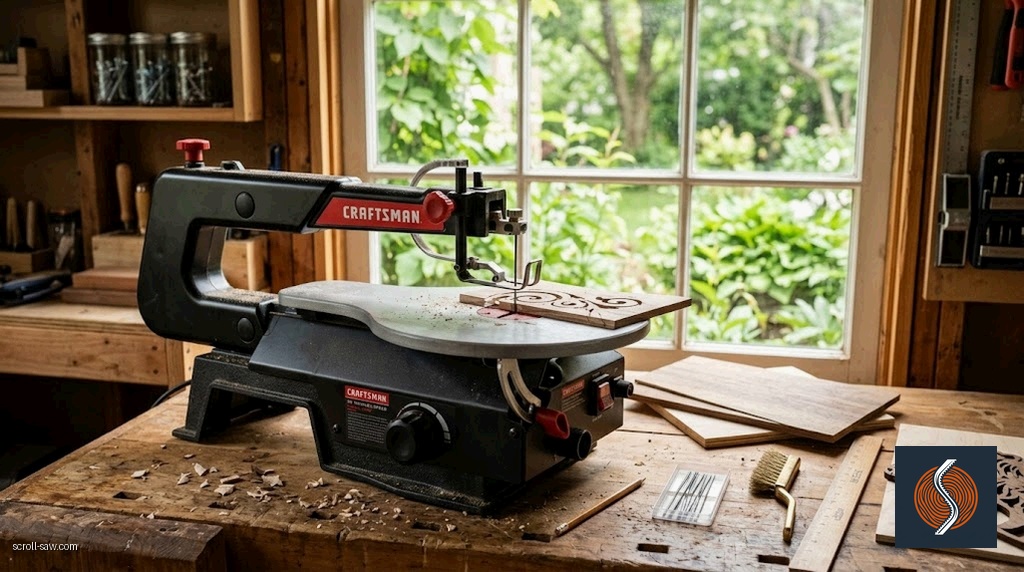
How to Set Craftsman 16 Variable Speed Scroll Saw for Cleaner Cuts and Longer Blade Life
Clean cuts and long blade life on a Craftsman 16 variable speed scroll saw come from the same place: correct blade size for the material, correct tension, correct speed, and a mechanically sound saw. Here is the complete guide.
Parts that most affect cut quality
Blade holders
Worn pin-end blade holders seat the blade at a slight angle. Even the best blade cuts crooked from a worn holder. If blades seat visibly angled with a fresh straight blade, the holders need attention.
-
Replace with OEM holders through Sears Parts Direct.
-
Or install the universal pin-to-pinless adapter to eliminate the pin-end geometry entirely.
Tension mechanism
The tension mechanism must hold a consistent load during the stroke. A worn tension spring allows the blade to drop below correct tension during the cutting stroke, causing wander and blade fatigue.
-
Inspect the tension spring for deformation or cracking.
-
OEM replacement through Sears Parts Direct; universal springs of similar spec substitute.
Speed control board
A failing speed control board on a Craftsman 16 produces inconsistent stroke speed — the saw feels jerky, and cut quality drops in a way that blade changes do not fix.
-
Symptom: speed jumps or dead zones across the dial.
-
Replace: third-party scroll saw speed control boards cross-reference for most Craftsman 16 saws.
Table flatness and squareness
A warped or tilted table that cannot be squared causes the blade to cut an angled edge even when everything else is correct.
-
Check with a machinist’s straight edge across both diagonals.
-
Check table-to-blade squareness with an engineer’s square.
Pressure foot
A mis-set pressure foot holds the workpiece down during the stroke but can also restrict feed on thin stock. It should just touch at the top of the stroke.
Blade freshness
Dull blades are the most common cause of poor cut quality. A fresh blade of the correct size is the single biggest improvement on a Craftsman 16.
Speed settings for clean cuts and blade longevity
| Material | Thickness | Blade # | SPM |
|---|---|---|---|
| Softwood | under 1/4” | #3 skip | 1,300-1,500 |
| Softwood | 1/4”-3/4” | #5 skip | 1,300-1,500 |
| Softwood | 3/4”-1.5” | #7 skip | 1,200-1,400 |
| Hardwood | under 1/4” | #3 reverse | 1,000-1,200 |
| Hardwood | 1/4”-1/2” | #5 reverse | 1,000-1,200 |
| Hardwood | 1/2”-1” | #7 double | 900-1,100 |
| Plywood | any | #5-7 reverse | 1,000-1,300 |
| Acrylic | any | #5 skip | 600-800 |
| Spiral | any | #0-#4 spiral | 800-1,200 |
Blade shelf
-
Plywood / veneered: Olson FR49202 reverse-tooth pin-end assortment.
-
Fine detail / tight curves: Olson FR44802 fine reverse-tooth blades.
-
Hardwood finish cuts: Olson DT49300 double-tooth blades.
-
Spiral (add universal pin-to-pinless adapter): Olson SP46500 spiral #4 general, Olson SP46300 spiral #2 fine, Olson SP46100 spiral #0 portrait.
-
Premium hardwood: Pegas #7 regular blades (plain-end, needs pinless adapter).
Setup sequence for both clean cuts and long blade life
Bolt or clamp the saw to a solid surface. A walking saw cannot cut precisely.
Square the table to the blade. Engineer’s square against blade and table. Adjust the tilt lock and mark true zero.
Tension by ear. Pluck the blade. A clear high note is correct tension. Dull thud means under-tension.
Set the pressure foot. It should just touch the workpiece at the top of the stroke.
Wax the table. Paste furniture wax makes feed noticeably smoother, especially on curves.
Add real light. A bench-mounted Neatfi XL magnifying lamp makes fine pattern lines visible at the blade.
Common problems and fixes
| Problem | Root cause | Fix |
|---|---|---|
| Blades dull quickly | Too fast, too hot | Reduce speed 200-300 SPM |
| Blades break at clamps | Over-tension or worn holder | Back off tension; check holder |
| Cut wanders | Worn holders or dull blade | Check holders; change blade |
| Saw feels jerky | Failing speed control board | Replace board |
| Table not squarable | Warped table or stripped tilt lock | Service tilt lock or shim |
FAQ
What part most affects cut quality on a Craftsman 16? The blade. Fresh blade, correct size, is the highest-impact change. What speeds extend blade life? Lowest speed that clears chips cleanly for the material and thickness. How do I know the tension spring is worn? Blade goes slack during the stroke despite appearing correctly tensioned at rest. Where do I find Craftsman 16 variable speed scroll saw parts? Sears Parts Direct for Sears-era models; Craftsman’s portal for modern ones. Can I replace the speed control board myself? Yes — third-party boards for most Craftsman 16 saws are plug-and-play replacements. What is the pressure foot for? It holds the workpiece against the table during the up stroke, preventing it from lifting with the blade. How do I check table flatness? Machinist’s straight edge across both diagonals. What if my Craftsman 16 feels jerky? Check the speed control board first. Jerkiness that blade changes do not fix is almost always the board. What blade for the cleanest cuts in 3/4” hardwood? #7 double-tooth at 900-1,100 SPM. What converts a pin-end Craftsman 16 to plain-end? The universal pin-to-pinless conversion adapter.
References
-
Sears Parts Direct manuals and parts for Sears-era scroll saws.
-
Olson Saw blade selection chart blade sizing reference.
-
Craftsman product support current Craftsman product references.


