
Dialing In Craftsman 20 Inch Variable Speed Scroll Saw Without Burning or Blade Wander
Dialing In Craftsman 20 Inch Variable Speed Scroll Saw Without Burning or Blade Wander
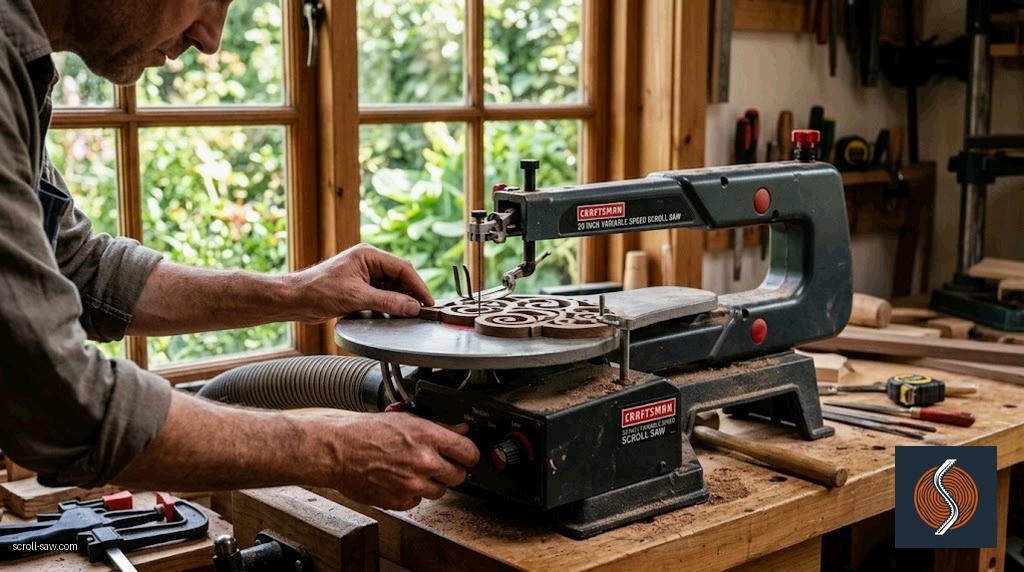
The Craftsman 20 inch variable speed scroll saw is a larger-throat variant from the Craftsman Sears-era lineup. Its 20-inch throat reaches far into large workpieces for big architectural scroll work and oversized portrait pieces. Burning and blade wander are the two most common complaints on this saw — both are fixable with systematic setup.
What burning tells you
Burning in the cut means the blade is removing material faster than chips can clear, or the blade is dull.
Too fast for the material. Lower the speed 300-400 SPM and cut the same test piece.
Blade dull. If lowering speed alone does not stop the burn, the blade needs replacing. A fresh Olson FR49400 skip-tooth pin-end assortment in the correct size should eliminate the burn immediately.
Too fine a blade for the thickness. A #5 blade in 1-1/4” oak has no chip clearance at any speed. Move to a #7 or #9.
Pressure foot too low. A pressure foot pressed down on the workpiece creates friction that adds heat to the cut. Reset to just-touching at the top of the stroke.
What blade wander tells you
Blade wander — the cut drifting from the line despite careful feed — traces to one of four causes:
Under-tension. Pluck the blade. Dull thud means under-tension. Increase tension until the pluck test rings clearly.
Dull blade. A dull blade wanders under normal feed pressure. Change the blade.
Blade too coarse for a tight curve. A #7 blade trying to follow a 1/8” radius curve will bind and wander. Switch to a #3 or #5.
Table not square. An out-of-square table causes even straight cuts to lean. Check with an engineer’s square against the blade.
Setup to eliminate both problems
Bolt or clamp the saw to a solid surface. A walking saw cannot cut precisely.
Square the table to the blade. Engineer’s square against blade and table. Adjust the tilt lock and mark true zero.
Tension by ear. Pluck the blade. A clear high note is correct tension. Dull thud means under-tension.
Set the pressure foot. It should just touch the workpiece at the top of the stroke.
Wax the table. Paste furniture wax makes feed noticeably smoother, especially on curves.
Add real light. A bench-mounted Neatfi XL magnifying lamp makes fine pattern lines visible at the blade.
Replace blade holders if worn. Worn pin holders seat the blade at an angle that makes wander unavoidable regardless of tension or speed.
Speed settings for the Craftsman 20
| Material | Thickness | Blade # | SPM |
|---|---|---|---|
| Softwood | under 1/4” | #3 skip | 1,300-1,500 |
| Softwood | 1/4”-3/4” | #5 skip | 1,300-1,500 |
| Softwood | 3/4”-1.5” | #7 skip | 1,200-1,400 |
| Hardwood | under 1/4” | #3 reverse | 1,000-1,200 |
| Hardwood | 1/4”-1/2” | #5 reverse | 1,000-1,200 |
| Hardwood | 1/2”-1” | #7 double | 900-1,100 |
| Plywood | any | #5-7 reverse | 1,000-1,300 |
| Acrylic | any | #5 skip | 600-800 |
| Spiral | any | #0-#4 spiral | 800-1,200 |
Blade shelf
-
Plywood / veneered: Olson FR49202 reverse-tooth pin-end assortment.
-
Fine detail / tight curves: Olson FR44802 fine reverse-tooth blades.
-
Hardwood finish cuts: Olson DT49300 double-tooth blades.
-
Spiral (add universal pin-to-pinless adapter): Olson SP46500 spiral #4 general, Olson SP46300 spiral #2 fine, Olson SP46100 spiral #0 portrait.
-
Premium hardwood: Pegas #7 regular blades (plain-end, needs pinless adapter).
Common problems and root causes
| Problem | Root cause | Fix |
|---|---|---|
| Burning in softwood | Too fast | Reduce speed 200-400 SPM |
| Burning in hardwood | Too fast, wrong size, or dull blade | Reduce speed; check blade size; change blade |
| Wander in straight cut | Under-tension or table not square | Pluck test; re-square table |
| Wander in tight curve | Blade too coarse | Finer blade |
| Wander in all cuts | Worn blade holders | Inspect and replace holders |
FAQ
What is the Craftsman 20 inch variable speed scroll saw? A 20-inch throat Craftsman scroll saw from the Sears era, designed for large-scale scroll work. What blades does it take? Standard 5-inch scroll saw blades — pin-end in factory configuration on most variants. What causes burning on a Craftsman 20? Too fast for the material, dull blade, or blade too fine for the thickness. What causes blade wander on a Craftsman 20? Under-tension, dull blade, too coarse a blade for the curve radius, or table not square. How do I know if tension is correct? Pluck the blade — clear high note is correct tension. What speed for 3/4” pine? 1,300-1,500 SPM with a #5 skip-tooth. What speed for 3/4” oak? 1,000-1,200 SPM with a #5 reverse-tooth or #7 skip-tooth. What blade for plywood? #5 or #7 reverse-tooth. Can I use spiral blades in a Craftsman 20? Yes, with a pin-to-pinless adapter if the factory holders are pin-end. What is the advantage of a 20-inch throat? Reach for large architectural scroll work and oversized portrait pieces that would not fit under a 16-inch throat.
References
-
Sears Parts Direct manuals and parts for Sears-era scroll saws.
-
Olson Saw blade selection chart blade sizing reference.
-
Craftsman product support current Craftsman product references.


