
Delta 15 Inch Scroll Saw Blades: Complete Selection Guide by Material and Curve Radius
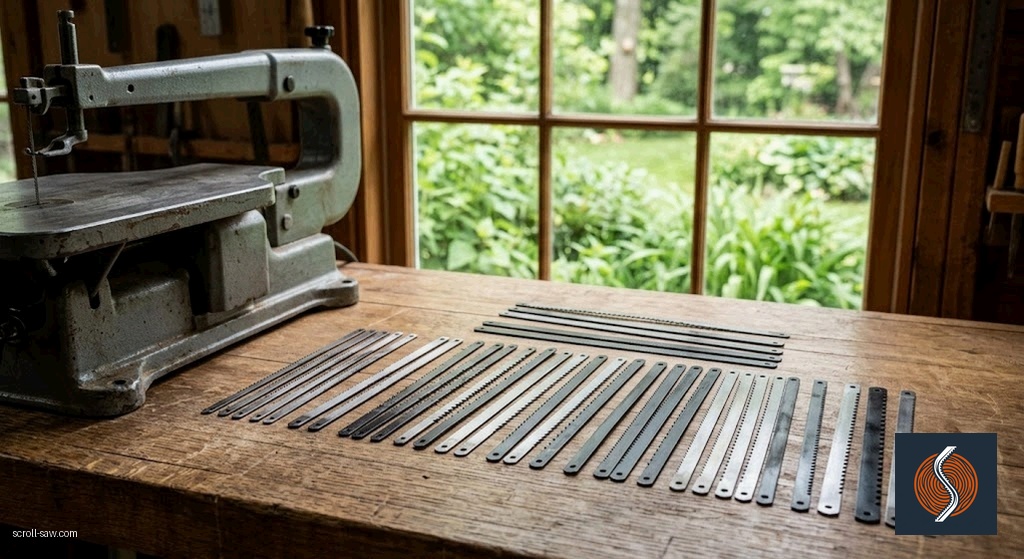
Delta 15 Inch Scroll Saw Blades: Complete Selection Guide by Material and Curve Radius
The Delta 15 inch scroll saw uses standard 5-inch blades. Matching blade size to material thickness and curve radius is the decision that most affects cut quality on this saw. The blade format is standard 5-inch, giving access to the full Olson and Pegas catalog.
Curve radius and blade size
-
Tight radius under 1/4”: #1 to #3 skip or reverse-tooth.
-
Medium radius 1/4” to 1”: #3 to #5 skip or reverse-tooth.
-
Large radius over 1”: #5 to #7 skip-tooth.
-
Straight cuts: #5 to #9 by thickness.
-
Any-direction portrait and puzzle: Spiral #0 to #4 with a universal pin-to-pinless adapter.
Blade type guide
Skip-tooth: Good chip clearance. Best for curves where sanding follows. Reverse-tooth: Lower teeth reversed. Eliminates bottom-face tearout. Essential for plywood. Double-tooth: Smoothest finish in hardwood. Best for pieces going straight into finish. Spiral: Feed in any direction without rotating the workpiece.
Speed and blade by material
| Material | Thickness | Blade | SPM |
|---|---|---|---|
| Softwood | under 3/4” | #5 skip | 1,300-1,500 |
| Softwood | 3/4”-1.5” | #7 skip | 1,200-1,400 |
| Hardwood | under 1/2” | #5 reverse | 1,000-1,200 |
| Hardwood | 1/2”-1” | #7 double | 900-1,100 |
| Plywood | any | #5-7 reverse | 1,000-1,300 |
| Acrylic | any | #5 skip | 600-800 |
| Spiral | any | spiral #0-4 | 800-1,200 |
The blade shelf
-
General softwood: Olson FR49400 skip-tooth.
-
Plywood/veneered: Olson FR49202 reverse-tooth.
-
Fine detail: Olson FR44802 fine reverse-tooth.
-
Hardwood finish cuts: Olson DT49300 double-tooth.
-
Spiral (add universal pin-to-pinless adapter for pin-end saws): Olson SP46500 spiral 4 general, Olson SP46100 spiral 0 portrait.
-
Premium hardwood: Pegas 7 blades (plain-end, needs pinless adapter).
Setup baseline
Bolt or clamp the saw to a solid surface. A walking saw cannot cut precisely.
Square the table to the blade. Engineer’s square against blade and table. Mark true zero.
Tension by ear. Pluck the blade. Clear high note is correct tension.
Set the pressure foot. Just touching the workpiece at the top of the stroke.
Wax the table. Paste furniture wax makes feed noticeably smoother.
Add real light. A bench-mounted Neatfi XL magnifying lamp makes fine pattern lines visible at the blade.
Common problems and fixes
| Problem | Cause | Fix |
|---|---|---|
| Blade wanders in tight curve | Blade too coarse | Switch to finer blade |
| Blade breaks in curve | Aggressive feed or over-tension | Slow feed, back off tension |
| Bottom tearout | Wrong blade type | Switch to reverse-tooth |
| Gentle curve cuts crooked | Table not square | Re-square |
| Burn marks | Too fast or dull blade | Slow down, change blade |
FAQ
What blades does the Delta 15-inch scroll saw take? Standard 5-inch scroll saw blades. What blade for tight curves? #1 to #3 skip or reverse-tooth for curves under 1/4” radius. What blade for gentle curves in thick stock? #5 to #7 skip-tooth. What blade for portrait scrolling? Spiral #0 with a pinless adapter. Can I use plain-end blades? Yes, with a universal pin-to-pinless adapter. Why does my blade break in tight curves? Feed rate too aggressive or blade over-tensioned. What is the throat depth? 15 inches. Should I use reverse-tooth for all curves? For plywood and veneered stock yes. For softwood, skip-tooth is fine. Where do I find a manual? Sears Parts Direct hosts older Delta scroll saw manuals. What if the blade holder pins are worn? Replace the holders or install the universal pin-to-pinless adapter.
References
-
Sears Parts Direct manuals and parts for Sears-era Delta scroll saws.
-
Olson blade chart blade sizing reference.
-
Delta Machinery current Delta product references.


