
Delta 40-694 Scroll Saw: Setup for Wood, Plastic, Metal
Delta 40-694 Scroll Saw: Setup for Wood, Plastic, Metal
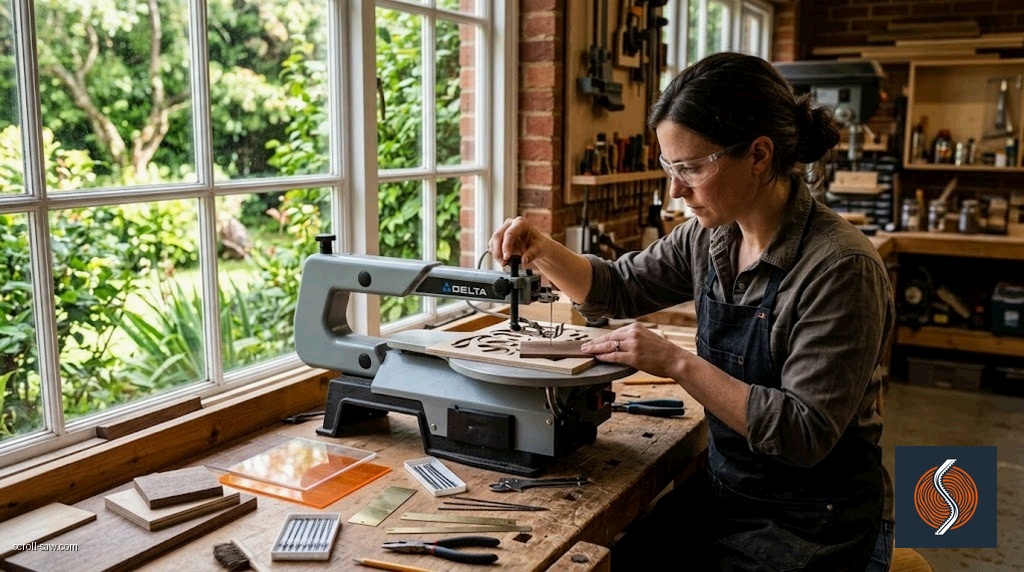
There is a moment right after you tension a fresh blade in a 40-694, before you have made a single cut, when the saw tells you what kind of day you are about to have. The arm sits square, the pluck comes back with a clean high note, and the table does not wobble when you press a corner. That is the machine ready to work. If any one of those three things feels off, the material you cut in the next hour will look off too, and no amount of speed adjustment will fix it.
The Delta 40-694 is a 20-inch throat, dual parallel-link scroll saw with variable speed from 400 to 1,750 strokes per minute, a 3/4-inch stroke length, and a 1.3-amp motor. It runs standard 5-inch plain-end blades and cuts up to 2-1/8 inches thick at 90 degrees, 1-5/8 inches at 45. The geometry is the same architecture used on the DeWalt DW788, and once you set it up correctly, it delivers cuts that read as calm, not chattery.
Getting the 40-694 to cut cleanly in wood, plastic, and thin metal is not a matter of finding a magic setting. It is a matter of matching the blade, the speed, and the feed to what the material actually needs, then trusting the machine to do the cutting so you do not push it. Below is how I approach each of those three material families on this saw, and the small adjustments that keep the cuts consistent from the first pass to the last.
What the 40-694 actually is
Delta lists the 40-694 with a 16 by 24 inch cast-iron table, a table tilt from zero to 45 degrees left and right, tool-free blade clamps, front-mounted tension, an on-tool blade storage well, a work light, and a flexible dust blower. It weighs about 70 pounds set up, ships from Delta Machinery’s supply chain built in Taiwan, and shares its price band with the DeWalt DW788 it competes with.
Two design decisions on this saw shape everything you do with it. The first is the dual parallel-link arm, which pivots the blade in a nearly vertical path at the top of the stroke. That keeps the cut line clean and reduces the front-to-back drift you get on a C-arm saw. The second is the front-mounted tension lever. You can drop tension to feed a blade through an interior hole and re-tension without walking around the machine. On long fretwork days that saves real time, and it lowers the temptation to leave a blade too tight through several interior cuts.
The tradeoff, and the one thing owners bring up most often on forums, is that Delta parts availability for older 40-series saws has been inconsistent. On a new 40-694 that is not an immediate concern, but it is a fair reason to register the warranty, keep the manual, and order a spare set of blade clamps early so you have them if a thumb screw strips.
Setting up for wood
Wood is what this saw was designed to cut, and it is where the 40-694 shows its best face. The general rule is the harder and thicker the wood, the coarser the blade and the slower the feed. Speed setting matters less than most first-time owners assume. On stock under 3/4 inch, most people run somewhere between 60 and 80 percent of full speed and let the blade do the work.
For 1/4-inch Baltic birch, which is the material most fretwork patterns are cut in, a #5 skip-tooth or #5 reverse-tooth blade at roughly 1,400 strokes per minute is a solid default. The reverse-tooth blade cuts most of the depth going down and clears the last 1/8 inch on the up-stroke, which almost eliminates the fuzzy bottom edge that new scrollers spend weeks trying to sand off. In 3/4-inch hardwood, drop to a #7 or #9 skip-tooth, slow the saw to about 1,200 strokes per minute, and reduce feed pressure until the shavings coming off the blade look like fine ribbon rather than dust. Dust means you are going too fast and burnishing the wood; ribbon means the tooth is loading and clearing properly.
The move that changes wood cut quality more than anything else on the 40-694 is blade tension. Pluck the blade like a guitar string. On a properly tensioned 5-inch blade, you should hear a clear pitch somewhere around a high C. If the note is dull, or you can push the blade sideways more than an eighth of an inch with light finger pressure, tension is too low and you will get blade drift on every curve. Retension, cut a test kerf in scrap, and check that the blade is tracking straight before you commit to the workpiece.
For real-world wood cutting on this saw, Olson’s plain-end scroll saw blades are the workhorse and they come in every configuration this machine needs. A 12-pack of Olson double-tooth blades in a mid-range TPI covers most of what a hobbyist cuts, and stocking blades in bulk before you need them is easier than replacing broken singles mid-project.
Setting up for plastic
Plastic on the 40-694 is where speed becomes the enemy, not the friend. Acrylic and polycarbonate melt before they cut when the blade runs too fast, and once the material re-fuses behind the blade, the cut is done. You will break the blade trying to reverse out of it.
Run acrylic between 600 and 900 strokes per minute. Use a skip-tooth blade with a coarser TPI than you would use in wood of the same thickness, roughly a #5 skip or a #7 skip on 1/4-inch acrylic. Feed lightly. If you see a haze of melted material collecting at the kerf edge, stop, back the workpiece out along the kerf line, and drop speed further. Laying a strip of blue painter’s tape over the top surface of the acrylic before you cut serves two purposes: it holds the chips off the surface, and it insulates the material against tear-out at entry and exit points on interior cuts.
Thin polystyrene and ABS forgive more than acrylic does. They can be cut at similar speeds to hardwood without melting, but you still want a slower feed than wood because the material grabs the blade if you push. This is a saw that rewards patience on plastic. If the piece is production work, cut two or three, then let the saw rest for a minute so the arm bearings and the blade itself cool down. On the 40-694 specifically, the arm runs cooler than on a C-arm design, but heat still accumulates on long runs.
Setting up for thin metal
Thin metal is the material category where owners get themselves into trouble. The 40-694 can cut mild steel sheet up to about 1/16 inch, brass and copper sheet up to about 3/32 inch, and aluminum sheet up to about 1/8 inch, but only with the right blade, a slow speed, and a lubricant. Above those thicknesses the saw is not the right tool, and pushing it will overheat the blade clamp and warp the workpiece.
Use a metal-cutting scroll saw blade specifically rated for the material. Olson and Pégas both make jeweler’s blades in fine TPI for exactly this work. Run the saw at its lowest speed setting, somewhere in the 400 to 600 SPM range. Apply a light coat of cutting wax or beeswax to the blade every few inches of cut. Feed pressure has to drop to almost nothing, roughly the weight of the workpiece resting on the table. If the blade is bending backward under load, you are feeding too fast, and the blade will heat up and lose its temper within an inch.
Sandwich thin brass or copper between two layers of scrap 1/8-inch plywood before cutting. The plywood stabilizes the metal, keeps the blade from grabbing at the kerf, and gives you a cleaner edge. It is an old jeweler’s trick and it works reliably on this saw.
Common adjustments that fix most cut-quality problems
Blade drift left or right on a straight line is almost always a tension problem, not an alignment problem. Re-tension first before you start adjusting the table.
Table tilt drift, where the table shifts a degree or two off zero after an hour of work, is a symptom of the trunnion lock not being fully seated. On the 40-694, run the tilt scale to zero, snug the lock, and confirm with a small engineer’s square laid against the blade. If the table will not hold zero, the lock bolt or the trunnion casting has worn, and Delta’s service parts list has the part number for both.
Blade slippage in the clamp is the most common single call to Delta’s service line on this saw. Nine times out of ten it is a chip of blade material stuck in the clamp face. Loosen the clamp, blow it out, wipe both jaw faces with a lint-free cloth, and re-clamp. If the blade still slips, the clamp thumbscrew has stripped and needs replacement.
One habit that adds years to any variable speed scroll saw: do not leave the machine tensioned when you walk away. Release tension at the end of every session. It takes ten seconds and it prevents the upper arm from taking a set that shows up later as a permanent alignment drift.
Who the 40-694 fits, and who should look at something else
If you are moving up from a benchtop hobbyist saw and want a machine you will still be using in ten years, the 40-694 is a genuinely good buy. It gets close to DW788 performance and the dual parallel-link arm makes it more accurate than any C-arm saw in the same class. It is the right saw for someone cutting fretwork, intarsia, and puzzle work on a regular schedule.
If you are an occasional weekend scroller cutting basic patterns in soft pine, this machine is more saw than you need and an entry-level Ryobi or WEN will serve you fine. And if you are doing production intarsia at professional volume, look at the Hegner or Pégas machines instead. Their bearings and arm rigidity hold up better under eight-hour days, and the 40-694 will show fatigue at that pace.
The one weakness worth naming out loud is what forum users report about long-term parts availability. If you are planning to keep this saw fifteen or twenty years, buy a spare blade clamp assembly and a spare tension lever the same week you buy the machine. Delta’s inventory on 40-series parts has been inconsistent enough that owners who wait until they need a part sometimes cannot find it.
FAQ
What blades does the Delta 40-694 use? Standard 5-inch plain-end scroll saw blades. Any 5-inch plain-end blade from Olson, Pégas, Flying Dutchman, or Delta’s own line will fit. It does not use pin-end blades.
What is the difference between the Delta 40-694 and the DeWalt DW788? Both are 20-inch dual parallel-link scroll saws with similar geometry, similar variable speed range, and similar cut capacity. The DW788 has slightly better long-term parts availability and a stronger secondary market. The 40-694 shares the same basic design and often ships from stock at Lowe’s and specialty tool retailers.
Can the 40-694 cut metal? Yes, thin sheet metal. Mild steel up to about 1/16 inch, brass and copper to about 3/32 inch, and aluminum to about 1/8 inch, using a metal-cutting blade, low speed, and cutting wax.
How thick can the 40-694 cut in wood? Delta rates it at 2-1/8 inches at 90 degrees and 1-5/8 inches at 45 degrees. Two inches of hardwood is the practical upper limit before feed pressure starts to slow the cut noticeably.
Does the 40-694 come with a stand? No. The machine is sold as a benchtop unit. You will either bolt it to a bench or add a compatible stand, sold separately.
Is the Delta 40-694 discontinued? As of writing it remains listed on Delta Machinery’s site and is stocked at Lowe’s and Acme Tools among others. Long-term parts availability for 40-series Delta saws has been uneven, so registering the warranty and keeping the manual is worth doing.
How do I change the blade on a 40-694? Release the front-mounted tension lever, open both tool-free blade clamps, drop the old blade out the bottom, seat the new blade in the lower clamp first, thread it through the workpiece if you are doing an interior cut, seat it in the upper clamp, and re-tension. Pluck-test before cutting.
Why is my 40-694 making chatter marks on the cut? Almost always low tension. Re-tension until the blade sings a clear high note when plucked. Second most common cause is a dull or heat-damaged blade; try a fresh blade and re-cut.
References
-
Delta Machinery. 40-694 20 in. Variable Speed Scroll Saw product page, owner’s manual, and service parts list.
-
Olson Saw Company. 5-inch plain-end scroll saw blade catalog and TPI reference.
-
Scroll Saw Village. Delta 40-694 owner review and specifications summary.
Title tag: Delta 40-694 Scroll Saw: Setup for Wood, Plastic, Metal Meta description: Set the Delta 40-694 20-inch variable speed scroll saw for wood, plastic, and thin metal with the right blade, speed, and feed. URL slug: delta-40-694-20-inch-variable-speed-scroll-saw Excerpt: A hands-on setup guide to the Delta 40-694 20-inch variable speed scroll saw. Real blade choices, speeds, and feed rates for wood, plastic, and thin metal, plus the small adjustments that fix chatter, drift, and blade slippage.


