
Delta 40-560 Scroll Saw Blades: Selection Guide
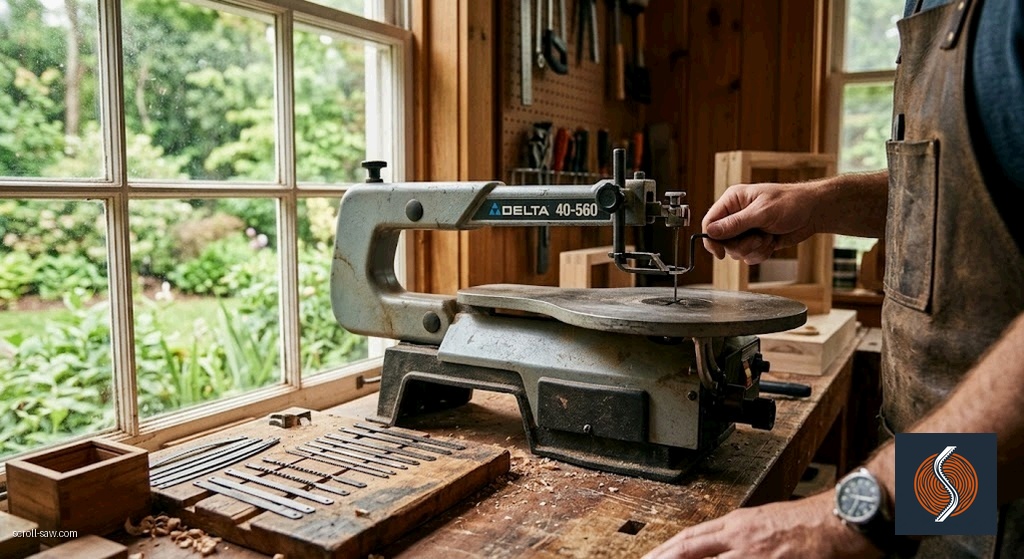
Delta 40-560 Scroll Saw Blades: Selection Guide
The 40-560 has been out of production long enough that most owners inherited it, bought it used, or dug it out of a family garage after someone stopped scrolling. That is part of its charm and also the reason the blade question comes up so often. The saw itself is still perfectly capable of cutting a clean fretwork line in Baltic birch, but the answer to “what blades does it take” has confused more first-time owners than any other single thing about the machine.
Here is the short version, and then the useful version. The 40-560 is a Delta 15 to 16-inch hobby-class scroll saw that accepts standard 5-inch plain-end scroll saw blades. Any modern 5-inch plain-end blade from Olson, Pégas, Flying Dutchman, or the remaining Delta-branded stock will fit and cut. The blade clamps grip the flat body of the blade, not a pin, so pin-end blades do not seat correctly. That single fact solves most of what people are trying to figure out when they first turn the saw on.
The longer version, which is where the actual craft is, is about which of those blades to reach for on a given piece of material.
Confirming your 40-560 before you buy a blade pack
Before ordering blades, check the blade clamp itself. The 40-560 shipped with clamps designed for a plain (flat) blade with a flat, unpinned end. If a previous owner swapped the clamp assembly for a pin-style clamp from a different Delta model, you will have to reverse that swap or accept that the saw now runs pin-end blades. This is uncommon but it happens on used 40-560s.
Measure the blade slot on both the upper and lower clamps. It should be roughly 5/32 inch wide and about 1/32 inch deep. That is the standard plain-end clamp profile. If the slot has an obvious cross-drilled hole through it, the clamp was modified for pin-end blades.
Second, confirm that the tension arm sits square and travels freely. A 40-560 that has been stored for a decade often has a stiff tension mechanism, and a stiff mechanism will chew through blades no matter which pack you buy. Work the tension arm through its full range a few times before mounting a fresh blade.
TPI, or the number that matters most
Teeth per inch is the number that decides how a scroll saw blade behaves in a given material. The general rule is that thicker and softer material wants fewer, larger teeth, while thinner and harder material wants more, smaller teeth. That rule is more reliable than any specific TPI recommendation because it accounts for the fact that no two woods behave the same at the blade.
On the 40-560, most owners settle into a small rotation of three blades that covers roughly 80 percent of what they cut. A #5 skip-tooth around 12.5 TPI handles 1/4 to 3/8-inch hardwood and Baltic birch. A #7 skip-tooth around 11.5 TPI takes over for 1/2 to 3/4-inch hardwood and puzzle stock. A #2 reverse-tooth around 20 TPI is what you switch to for anything under 1/4 inch where a clean bottom edge matters.
Buying blades in dozens rather than singles is worth doing on this saw. The 40-560 tends to break blades a little more often than a modern parallel-link machine because the clamp geometry puts extra bending stress on the tang. Olson’s dozen packs are the practical choice; a 12-pack of Olson 5-inch plain-end skip-tooth blades in #5 gets you through a season of light hobby work.
Tooth geometry and what each style is for
Standard tooth blades have evenly spaced teeth pointing down. They cut steadily, load slowly, and produce a slightly rough bottom edge because the down-stroke tears fibers as it exits. They are the right choice for straight cuts in soft wood and for beginners learning to feed at a consistent pressure.
Skip-tooth blades remove every other tooth, which gives each remaining tooth a bigger gullet to clear chips. On a 40-560 with a modest 1/2 to 5/8-inch stroke, the extra chip clearance matters. Skip-tooth blades run cooler and last longer than standard-tooth blades on the same material. Almost every 40-560 owner ends up running skip-tooth as the default.
Reverse-tooth blades have the last five or six teeth at the bottom of the blade pointing up, which cuts on the up-stroke and cleans the bottom edge of the workpiece. They produce a noticeably better finish on the underside of a piece but they are slower and they need a firmer feed pressure to keep the up-teeth engaged. If you cut fretwork in stacked Baltic birch, reverse-tooth is the blade that saves you a full pass of sanding.
Precision-ground blades have their teeth ground rather than milled, and they cut faster with less feed pressure than a milled equivalent. They cost more, they last longer, and they are worth the money on hardwood. Pégas modified-geometry blades in this style are a common upgrade path for 40-560 owners who cut a lot of hard maple or oak.
Spiral blades cut in all directions and let you turn a workpiece in place without rotating it around the blade. They also leave a wider kerf and a fuzzier edge, so they are a specialty tool, not a default. Use them only when the pattern demands 360-degree cutting.
Matching the blade to the material
For construction plywood or pine under 1/2 inch, a #5 or #7 skip-tooth is the right first move. Speed the saw to about 1,400 SPM and feed steadily. If you smell burning or see smoke, you are pushing too hard or running too fast.
For Baltic birch 1/4 to 1/2 inch, either a #5 skip-tooth or a #2 reverse-tooth works depending on how the finished bottom edge matters. Fretwork projects almost always want the reverse-tooth. Puzzles and stacked cutting want the skip-tooth for speed.
For hardwood over 1/2 inch, a #7 or #9 skip-tooth. Slow the saw to around 1,000 to 1,200 SPM and let the blade eat. On oak or hickory, expect blade life measured in feet of cut rather than hours.
For thin plastic (acrylic under 1/4 inch), a #5 skip-tooth run slowly, around 700 to 900 SPM, with the material taped down and clear packing tape over the pattern. Skip-tooth prevents chip loading in the kerf, which is what causes acrylic to weld itself back together behind the blade.
For thin non-ferrous metal (brass, copper, aluminum under 1/16 inch), a metal-cutting scroll saw blade with 30 TPI or higher. Feed almost nothing. Wax the blade every few inches. The 40-560 will cut this material but it is not the machine’s happy place, and you will burn through blades fast.
Tensioning correctly on an older Delta
The 40-560 tensions from the top of the arm, and the mechanism relies on the arm itself flexing slightly to hold pressure on the blade. Set the blade in both clamps first, then bring the tension lever up until the blade plucks with a clear high note, somewhere between a C and a D on a piano. If the note sounds dull, tension more. If the arm visibly bends, tension less.
One small thing that saves blade life on this specific saw: after seating a new blade, run the saw at low speed for five seconds without cutting anything, then stop and re-check tension. The clamps often let the blade shift a hair on the first strokes, and re-tensioning after that settling extends blade life meaningfully.
What to skip
The 40-560 is not the saw for someone whose main goal is production work. It is a hobby machine built to a price and it feels like one under sustained use. If you find yourself buying blades in gross packs and running the saw four hours a day, you have outgrown the machine and the honest recommendation is to move to a Delta 40-694, a DeWalt DW788, or better. Trying to force a 40-560 to keep pace with pattern work at that volume will crack the arm at the pivot before it will improve your output.
It is also not the saw for cutting anything thicker than about 1-3/4 inches in hardwood. The stroke length and the motor were sized for hobby fretwork, and pushing it into thicker stock overheats the motor and cooks blades.
FAQ
Does the Delta 40-560 use pin-end or plain-end blades? Plain-end. Standard 5-inch plain-end scroll saw blades from any current manufacturer will fit.
Can I use pin-end blades in a 40-560 with an adapter? Only if you have already swapped the clamp for one designed for pin-end blades, which was not the factory configuration. The stock clamp geometry does not seat a pinned blade securely.
What TPI blade should I start with? A #5 skip-tooth (around 12.5 TPI) is the safest first pack. It covers most 1/4 to 1/2-inch wood cutting.
How often should I change the blade? When it stops cutting cleanly. On hardwood, that can be as short as ten minutes of continuous cutting. On soft wood, blades last longer. A blade that leaves burn marks or drifts sideways under normal feed pressure is done.
Are Olson blades better than Pégas on this saw? Both work. Olson blades cost less and are widely stocked. Pégas modified-geometry blades cut faster with less feed pressure but cost more. On a 40-560 running hobby volumes, Olson is the practical default.
Where do I find the 40-560 owner’s manual? Mike’s Tools hosts a scanned copy of Delta scroll saw manuals, and Delta Machinery’s site retains parts diagrams for many discontinued 40-series models.
Why does my 40-560 keep breaking blades at the clamp? Almost always one of two things: clamp jaws that have a chip of old blade stuck in them, or a tension setting so high the blade tang cannot flex through the arm’s stroke. Clean the clamp faces, back off tension a quarter turn, and re-test.
References
-
Olson Saw Company. Plain-end scroll saw blade catalog with TPI, tooth style, and material recommendations.
-
Scroll Saw Woodworking & Crafts forum. Source of saw blades for Delta 40-560 saw.
-
Delta Machinery. Service and support portal with legacy 40-series parts references.
Title tag: Delta 40-560 Scroll Saw Blades: Selection Guide Meta description: Which 5-inch plain-end blades fit the Delta 40-560, how to pick TPI and tooth style, and how to tension without breaking blades. URL slug: delta-scroll-saw-40-560-blades Excerpt: The Delta 40-560 takes standard 5-inch plain-end scroll saw blades. Which TPI to choose, which tooth style matches the material, and how to tension the older Delta arm without breaking blades on the first pass.


