
Delta Shopmaster 16 Scroll Saw: Restore Cut Quality
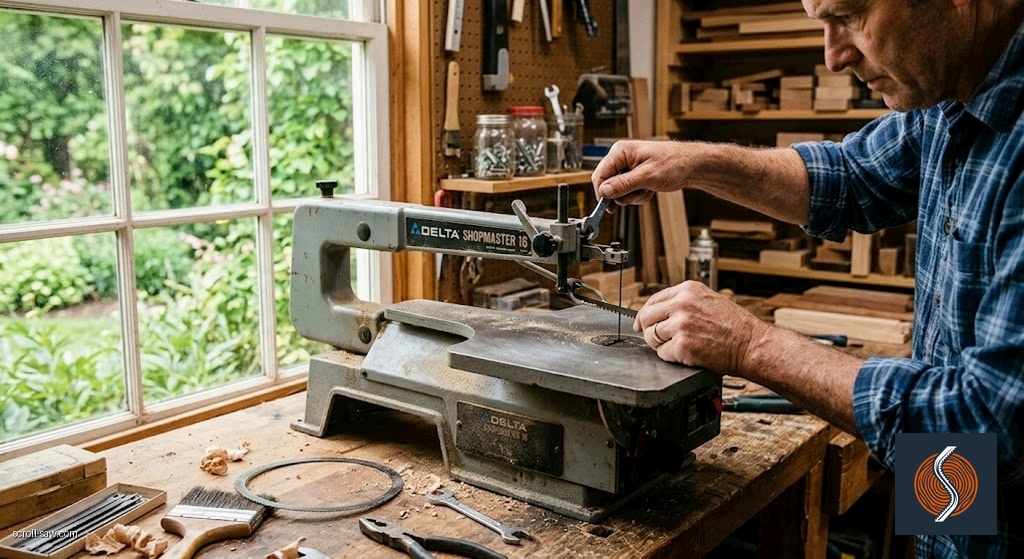
Delta Shopmaster 16 Scroll Saw: Restore Cut Quality
Most people who own a Delta Shopmaster 16 did not buy it new. It was a hobbyist saw sold at the price-conscious end of Delta’s line in the late 1990s and early 2000s under the SS250 model number, and by now nearly all of them have passed through at least one garage sale, one estate, or one basement. If you inherited or picked up one used, the first hour with it usually tells you the same story: it cuts, but the cut is not as clean as it used to be, or as clean as you know a scroll saw can be. The good news is that on this saw, the difference between an acceptable cut and a genuinely clean one almost always comes down to four or five things you can fix in an afternoon.
The Shopmaster 16 is a 16-inch throat, variable speed benchtop scroll saw with a small AC motor, a cast aluminum table, and a C-arm design. It runs 5-inch plain-end blades. That last detail is worth double-checking on your specific unit because Delta sold hobby scroll saws in both pin-end and plain-end configurations over the years, and a previous owner may have modified the clamps. Look at the blade slot: a narrow flat slot without a cross-drilled hole means plain-end.
What follows is the order I work through when a Shopmaster 16 comes in with degraded cut quality. Each step matters more than the ones after it, so start at the top.
Start with the blade
The most common single reason a Shopmaster 16 stops cutting cleanly is the blade in it right now. If it has been sitting for a while, the blade may have been left tensioned, which fatigues the steel. Or the blade in the clamp is the one that came with the saw, and it dulled ten owners ago.
Put a fresh blade in before you diagnose anything else. Match it to the material you are testing on: a #5 skip-tooth for 1/4 to 1/2-inch pine or Baltic birch, a #7 skip-tooth for 3/4-inch hardwood. Tension it until it plucks like a guitar string with a clear high note. Cut a straight test line in scrap. If the line is clean and the blade tracks straight, you have already fixed the problem and nothing else in this article applies.
Then check the blade clamps
The SS250 blade clamps are small aluminum blocks with a set screw pressing the blade against a fixed jaw. Over time the jaw face wears smooth, the set screw thread wears, and the clamp starts to let the blade shift under stroke pressure. That shows up in the cut as a wobble, a taper, or a blade that lifts free of the workpiece on the up-stroke.
Loosen both clamps and inspect them. Look for shiny wear polish on the jaw face, threads that grip weakly when you turn the set screw, or any visible cracking around the clamp body. Wipe the jaw faces clean with a lint-free cloth. If the set screw feels loose in the thread, replace the clamp assembly. Delta parts for the SS250 are not always available new but eBay listings for the exact part are still common because so many of these saws are being parted out.
Then look at the upper arm grommet
This is the failure mode that owner forums come back to more often than any other on the Shopmaster 16. The upper arm has a rubber grommet at the pivot where it meets the tension mechanism. Over years, the grommet compresses, cracks, or falls apart entirely, and the arm develops slack at the pivot. Once that happens, no amount of tension will keep the blade taut through the stroke, and every cut will look chattery on one side.
Lift the upper arm cover if your unit has one. Look at the grommet directly. If it is compressed to less than half its original thickness, or if it is missing chunks, replace it. A generic rubber grommet of the same outside diameter, roughly 3/8 to 1/2 inch depending on model year, cut from neoprene or hard rubber, is a functional replacement. This single repair often brings a tired Shopmaster back to its original cut quality.
One related warning from the forums: owners have reported the upper arm cracking at the pivot point when the grommet fails and is left in service. Sears repaired several of these under warranty in the SS250’s original run. If your grommet has been dead for a long time, inspect the arm casting around the pivot for hairline cracks before you replace the grommet and go back to work. A cracked arm cannot be safely repaired at home.
Then check tension travel
The SS250 tensions from a lever at the back of the upper arm. The lever should move through a firm, positive travel with a clear stop at full tension. If the lever flops or if it hits its stop before the blade sings, the tension spring or the linkage has worn.
Work the lever through its full range with no blade installed. It should return under its own weight smoothly. If it binds, the pivot needs cleaning and a drop of oil. If it does not spring back at all, the internal tension spring has broken and needs replacement. Both fixes are straightforward but the second requires opening the arm housing, which is worth doing with the parts diagram in front of you.
Then vibration
Shopmaster 16s vibrate more than modern parallel-link saws by design. A little vibration is normal. Enough vibration to walk the saw across a bench, or enough to blur the cut line at low speeds, is not normal.
Check the motor mount bolts first. They loosen over time from the arm’s oscillation. Snug all four. Then check that the table is fully seated on its trunnion and that the trunnion lock is tight. A loose table amplifies whatever the arm is doing.
If the vibration is still bad, look at the motor pulley and the drive belt. Belts stretch and pulleys get out of alignment. A pulley that wobbles visibly during operation needs to come off and go back on with the set screw properly seated on the shaft flat. A belt that is glazed or cracked needs replacing. Belt part numbers are in the SS250 service parts list and generic equivalents by dimension are easy to find.
When to stop repairing and move on
There is a point where the Shopmaster 16 asks more than it is worth. If the arm has cracked, if the trunnion is warped, if the motor windings are burned, or if you have replaced more than two major assemblies already, the honest answer is that a fresh DW788 or a Delta 40-694 will cost less than continuing to bring an SS250 back to life. The Shopmaster was not a premium machine even when new, and the modern parallel-link designs cut more accurately with less maintenance.
One heuristic that works for hobby scrollers: if a machine is generating more shop time in repair than in cutting, sell it and buy fresh. If it still cuts and only needs consumables and small parts, keep it. The SS250 lives right at that line for a lot of owners.
What to keep on hand
Even a well-tuned Shopmaster benefits from a small parts drawer. Keep a dozen fresh 5-inch plain-end blades in the two TPI ranges you use most. A 12-pack of Olson skip-tooth blades is the low-cost default. Keep a spare blade clamp assembly if you can source one, a length of neoprene tubing for grommet replacements, and a small can of light machine oil for the pivot points. That kit will keep the saw running through anything short of an arm crack.
FAQ
What blades does the Delta Shopmaster 16 use? Standard 5-inch plain-end scroll saw blades on most SS250 units. Check your specific clamp geometry before ordering.
Where can I find the SS250 manual? ManualsLib and ManyManuals host scanned copies of the 20-page Delta SS250 instruction manual. Delta’s site retains the parts diagram in its service archive.
Why does my Shopmaster vibrate so much? A loose motor mount, a worn drive belt, or a compressed upper arm grommet, in that order. Check each in turn.
Can I convert the Shopmaster to pin-end blades? Owners have done it by swapping the clamp assemblies. It is possible but the geometry is not ideal, and modern pin-end blade selection is narrower than plain-end.
Is the Shopmaster 16 worth repairing? Up to a point. Blade clamps, belts, grommets, and pivot cleaning are worth the time. A cracked arm or burned motor usually is not.
How thick can it cut? Roughly 1-3/4 inches at 90 degrees on soft wood. It struggles above 1 inch in hardwood.
References
-
ManualsLib. Delta SS250 Shopmaster 16 instruction manual.
-
NC Woodworker forum. Delta SS250 scroll saw vibration and grommet failure discussion.
-
Scroll Saw Woodworking & Crafts forum. Delta SS250 long-term owner reports and maintenance notes.
Title tag: Delta Shopmaster 16 Scroll Saw: Restore Cut Quality Meta description: Fix the Delta Shopmaster 16 (SS250) scroll saw: blade clamp wear, upper arm grommet, tension travel, and vibration in order. URL slug: delta-shopmaster-16-variable-speed-scroll-saw Excerpt: A walk-through for restoring cut quality on a used Delta Shopmaster 16 (SS250). Blade first, then clamps, then the upper arm grommet, then tension travel, then vibration, in the order that fixes the most common problems fastest.


