
Delta 40-540 Scroll Saw Setup: Material-by-Material Guide
Delta 40-540 Scroll Saw Setup: Material-by-Material Guide
The Delta 40-540 is one of those tools that outlived its brochure. It was sold as a hobby-grade 16-inch variable speed scroll saw with the Quickset II blade-changing feature, and it has quietly stayed in workshops for two decades because the mechanical design is straightforward, the parts diagrams are still available, and the machine keeps working if you feed it the right blade and treat the tension mechanism gently. The instruction manual from the original run is still hosted online, which matters more than most owners realize, because the trunnion diagrams and the Quickset II parts drawings save a real amount of guesswork when something wears out.
Here is how to set up a 40-540 by the material you are cutting. Each section assumes the saw is in reasonable mechanical shape: clamps clean, tension travel smooth, table locked at zero on the tilt scale. If any of those is wrong, no material-specific setting will fix it, so put a fresh blade in and do a straight test cut in scrap before you go further.
What the 40-540 actually is
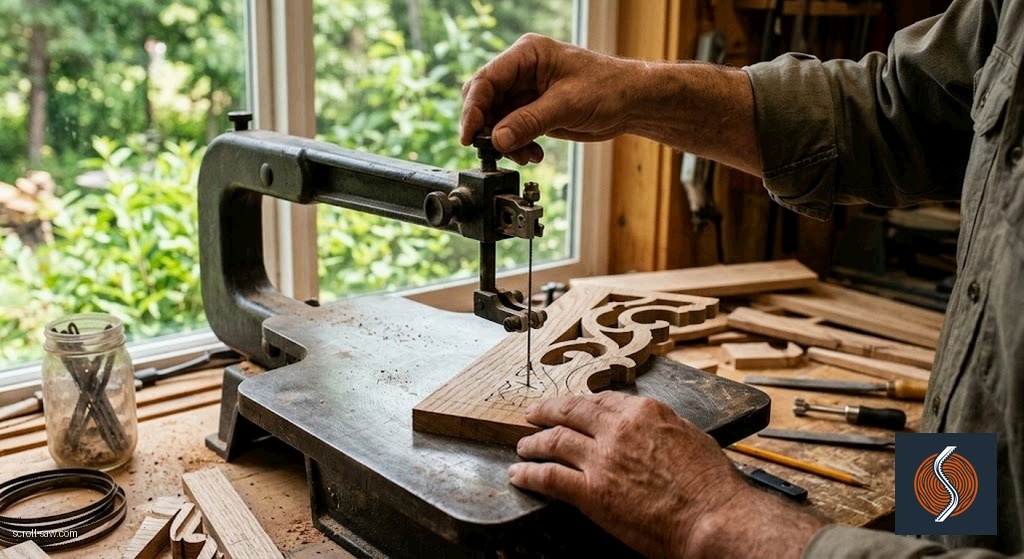
The 40-540 is a 16-inch throat, variable speed, C-arm scroll saw with a cast aluminum table, front-mounted tension, and the Quickset II clamp system that grips a 5-inch plain-end blade with a lever rather than a set screw. Delta rated it at about 1-3/4 inches of cut capacity at 90 degrees and a stroke length in the 3/4-inch range. The motor is small, roughly 1 amp, and the machine is meant for hobby fretwork and light puzzle work rather than production intarsia.
The Quickset II is the feature that shaped how this saw runs. It clamps the blade with a cammed lever, so blade changes take a few seconds and interior-cut threading through a workpiece is faster than on a set-screw clamp. The tradeoff is that the cam surface wears over years, and a worn Quickset II lets the blade shift under tension. If your 40-540 sings a good pluck note when you set it but the blade has visibly slipped when you check it ten minutes later, the Quickset II cam is due for replacement.
Setting up for soft wood and pine
Soft wood is where the 40-540 is happiest. A #5 skip-tooth blade at roughly 80 percent of full speed cuts 1/2-inch pine cleanly with almost no feed pressure. If you find yourself pushing, back the speed off. The saw’s small motor drops RPM under load faster than a larger machine, which reads as a soft, slow cut rather than a straight one.
The Quickset II clamp holds a plain-end blade at both the top and bottom of the arm. When you seat a new blade, push the blade fully into the lower clamp first, close the lever, then feed it up through the workpiece if you are doing an interior cut, then close the upper clamp. Tension last. If you tension before the blade is fully seated in both clamps, the blade will pull free at the first stroke.
Setting up for hardwood
Hardwood asks more of the 40-540 than the machine was really designed to give. It will cut oak, maple, and cherry up to about 3/4 inch, but the pace has to slow and the blade has to be right. A #7 skip-tooth at around 60 percent of full speed is the safe default. Feed pressure has to drop as the wood gets harder, and the ribbon of shaving coming off the blade should stay continuous. Broken chip flow means the tooth is not clearing and the blade is about to heat up.
If you cut hardwood more than a few times a month on this saw, invest in precision-ground blades rather than milled. The Pégas modified-geometry blades cut with about half the feed pressure of a milled equivalent, which means the 40-540’s small motor holds RPM better and the arm sees less shock. That translates to blade life and to Quickset II cam life.
Setting up for plywood, especially Baltic birch
Baltic birch is the material this saw was practically designed around. It cuts predictably in plywood between 1/8 and 1/2 inch, and the reverse-tooth blade advantage shows up most clearly on this stock.
Use a #3 or #5 reverse-tooth blade for any fretwork piece where the bottom face of the plywood will be visible. Speed around 1,300 to 1,500 SPM. Feed steady. The reverse teeth at the bottom of the blade clean the exit face on the up-stroke, which eliminates about 80 percent of the sanding a scroll saw normally leaves behind on plywood.
Stacking two or three sheets of 1/4-inch Baltic birch with double-sided tape between layers is a common trick on the 40-540 for cutting matched sets of pattern pieces. The saw can handle a stack up to about 3/4 inch total. Beyond that the small motor starts to complain and the blade heats up.
Setting up for plastic
Plastic wants slow speed and a coarse-toothed blade with plenty of chip clearance. On the 40-540, run acrylic between 500 and 800 SPM with a #5 or #7 skip-tooth blade. The motor’s low SPM range is friendly to plastic work; a lot of newer variable speed saws bottom out too high to cut acrylic without melting.
Cover the cut line with clear packing tape before cutting. The tape holds chips off the surface and it insulates the material against melt-back at the kerf. Feed pressure has to be light, and if you see any hint of the plastic re-fusing behind the blade, stop immediately and back the workpiece out along the kerf you already cut.
Thin styrene and ABS forgive more than acrylic. They can be cut at similar speeds to soft wood, but keep a light feed.
Setting up for thin metal
Thin metal on the 40-540 is a specialty operation, not the machine’s normal work. The small motor and short stroke are not really built for it. That said, sheet brass under 1/16 inch, sheet copper under 1/16 inch, and aluminum sheet under 3/32 inch can all be cut with a metal-cutting scroll saw blade, at the saw’s lowest speed setting, with a light coat of cutting wax on the blade every couple of inches.
Sandwich the metal between two thin scraps of plywood before cutting. That stops the blade from grabbing at the kerf and it stops the sheet from vibrating. Feed pressure has to drop to almost nothing.
Do not attempt steel on this saw. The motor cannot maintain SPM under the load, and the Quickset II cam will slip.
Blade choice, in short
For the 40-540, most owners settle into three blades:
-
#5 skip-tooth 5-inch plain-end for general 1/4 to 1/2-inch wood work. An Olson 12-pack covers the pack cost of a season of hobby use.
-
#3 or #5 reverse-tooth 5-inch plain-end for Baltic birch fretwork where the bottom face shows.
-
#7 skip-tooth 5-inch plain-end for 3/4-inch hardwood and stacked cutting.
A fourth blade worth having in the drawer is a fine metal-cutting blade at 30 TPI or higher, for the occasional thin brass or copper piece.
Small habits that add years
Release tension at the end of every session. A tensioned blade left overnight on the 40-540 stresses the C-arm at the pivot and, over years, produces a permanent arm bend that shows up as a taper in every cut.
Brush the Quickset II cam and clamp faces clean at least monthly. Fine sawdust accumulates in the cam groove and it prevents the lever from seating fully, which produces slow blade slippage that reads as sudden dulling.
Oil the tension pivot annually with a single drop of light machine oil. Overdoing it drips onto the table and stains workpieces. One drop is enough.
Keep the blade storage well loaded. The saw is easier to run when the blades you use most are within reach of the tension lever.
FAQ
What blades does the Delta 40-540 use? Standard 5-inch plain-end scroll saw blades. The Quickset II clamp is designed for plain-end.
Is the 40-540 still made? No. Production ended more than a decade ago. Parts diagrams remain available through Delta’s service archive and Mike’s Tools.
How thick can the 40-540 cut? About 1-3/4 inches at 90 degrees on soft wood. Hardwood over 3/4 inch strains the motor.
Can I upgrade the Quickset II to a better clamp? Some owners have swapped in aftermarket clamps from Pégas. The retrofit works but requires custom mounting, and the Quickset II is competent when kept clean.
Why does the blade slip after ten minutes of cutting? Worn Quickset II cam. Replace the cam assembly or, as a stopgap, use a small piece of shim brass between the blade and the fixed jaw to increase clamp pressure.
Where do I download the 40-540 manual? ManualsLib and Mike’s Tools both host the original 17-page instruction manual and the associated parts drawings.
References
-
ManualsLib. Delta 40-540 16-inch Variable Speed Scroll Saw instruction manual.
-
Mike’s Tools. Delta 40-540 parts list, T2 revision, 16-inch variable speed scroll saw.
-
Olson Saw Company. 5-inch plain-end scroll saw blade product catalog with tooth style comparison.
Title tag: Delta 40-540 Scroll Saw Setup: Material-by-Material Guide Meta description: Set up the Delta 40-540 16-inch variable speed scroll saw by material: soft wood, hardwood, plywood, plastic, and thin metal. URL slug: delta-variable-speed-scroll-saw-model-40-540 Excerpt: A practical, material-by-material setup guide for the Delta 40-540 scroll saw. Blade choice, speed, and feed for pine, hardwood, Baltic birch, acrylic, and thin metal, plus the small habits that keep the Quickset II clamp accurate for years.


