
DeWalt DW788 Scroll Saw: Speed by Material Guide
DeWalt DW788 Scroll Saw: Speed by Material Guide
Watch a good scroller work on a DeWalt 20-inch variable speed for ten minutes and one thing becomes obvious. The person at the saw never runs the speed dial at the same position for two different materials. Speed is not a preference on this machine, it is a variable, and treating it that way is what separates a chattery, burned cut from a line that comes off the blade looking almost finished.
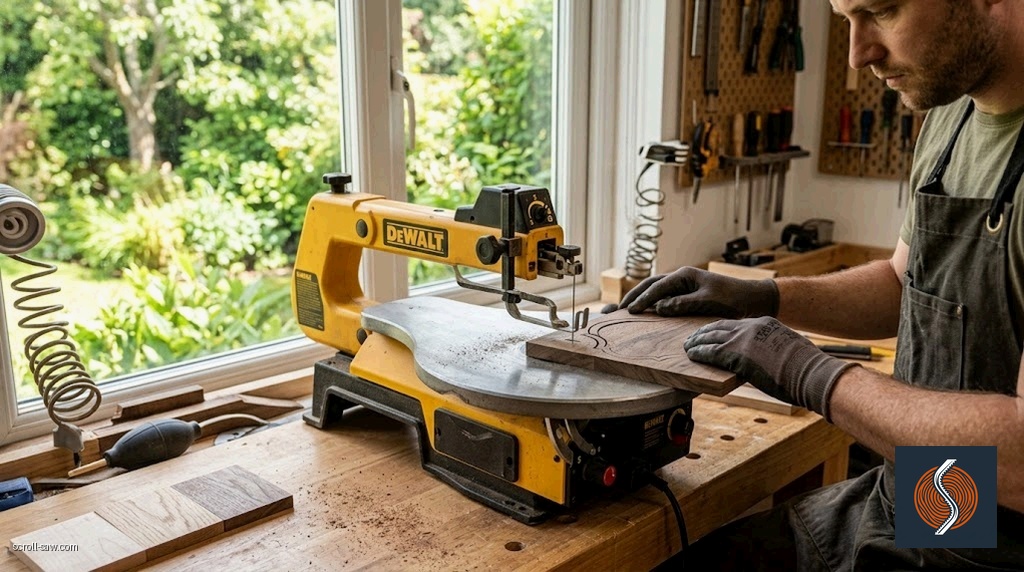
The DeWalt DW788 is a 20-inch dual parallel-link scroll saw rated 400 to 1,750 strokes per minute, with a 3/4-inch stroke length, a 1.3-amp motor, and a 2-inch cut depth. It takes 5-inch plain-end blades and it tilts 45 degrees left and right. The saw has held its place at the top of the hobbyist and semi-pro market for two decades because the parallel-link arm design keeps the blade close to vertical at the top of the stroke, which is what makes fine curve cutting possible.
What follows is how to actually use the speed dial across the materials most owners cut, and why the dial is the single most under-used control on this saw.
Why speed matters more than most people think
A scroll saw blade cuts by dragging its teeth through the workpiece on the down-stroke. Every tooth takes a small bite, clears the chip through the gullet, and returns empty on the up-stroke. Two things go wrong when the SPM is mismatched to the material.
At too high a speed, the tooth passes through faster than the chip can clear. The gullet loads, heat builds, and the blade starts burnishing the wall of the kerf instead of cutting it. That is the origin of the brown scorch line you see on the edge of a cut in hardwood, and it is why the same blade that cut a clean line in pine at 1,600 SPM leaves a black streak in oak.
At too low a speed, the tooth engagement per pass is too aggressive. The blade wants to grab, the arm feels it, and the feed rate you can maintain drops. In soft plastic or thin metal, running the saw too slow can also let the material re-weld behind the blade if the chip does not clear before the return stroke.
The DW788’s dial is continuous, not stepped. Learn where the dial sits at three positions for the material you cut most, and mark them with a piece of tape if it helps.
Speed for hardwood
Hardwood likes slow. On the DW788, that means somewhere between 900 and 1,300 SPM for the vast majority of hardwood scroll work.
Cherry, walnut, maple, and oak between 1/2 and 1 inch thick cut cleanly with a #5 or #7 skip-tooth blade at roughly 1,100 to 1,200 SPM. Feed lightly. If the wood smokes, drop the speed 100 SPM and try again. If the blade drifts sideways under normal feed, tension is low, not speed.
Extreme-hardwood species (hickory, hard maple, dense exotics like bloodwood or ipé) want the low end of that range, closer to 900 SPM. The blade will still cut, but slowly, and the tempo of the cut has to change to match. A cut that would take 30 seconds in cherry may take two minutes in ipé. Trying to force the DW788 to cut ipé at cherry pace burns blades and can put a permanent bow in the arm over time.
Speed for soft wood and plywood
Soft wood tolerates a wider speed range. Pine, poplar, cedar, and basswood cut fine anywhere from 1,200 to 1,700 SPM. The middle of the range is a good default.
Baltic birch plywood is the standard fretwork material and it likes about 1,400 SPM with a #3 or #5 reverse-tooth blade for pieces where the bottom face will be visible. The reverse-tooth blade cleans the exit face and the mid-range speed keeps the chip clearing at a steady rate. Speed the saw up if the cut feels sluggish. Slow it down if you see any hint of scorch or feel the blade heat when you stop.
Construction plywood, MDF, and particle board are harder on blades than most people expect. Run them at 1,200 to 1,400 SPM with a #7 or #9 skip-tooth. Expect to change blades more often than you would in solid wood of the same thickness because the resin and glue in these panels dull teeth quickly.
Speed for plastic
Plastic is where the DW788 rewards a light hand and a slow dial. Acrylic and polycarbonate melt before they cut when speed is too high, and the melted material welds behind the blade and finishes the cut for the wrong reason.
Run acrylic between 600 and 900 SPM. Use a skip-tooth blade with coarse TPI, roughly a #5 skip on 1/4-inch material. Feed steadily but lightly. Watch the kerf: if you see any hint of a re-fused edge, drop speed by 100 SPM immediately.
Styrene, ABS, and PVC forgive more than acrylic and can be cut at 900 to 1,200 SPM. But they still like a light feed. The DW788’s low-end speed range is broad enough to handle any plastic a scroller normally encounters. That is one of the specific advantages of this saw over cheaper single-speed machines.
Speed for thin metal
Metal cutting on the DW788 uses the very bottom of the speed range, 400 to 600 SPM, with a metal-cutting blade rated for the specific material.
Brass and copper sheet under 3/32 inch cut at about 500 SPM with a 30 TPI or higher blade, a light coat of cutting wax every few inches, and the sheet sandwiched between two 1/8-inch plywood scraps. Aluminum sheet under 1/8 inch cuts similarly. Steel is possible up to about 1/16 inch but the machine’s small motor is not really suited to it and blades last a matter of feet, not hours.
Feed pressure on metal has to drop to almost nothing. The workpiece rests on the table, the blade eats through it at its own pace, and any attempt to push produces heat, warp, or a broken blade.
A quick material-to-speed table
| Material | Thickness | Speed (SPM) | Blade |
|---|---|---|---|
| Baltic birch | 1/4 in | 1,300–1,500 | #3 or #5 reverse-tooth |
| Pine, poplar | 1/2 in | 1,400–1,700 | #5 skip-tooth |
| Cherry, walnut | 3/4 in | 1,100–1,300 | #7 skip-tooth |
| Hard maple, oak | 3/4 in | 900–1,200 | #7 or #9 skip-tooth |
| Acrylic | 1/4 in | 600–900 | #5 skip-tooth |
| Styrene, ABS | 1/8 in | 900–1,200 | #5 skip-tooth |
| Brass sheet | 1/16 in | 400–600 | 30 TPI metal |
| Aluminum sheet | 1/8 in | 400–600 | 20–30 TPI metal |
What the DW788 does that cheaper saws do not
The advantage of the DW788 over a WEN, Ryobi, or entry-level Craftsman is not the throat depth or the motor size. Those specs are broadly similar. The advantage is the parallel-link arm geometry. On a C-arm design, the blade traces a shallow arc through its stroke, which pushes the blade slightly forward at the top of the cut. That forward drift shows up as a chattery cut on tight curves and it is the single largest reason inexpensive scroll saws produce inconsistent results.
The DW788’s parallel-link arm keeps the blade nearly vertical at the top of the stroke. That means the blade enters and exits the workpiece on the same line, tight curves cut clean, and interior fretwork looks like it came off a much more expensive machine.
The tradeoff, and the honest weakness worth naming, is that the DW788 is a big saw. It weighs 56 pounds set up, it needs bench space or a dedicated stand, and it is not a machine you set up on the kitchen counter for an evening. If you scroll occasionally, or if bench space is short, the DW788 may be more saw than your workflow needs.
Who should skip this saw
Hobbyists who cut simple patterns in pine three or four times a year will not see enough difference between the DW788 and a benchtop Ryobi to justify the size and cost. The parallel-link advantage shows up in tight-curve fretwork and thick hardwood, not in occasional soft-wood cutting.
Serious production intarsia workers who run the saw six to eight hours a day may find the DW788’s 1.3-amp motor a limitation on very thick hardwood. For that use case, a Hegner or a Pégas ergo is a step up.
Everybody in between is squarely the DW788’s market, and the saw has held that market for a reason.
FAQ
What blades does the DeWalt DW788 use? Standard 5-inch plain-end scroll saw blades. Any brand that makes 5-inch plain-end will fit.
How thick can the DW788 cut? DeWalt rates it at 2 inches at 90 degrees. Two inches of hardwood is the practical upper limit.
Does the DW788 come with a stand? No. The DW7880 stand is sold separately and is designed to fit.
Why does my DW788 leave scorch marks on hardwood? Speed is too high, blade is too fine, or feed is too slow, in that order. Drop SPM by 100, try a coarser blade, and let the blade do the cutting.
Can the DW788 cut metal? Yes, thin non-ferrous metal (brass, copper, aluminum) with the right blade and slow speed. Steel is possible but not the saw’s strong suit.
Is the parallel-link arm really that different from a C-arm? Yes, on tight curves and interior fretwork. On straight cuts and gentle curves the difference is smaller.
Does DeWalt still make the DW788? Yes. It is a long-running production model with active parts support.
References
-
DeWalt. DW788 20-inch variable speed scroll saw product page, manual, and exploded diagram.
-
Woodcraft. DW788 specifications and included accessories listing.
-
Olson Saw Company. 5-inch plain-end blade catalog with TPI and tooth style reference.
Title tag: DeWalt DW788 Scroll Saw: Speed by Material Guide Meta description: Match speed to material on the DeWalt DW788 20-inch variable speed scroll saw for cleaner cuts in wood, plastic, and thin metal. URL slug: dewalt-20-in-variable-speed-scroll-saw Excerpt: The speed dial is the most under-used control on the DeWalt DW788. Which SPM range fits hardwood, soft wood, plywood, plastic, and thin metal, plus a quick reference table for the materials scrollers cut most.


