
DeWalt DW788: Fix Cut Quality Problems in Order
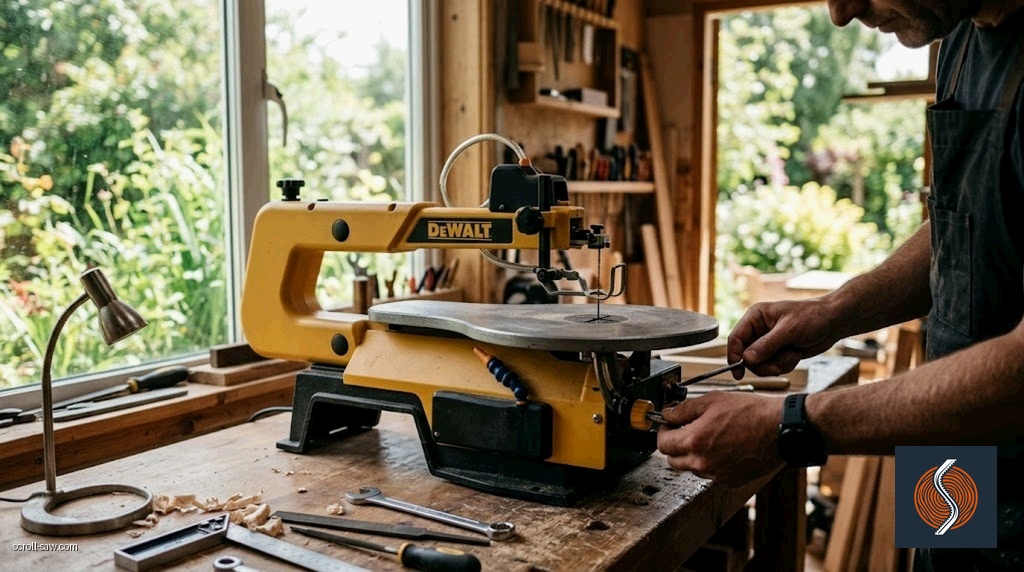
DeWalt DW788: Fix Cut Quality Problems in Order
A scroll saw that once cut a clean line and now does not is telling you something specific, and the message is usually simple. The DeWalt DW788 is a mechanically straightforward machine, and every category of degraded cut quality on it points to one of five things. Working through them in the right order saves an evening of guessing.
The DW788 is a 20-inch variable speed scroll saw with a parallel-link arm, front tension lever, tool-free blade clamps, and a 1.3-amp motor. When the cut goes wrong, it is almost never the motor. It is almost always the blade, the tension, the clamps, the bearings, or the table, in that order.
First: the blade itself
The simplest fix is almost always the answer. A blade that was fine an hour ago may be dulling. Blade life on a scroll saw is measured in minutes of continuous cut, not hours. A #5 skip-tooth in Baltic birch might give 30 to 60 minutes before showing wear. A #7 in oak might give half that.
Signs of a dull blade: burn marks on the cut edge, sudden increase in the feed pressure you need to maintain, drift on straight lines that did not drift before, or a rough edge that used to come off clean.
Replace the blade before doing anything else. Then cut a test line in scrap. If the fresh blade cuts clean, the problem was just wear and you can go back to work.
Second: the tension
If the fresh blade also cuts poorly, check tension. The DW788’s tension lever is meant to be used every blade change, and it is meant to bring the blade to a clear pluck note, roughly a high C.
Under-tension shows up as blade drift, sideways wander on tight curves, and a soft feel to the blade when you push against it lightly with a fingernail. Over-tension shows up as sudden blade breakage at the clamp, a high whining note when the saw runs, and rapid dulling because the over-flexed blade heats up in the stroke.
Adjust and cut a test line. If tension fixes it, do the pluck test after every blade change from now on.
Third: the blade clamps
The DW788’s tool-free clamps grip the blade with a cammed lever. Over time, sawdust builds in the clamp jaws, blade fragments get lodged in the grip surface, and the cam itself wears. A worn or dirty clamp reads as slow blade slippage during the cut: the blade seems tight when you set it, but ten minutes later the tension has softened and the cut has gone off.
Open both clamps. Brush the jaw faces clean with a stiff nylon brush. Blow out debris with compressed air. Inspect the jaws for wear or cracking. If the clamp will not close firmly with a fresh blade, the cam or the clamp body has worn and needs replacement. DeWalt sells the assembly and it is a straightforward swap.
Before blaming a clamp, check that the blade tang is fully seated in both clamps. A blade sitting shallow in the lower clamp will slip on the first cut. Push the blade in until it stops, then close the clamp.
Fourth: the upper arm bearings
If blade, tension, and clamps all check out and the saw still cuts poorly, look at the upper arm. The parallel-link design uses pivot bearings at the arm joints. Over years of use, or with heavy hardwood cutting volumes, those bearings develop play.
With the saw off and unplugged, grip the upper arm at the front near the blade clamp and press it sideways gently. Any visible lateral motion at the pivot points means the bearings are worn. Small motion, up to about 1/32 inch, is normal on a used saw and usually does not affect cut quality. More than that, and the arm is letting the blade rock at the top of the stroke, which produces both burn and wander that no amount of tension or blade choice will fix.
Bearing replacement on the DW788 is a shop job that most hobbyists can do with a bearing press or a socket-and-hammer technique described in the parts manual. Some owners send the saw in for service instead. The bearing kit itself is inexpensive.
Fifth: the table
A cut that is clean but not square (leaves a bevel where you cut a straight cut) points at the table, not the blade. The DW788 table sits on a trunnion that locks at the tilt scale. Two failures happen here.
The first is that the tilt lock has loosened. Set the table to zero, snug the lock down, and check the blade-to-table square with a small engineer’s square. If the table wants to move under normal cutting load, the lock has stripped and needs replacement.
The second is that the tilt scale itself has drifted. Zero on the scale may not be zero to the blade if someone previously adjusted the scale bracket. Ignore the scale and set square directly against the blade. Once the table reads square to the blade, note where the pointer sits on the scale for future reference.
Rare: motor or drive
Motor problems on the DW788 are rare and usually manifest as reduced SPM under load (the motor bogs on hardwood cuts it used to breeze through) or as smoke. If you see either, stop cutting and inspect. Brushes wear out and are replaceable. Windings burn and are not economically repairable.
Drive-belt issues on this saw are almost nonexistent because the DW788 uses a direct drive from the motor to the arm mechanism. There is no belt to slip or crack.
The order matters
Working through blade, tension, clamps, bearings, table in that order fixes about 95 percent of cut-quality drops on the DW788 within the first two steps. Owners who jump straight to bearings or table adjustments usually end up backing out and starting over from blade change. Save the time and go through in order.
Small maintenance that prevents most of this
Detension the blade at the end of every session. This is the single largest factor in long-term arm life on the DW788.
Brush the blade clamps clean before every blade change. Two minutes per session, and it saves clamp replacement over years.
Oil the tension pivot annually with one drop of light machine oil.
Replace worn parts before they fail. A blade clamp that will not close as firmly as it used to is going to slip during a cut sooner or later. Replacing it during a planned maintenance session is easier than replacing it mid-project.
Keep a small stock of consumables on hand. A 12-pack of Olson blades in the size you use most removes one common source of session interruption.
Who should skip this saw
The DW788 is the wrong buy for the very casual scroll saw user who cuts occasional gift projects in pine. A cheaper benchtop saw will handle that work without the maintenance overhead this machine expects.
It is also the wrong buy for the production intarsia worker who runs the saw eight hours a day. At that volume, the arm bearings will show wear within a few years, and a machine built for continuous production, like a Hegner or a Pégas Ergo, will hold up better.
Everybody between those two extremes is the DW788’s market. That is a wide market, and the saw has held it for a reason.
FAQ
Why does my DW788 suddenly cut poorly after cutting fine yesterday? Usually a dull blade. Replace it first and test.
How do I know if the arm bearings are worn? With the saw off, gently press the upper arm sideways at the front. Any visible motion at the pivot points more than 1/32 inch is wear.
Can I replace the arm bearings myself? Yes, with a bearing press or socket-and-hammer. The parts manual shows the procedure. Some owners prefer to send the saw for service.
Why does the DW788 blade slip in the clamp? Dirty clamp jaws, worn cam, or blade tang not fully seated. Clean, check for wear, and reseat.
Should I detension the blade every night? Yes. It adds real life to the arm and to the blade.
Is the DW788 still worth buying new? Yes. It remains the standard against which other scroll saws in its class are measured.
Do I need special blades for this saw? No. Any 5-inch plain-end scroll saw blade from a mainstream manufacturer will fit.
References
-
DeWalt. DW788 variable speed scroll saw product page and manual.
-
Home Depot. DW788 product listing with owner reviews and specifications.
Title tag: DeWalt DW788: Fix Cut Quality Problems in Order Meta description: The five things to check when a DeWalt DW788 variable speed scroll saw stops cutting cleanly, in the right order. URL slug: dewalt-dw788-variable-speed-scroll-saw Excerpt: A DW788 that used to cut clean and now does not is one of five problems: blade, tension, clamps, bearings, or table. Working through them in the right order fixes most cases in the first two steps.


