
Dremel 1671 Scroll Saw Blades: Selection Guide
Dremel 1671 Scroll Saw Blades: Selection Guide
The Dremel Model 1671 is one of the older 16-inch scroll saws that keeps turning up in workshops, in estate sales, and in the corner of hobbyist basements that were used heavily for a few years and then quietly retired. If you have one now, it probably came with no blade at all, or with a single blade of unknown origin that came loose from the clamp the first time you turned the saw on. Blade selection is the first practical problem, and it has a clear answer.
The 1671 uses 5-inch pin-end scroll saw blades. That is the format, and any modern 5-inch pin-end blade from Olson, Flying Dutchman, or similar will fit the clamps and cut correctly. Beyond that fit question, the useful conversation is which blade to reach for on a given material.
Confirming your 1671 before you buy blades
Before ordering blades, look at both clamps on your specific saw. The Dremel 1671 shipped with pin-end clamps: small blocks with cross-drilled holes on each side, into which the blade’s pins seat. If your saw shows a flat slot without cross-drilled pin holes, a previous owner has converted the clamps to plain-end. Either configuration cuts wood; the difference is which blade family you buy.
Standard pin-end clamps on the 1671 accept blades where the pins are spaced about 4-5/8 inches apart on a 5-inch blade body. That is the standard 5-inch pin-end format used across the majority of hobby scroll saws from the 1980s through the 2000s. Any modern 5-inch pin-end blade will match.
Also check that the tension arm works freely. A 1671 that has been in storage often has a stiff or frozen tension mechanism. Work the arm through its full range a few times with no blade installed. If the motion is not smooth, a drop of light machine oil at the pivot fixes most cases.
The three blades that cover 80 percent of hobby work
Most 1671 owners settle into a small blade rotation. Three blades cover the majority of what a hobby scroller cuts on this saw.
#5 skip-tooth pin-end. About 12.5 TPI. The default for 1/4 to 1/2-inch soft wood and Baltic birch pattern work. Cuts fast enough to stay productive and clean enough to avoid excessive sanding. Buy a dozen at a time.
#7 skip-tooth pin-end. About 11.5 TPI. Steps up when cutting 3/4-inch hardwood or when stacking multiple sheets of thinner material. The coarser tooth clears chips better in dense wood and reduces the heat that dulls blades in oak or maple.
#3 reverse-tooth pin-end. About 18 TPI with the bottom teeth reversed. The right choice for plywood fretwork where the exit face of the plywood will be visible in the finished piece. Reverse teeth cut the fibers cleanly on the up-stroke and eliminate most of the sanding a scroll saw normally leaves behind.
Olson makes all three in dozen packs. Keep two dozen of your primary blade and a dozen each of the other two in a divided case within reach of the saw.
Beyond the basics
For specialized cutting on the 1671, four other blade types are worth knowing.
Spiral blades cut in all directions. The teeth wrap around the blade body so any feed direction produces cutting. On a 1671, spiral blades let the operator cut complex patterns without rotating the workpiece around the blade. The tradeoff is a wider kerf, a fuzzier edge, and shorter blade life. Use spirals for pattern work where the fuzzy edge does not matter or will be sanded off.
Precision-ground blades have their teeth ground rather than milled. They cut cleaner with less feed pressure. On a 1671’s small motor, the reduced load matters more than on a larger saw. Precision-ground blades cost more per blade but they cut faster and last longer, especially in hardwood.
Double-tooth blades pair standard and reverse teeth in a specific pattern to balance cut speed and exit-face cleanness. They are a middle ground between skip-tooth and reverse-tooth. Common owner report is that they perform well on stacked cutting.
Metal-cutting blades in fine TPI (30 or higher) fit the pin-end clamps and can cut thin brass, copper, and aluminum on the 1671. Speed drops to the saw’s minimum, feed pressure goes to almost nothing, and a light coat of cutting wax on the blade every few inches extends blade life. This is a specialty use case on the 1671; the saw was not built for metal but it will do occasional thin sheet work.
The TPI-to-material shortcut
A rough rule that works well for the 1671:
-
20 to 30 TPI for very thin material (under 1/8 inch) or for thin non-ferrous metal.
-
12 to 18 TPI for medium material (1/4 to 1/2 inch).
-
7 to 12 TPI for thick material (3/4 inch and up).
Acrylic and thin plastic want the mid-range TPI, run at low speed. Very fine fretwork in Baltic birch wants the mid-to-high range with reverse teeth. Straightforward puzzle work in soft wood is happiest at the mid range in skip-tooth.
Blade tension and clamp habits
The 1671 tensions from the upper arm. Correct tension for a 5-inch pin-end blade is a clear high pluck note, roughly between B and C on a piano. The pluck test after every blade change is the single most useful diagnostic on the saw.
Pin-end clamps deserve a specific mention. The pins seat into cross-drilled holes, and the holes gather dust and chips over years. Before every blade change, brush the pin holes clean with a small stiff brush or a compressed-air blast. A pin that does not seat fully rotates slightly during the stroke, which reads as chatter in the cut and shortens blade life through pin fatigue.
Also check the pin holes for elongation. Over years the holes wear from round to oval, and the pins develop play. If the pin visibly rocks in the hole with the blade unloaded, the clamp is worn. Dremel’s parts network sells replacement clamps for the 1671, and the swap takes about 10 minutes.
Storage and stock
Buy blades in dozen packs from a single supplier. Blade behavior varies slightly between manufacturers, and mixing brands within a project introduces variables that make it harder to diagnose problems.
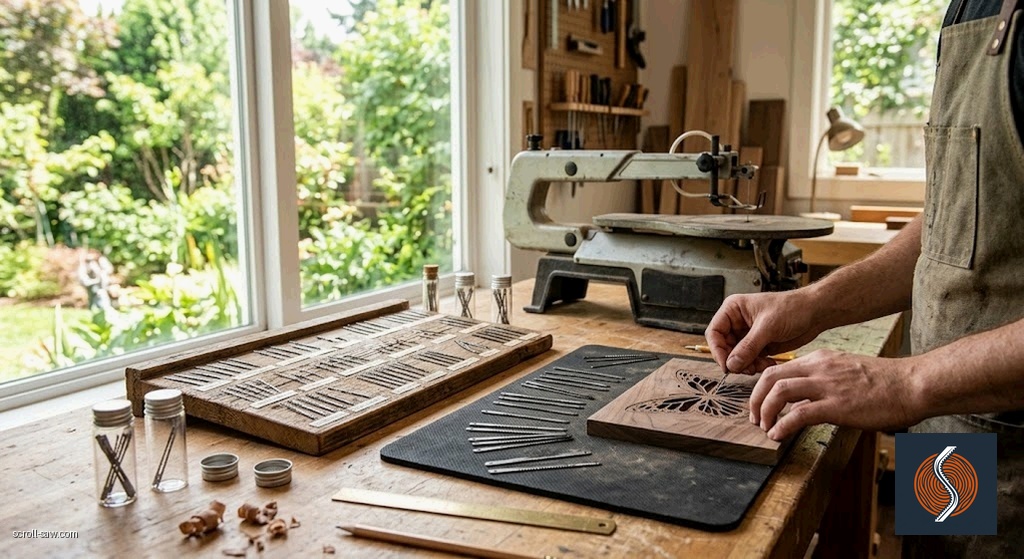
Store blades flat in a divided case with the pin ends aligned. Blades that live loose in a drawer bend against each other and arrive at the saw already stressed.
Label the case sections with tooth style and TPI. Trying to identify a loose blade by eye is possible but slow, and it wastes shop time.
Stock a small emergency supply of your primary blade. Running out of your standard #5 skip-tooth in the middle of a project is the kind of interruption that turns an afternoon of work into next weekend’s project.
When the blade is not the problem
On a 1671 that cuts poorly with a fresh, correctly tensioned blade, the problem is somewhere else. Common causes: worn clamps as described above, a loose motor mount, or a drive belt (on models that use one) that has stretched or glazed. Older 1671s in particular can develop arm bearing play that no blade will compensate for.
Before assuming a mechanical fault, though, try three fresh blades in the sizes you think should fit the material. Sometimes a single new blade is defective from the pack; three in a row cutting poorly is a machine issue, not a blade issue.
FAQ
What blades fit the Dremel 1671? Standard 5-inch pin-end scroll saw blades.
Where do I buy pin-end blades? Olson, Flying Dutchman, and Sloan’s Woodshop all stock them. Amazon carries the Olson dozen packs.
Can I use plain-end blades on a 1671? Only if the clamps have been converted. The factory clamps are pin-end.
How long does a blade last on this saw? Roughly 15 to 45 minutes of cutting per blade depending on wood, TPI, and speed.
Does the 1671 need lubrication? A drop of light machine oil at the arm pivot annually. Nothing else needs regular oiling.
Why do my blades keep breaking at the pin? Usually over-tension or a blade left tensioned overnight. Detension between sessions.
Is the 1671 worth restoring? For light hobby use, yes. For heavy production work, a modern parallel-link saw will outperform it and cost less than continued repairs.
References
-
Olson Saw Company. Pin-end scroll saw blade catalog and TPI reference.
-
Scroll Saw Woodworking & Crafts forum. Blade selection discussions for Dremel and similar pin-end saws.
-
Dremel. Customer support and parts documentation for legacy scroll saw models.
Title tag: Dremel 1671 Scroll Saw Blades: Selection Guide Meta description: Which pin-end blades fit the Dremel 1671 scroll saw, and how to pick TPI, tooth style, and stock for hobby cutting. URL slug: dremel-16-scroll-saw-model-1671-blades Excerpt: The Dremel Model 1671 scroll saw takes standard 5-inch pin-end blades. Which three blades cover 80 percent of hobby work, what to reach for in specialty cuts, and how to keep the pin clamps holding blades securely for years.


