
Dremel 1680 Scroll Saw: Setup by Material and Thickness
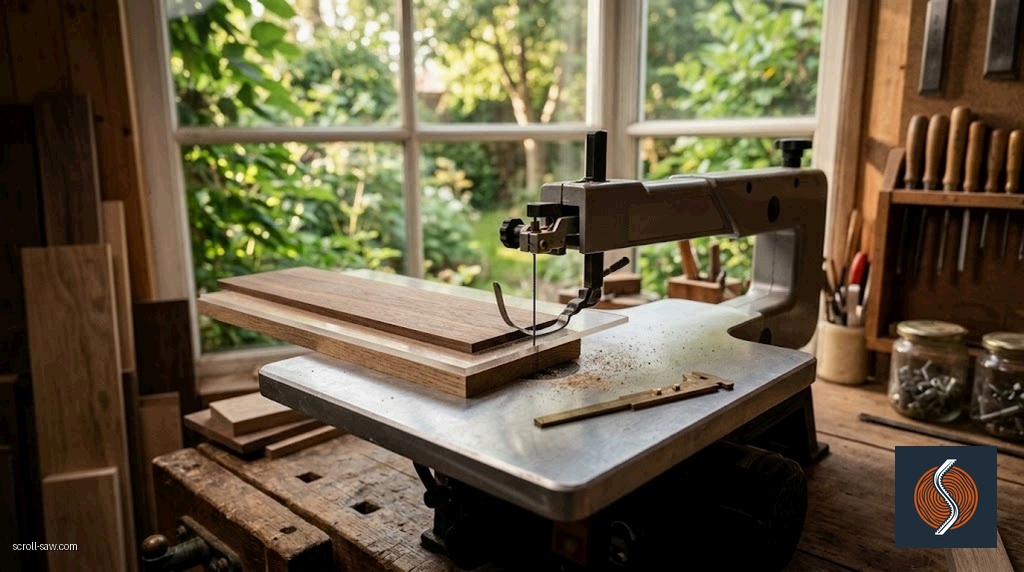
Dremel 1680 Scroll Saw: Setup by Material and Thickness
The Dremel 1680 is one of those hobby scroll saws that shows up in a lot of workshops without a lot of ceremony. It was Dremel’s mid-run 16-inch variable speed offering, sold widely through the late 1990s and early 2000s, and the model still cuts well when set up correctly. Where the 1680 disappoints is in the same place most compact scroll saws disappoint their owners: a single set of speed and blade settings gets used for every material, and the cuts get progressively worse as the material changes.
The fix is not complicated. Every material category (soft wood, hardwood, plywood, acrylic, thin metal) has its own combination of blade, speed, feed, and tension that produces a clean cut on this saw. This guide covers those combinations for the materials most 1680 owners actually cut, at the thicknesses that fit within the saw’s 1-3/4-inch depth capacity.
About the 1680
The Dremel 1680 is a 16-inch throat, C-arm scroll saw with variable speed roughly 500 to 1,500 SPM. It uses 5-inch pin-end scroll saw blades, weighs about 25 pounds, and mounts either to a benchtop or (with a set of soft feet) to a portable work surface. The motor is small at roughly 0.7 amps, which limits the saw’s practical reach in hardwood but keeps the machine quiet and easy on shop electrics.
Before anything else, check the saw’s basic condition. Work the tension mechanism through its full range with no blade installed. Look for lateral play in the upper arm. Brush the blade clamp pin holes clean. A 1680 that has been in storage often has a stiff tension arm or dust-packed clamps, and both are easier to fix before running the first cut than to diagnose later.
Soft wood: pine, poplar, basswood
Soft wood is where the 1680 is happiest. The small motor has plenty of headroom, blade life is long, and cuts come off clean with basic setup.
For material 1/8 to 3/8 inch thick, use a #3 or #5 skip-tooth pin-end blade at roughly 1,200 to 1,400 SPM. Feed at a rate that produces a continuous ribbon of shaving; if you see dust instead of ribbon, either slow the SPM or feed faster.
For material 1/2 to 3/4 inch thick, step up to a #5 or #7 skip-tooth. Drop speed to 1,000 to 1,200 SPM. Soft wood at that thickness cuts fast but the extra depth reduces the effective chip clearance per stroke, so the slower speed keeps the cut cool.
For material 1 inch and thicker, use a #9 skip-tooth at 800 to 1,000 SPM. This is near the practical top end for the 1680 in soft wood. The saw will handle it, but session length shortens because the motor works harder.
Hardwood: oak, maple, cherry, walnut
Hardwood is where the 1680’s small motor shows its limits. The saw can cut hardwood up to 3/4 inch cleanly with the right setup, but the operator has to feed lighter and expect shorter blade life.
For material under 1/2 inch, use a #5 skip-tooth or, better, a #5 precision-ground pin-end blade at 900 to 1,100 SPM. Precision-ground blades cut with noticeably less feed pressure and stretch blade life in hardwood.
For 1/2 to 3/4 inch hardwood, step to a #7 skip-tooth at 800 to 1,000 SPM. Feed lightly. The motor should not audibly labor. If you hear the SPM drop under feed pressure, back off; you are pushing too hard for the saw.
Hardwood over 3/4 inch is technically within the saw’s capacity but rarely the right project for a 1680. Stack cutting thin hardwood is a better use of the saw for volume work.
Plywood: Baltic birch, hardwood-faced plywood
Baltic birch is the workhorse material for scroll saw pattern work, and the 1680 cuts it well. The main variable is the exit face: if the underside of the workpiece will be visible in the finished piece, reverse-tooth blades save most of the sanding step.
For 1/8-inch Baltic birch, use a #3 reverse-tooth pin-end blade at 1,000 to 1,300 SPM. The reversed teeth at the blade’s bottom clean the exit face on every up-stroke.
For 1/4-inch Baltic birch, step to a #5 reverse-tooth at 1,100 to 1,300 SPM. This is the most common scroll saw pattern setup on the 1680, and it is worth stocking a dozen of the blade you settle on.
For 3/8 to 1/2-inch plywood, a #5 or #7 skip-tooth at 1,000 to 1,200 SPM works. Reverse-tooth in these sizes is available but harder to source in pin-end format.
Hardwood-faced plywood (oak-face, birch-face, or similar over a softer core) cuts like the harder face, not like the softer core. Set speed and blade to the face material.
Acrylic and thin plastic
Acrylic is unforgiving on scroll saws because the material heats and welds itself back into the kerf. The 1680 cuts acrylic well if the speed stays low enough.
For 1/8-inch cast acrylic, use a #5 skip-tooth at 500 to 800 SPM. Feed slowly and steadily. If the blade appears to leave a hazy edge on the acrylic, either the speed is too high or the feed is too slow. Adjust one variable at a time.
For 1/4-inch acrylic, drop to a #7 skip-tooth at 400 to 700 SPM. Consider a very light coat of cutting wax on the blade to reduce weld-back. Wax scroll saw blades wear a light film onto the blade body and reduce heat buildup dramatically.
Extruded acrylic cuts more easily than cast acrylic but tends to chip at the exit face. Cast acrylic cuts slower but comes off cleaner. If you have a choice, use cast for scroll saw work.
Thin metal
The 1680 is not a metal-cutting saw, but it can handle thin non-ferrous sheet for occasional inlay or craft work. Brass, copper, and thin aluminum up to about 20 gauge (0.032 inch) cut on this saw with the right blade.
Use a 30-plus TPI metal-cutting pin-end blade if you can source one, or a fine-tooth wood blade as a backup. Run at the saw’s minimum speed, roughly 500 SPM. Feed almost imperceptibly slowly. A light coat of cutting wax between passes extends blade life substantially.
Metal on a scroll saw takes patience. If you plan to cut metal more than occasionally, a scroll saw is the wrong tool; a jeweler’s saw or a bandsaw with a metal-cutting blade is the right one.
Blade stock for the 1680
Most 1680 owners settle into a rotation of three or four blades:
-
#5 skip-tooth pin-end: the all-purpose default for medium wood
-
#3 reverse-tooth pin-end: for plywood fretwork where exit face matters
-
#7 skip-tooth pin-end: for thicker or harder material
-
#9 skip-tooth pin-end: for thick soft wood and stacked cuts
Buying blades in dozen packs from a single supplier keeps behavior consistent. Olson makes pin-end scroll saw blades in these sizes and they hold up well for hobby volumes. For more specialized needs (reverse-tooth pin-end in larger sizes, spiral pin-end, metal-cutting pin-end), Sloan’s Woodshop and similar specialty suppliers stock a wider range than mass retailers.
Small habits that make everything easier
Detension the blade at the end of every session. This is the single largest factor in long-term blade life on the 1680.
Brush the clamp pin holes clean before every blade change. A single grain of dust in the pin hole prevents full seating and produces chatter.
Store blades flat in a divided case, labeled by size and tooth style.
Work in reasonable session lengths. Twenty minutes cutting, five minutes rest keeps the small motor cool.
Mark project scrap with the blade and speed that worked. Personal notes accumulate faster than any published chart.
Who this saw fits
The 1680 fits the hobbyist who cuts small pattern pieces, holiday ornaments, name plaques, and simple puzzles in soft wood and Baltic birch. In that use case, it performs well and the blades are inexpensive.
The 1680 does not fit anyone doing production intarsia, thick hardwood work, or fine-detail fretwork with 1/16-inch inside curves. A parallel-link saw handles those jobs cleaner and holds up under continuous use.
Between those two ends, the 1680 covers a wide middle ground. If you already own one, this setup guide is what makes it earn its bench space.
FAQ
What is the maximum cut depth on the Dremel 1680? About 1-3/4 inches at 90 degrees on soft wood, less in hardwood.
What blades fit the 1680? Standard 5-inch pin-end scroll saw blades.
Can I cut thick hardwood on this saw? Up to 3/4 inch cleanly. Beyond that, the small motor struggles.
Why does my acrylic weld back after the blade passes? Speed too high. Drop to 500-800 SPM and feed slowly.
Is the Dremel 1680 still in production? No. Parts and blades remain available through Dremel’s service network and third-party suppliers.
How do I know if the blade tension is right? Pluck the blade with a fingernail. A clear high pluck note (around a high C) is correct.
Do I need special blades for the 1680? No. Any 5-inch pin-end blade from a mainstream manufacturer fits.
References
-
Olson Saw Company. Pin-end scroll saw blade catalog and material selection guide.
-
Scroll Saw Woodworking & Crafts forum. Dremel 1680 owner discussions and setup archives.
Title tag: Dremel 1680 Scroll Saw: Setup by Material and Thickness Meta description: Blade, speed, and feed settings for the Dremel 1680 16-inch variable speed scroll saw across wood, plywood, acrylic, and metal. URL slug: dremel-16-variable-speed-scroll-saw-model-1680 Excerpt: A material-by-material setup guide for the Dremel 1680 16-inch variable speed scroll saw. Blade, speed, and feed settings that produce clean cuts in soft wood, hardwood, Baltic birch, acrylic, and thin metal.


