
Porter-Cable 16 in Scroll Saw: Wood, Plastic, Metal
Porter-Cable 16 in Scroll Saw: Wood, Plastic, Metal
A scroll saw earns its space by cutting well across a range of materials, not just one. The Porter-Cable 16-inch variable speed scroll saw is built for that broader use, and its variable speed control was designed specifically so operators could shift between materials without changing machines. Getting the shift right, though, is not obvious. Speed, feed, and blade choice all change depending on what is under the blade, and the operator who learns the starting points for each material gets clean cuts from day one instead of week three.
This guide covers those starting points on the Porter-Cable 16-inch variable speed scroll saw. Wood first, then plastic, then thin metal. Each material has a specific combination of blade, speed, and feed that produces a clean cut. Once dialed in, the saw handles all three well.
About the saw
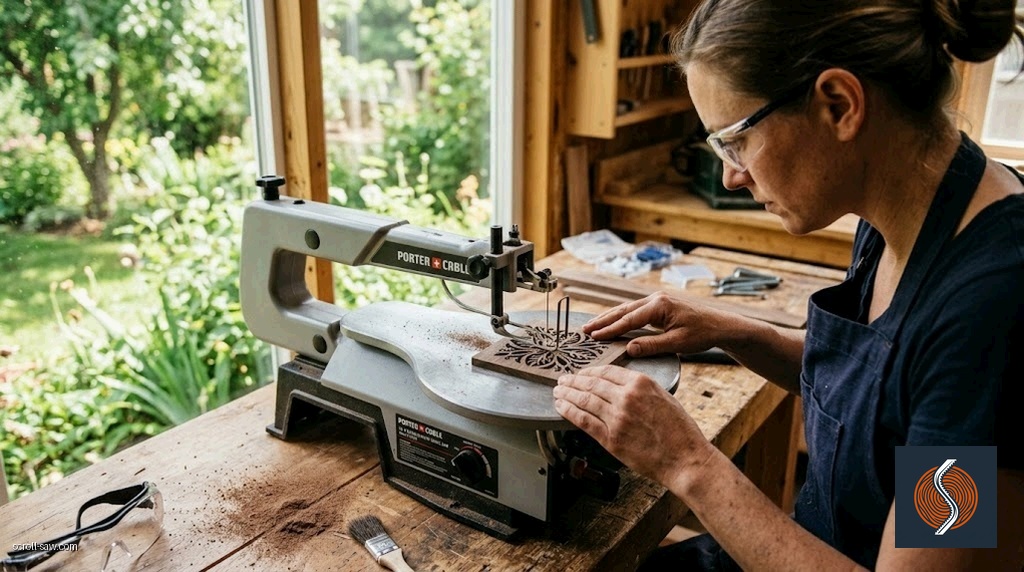
The Porter-Cable 16-inch variable speed scroll saw is a benchtop machine with a 16-inch throat, a variable speed motor ranging roughly from 400 to 1,600 SPM, and a cast-aluminum table that tilts for bevel cuts. It uses standard plain-end scroll saw blades on most units, and an adapter is available for pin-end blades where needed.
The variable speed range is wide enough to cover materials from soft pine to thin brass. That range is the saw’s main practical advantage over single-speed machines in the same size class.
Wood: the primary use case
Most Porter-Cable 16-inch owners cut wood the majority of the time. Wood cutting on this saw follows the same patterns as any scroll saw: match blade to material thickness and hardness, run speed appropriate to the wood, feed lightly and steadily.
Soft wood (pine, poplar, basswood, cedar) 1/4 to 1/2 inch: #5 skip-tooth blade at 1,200 to 1,500 SPM. Feed moderate. Blade life is long and cuts come off clean with minimal sanding.
Soft wood 1/2 to 1 inch: #7 skip-tooth at 1,000 to 1,300 SPM. Slightly lighter feed than thin material because chip volume increases.
Hardwood (oak, maple, cherry, walnut) 1/4 to 1/2 inch: #5 skip-tooth or precision-ground #5 at 900 to 1,100 SPM. Feed light. Precision-ground blades cut with noticeably less operator effort in hardwood.
Hardwood 1/2 to 3/4 inch: #7 precision-ground at 800 to 1,000 SPM. Session length shortens because motor works harder.
Baltic birch plywood 1/8 inch, fine fretwork: #3 reverse-tooth at 1,000 to 1,300 SPM.
Baltic birch 1/4 inch pattern work: #5 reverse-tooth at 1,100 to 1,400 SPM.
Baltic birch 3/8 to 1/2 inch: #7 skip-tooth at 1,000 to 1,200 SPM.
Plastic: acrylic, polycarbonate, PVC
Plastic cuts on a scroll saw only when heat is controlled. Acrylic in particular welds itself back into the kerf if the blade runs too fast or the operator hesitates. Cutting plastic requires slower speeds than wood and continuous, deliberate feed.
Cast acrylic 1/8 inch: #5 skip-tooth at 500 to 800 SPM. Feed slowly and steadily.
Cast acrylic 1/4 inch: #7 skip-tooth at 400 to 700 SPM. A light coat of cutting wax on the blade reduces weld-back.
Extruded acrylic: cuts easier than cast but chips more at the exit face. Use masking tape on the exit face to reduce chipping.
Polycarbonate: cuts similar to acrylic but tolerates slightly higher speeds. Start at 600 to 900 SPM.
PVC (rigid) thin sheet: #5 skip-tooth at 500 to 800 SPM. PVC dust is unpleasant; use dust extraction.
Signs of correct plastic cutting: continuous ribbon shaving from the kerf, clean edge with no melt-back, no chip-out at the exit face.
Signs of incorrect plastic cutting: melt-back into the kerf (speed too high or feed too slow), chip-out at exit face (blade too aggressive), fuzzy edge (blade dull).
Thin metal: brass, copper, aluminum
The Porter-Cable 16-inch is not a metal saw, but its low-speed range makes it capable of occasional thin non-ferrous cuts. Brass, copper, and aluminum up to about 20 gauge (0.032 inch) cut cleanly with the right setup.
Brass sheet up to 20 gauge: metal-cutting pin-end or plain-end blade with 30+ TPI at 400 to 600 SPM. Very slow feed. Cutting wax between passes.
Copper sheet: cuts similar to brass. Copper is softer and tends to gum the blade; wax the blade generously.
Aluminum sheet up to 20 gauge: fine-tooth blade at 500 to 700 SPM. Aluminum cuts cleaner than brass but gums the blade faster.
Signs of correct metal cutting: fine shavings clear the kerf, no galling on the blade, clean cut edge.
Signs of incorrect metal cutting: blade galls (metal welds to teeth), blade dulls rapidly, cut edge is torn rather than sheared.
Metal on a scroll saw takes patience. If metal cutting is a regular need, a jeweler’s saw or a metal bandsaw is the right tool.
Feed technique across materials
Feed pressure on the Porter-Cable 16-inch should be steady, light, and continuous. Regardless of material, the blade does the work. The operator’s job is to keep the workpiece moving.
In wood, the ideal feed produces a continuous ribbon of shaving from the kerf. In plastic, it produces a thin continuous shaving. In metal, it produces fine shavings that clear the kerf.
Hesitation is the enemy across all materials. In wood, hesitation produces burn. In plastic, it produces melt-back. In metal, it produces heat that dulls the blade rapidly.
Blade tension
Correct tension is set by pluck test. A #5 blade under correct tension gives a clear high pluck note. Check tension after every blade change and again ten minutes into any long session.
Blade stock
A working Porter-Cable 16-inch blade drawer:
-
Two dozen #5 skip-tooth plain-end blades (primary, general wood)
-
One dozen #3 reverse-tooth (plywood fretwork)
-
One dozen #7 skip-tooth or precision-ground (thick or hard wood)
-
A few metal-cutting blades in 30+ TPI (occasional metal work)
-
Optional: spirals and precision-ground specialty blades
A dozen pack of Olson skip-tooth blades covers the primary blade slot.
Habits
Detension between sessions.
Brush the blade clamps clean at every blade change.
Match speed to material before starting the cut.
Start the motor before feeding the workpiece.
Use cutting wax on the blade for plastic and metal.
Use dust extraction when cutting PVC or other plastics that produce fine, irritating dust.
When cuts still look wrong
A fresh, correctly sized blade at correct tension in clean clamps at the right speed for the material that still cuts poorly points at a mechanical issue on the saw. Common causes: worn upper arm bearings, loose motor mount bolts, table not perpendicular to the blade, blade clamp jaws worn.
Who this saw fits
The Porter-Cable 16-inch fits the hobbyist or light-professional scroller who cuts a range of materials. Wood is the primary use, plastic and metal are occasional. For that use case, the saw performs well across all three when speed and blade are matched to the material.
FAQ
Can this saw cut metal? Thin non-ferrous sheet, yes. Steel or thick metal, no.
What is the best all-purpose blade? A #5 skip-tooth plain-end.
Why is my acrylic melting back into the kerf? Speed too high or feed too slow. Drop speed and feed continuously.
How thick can this saw cut? About 2 inches at 90 degrees on soft wood.
Does the Porter-Cable 16-inch take pin-end blades? Plain-end is standard. Adapter available for pin-end.
How do I check blade tension? Pluck the blade. Clear high note means correct.
Is dust extraction necessary? For wood, helpful. For PVC and other plastics, yes.
References
-
Olson Saw Company. Plain-end scroll saw blade catalog and material selection.
-
Scroll Saw Village. Speed and feed reference for benchtop scroll saws.
-
Porter-Cable. Scroll saw product and service documentation.
Title tag: Porter-Cable 16 in Scroll Saw: Wood, Plastic, Metal Meta description: Starting points for the Porter-Cable 16-inch variable speed scroll saw across wood, plastic, and thin metal. URL slug: porter-cable-16-in-variable-speed-scroll-saw Excerpt: Blade, speed, and feed starting points for the Porter-Cable 16-inch variable speed scroll saw across wood, plastic, and thin non-ferrous metal.


