
Porter-Cable 18 in Scroll Saw: No Burn, No Wander
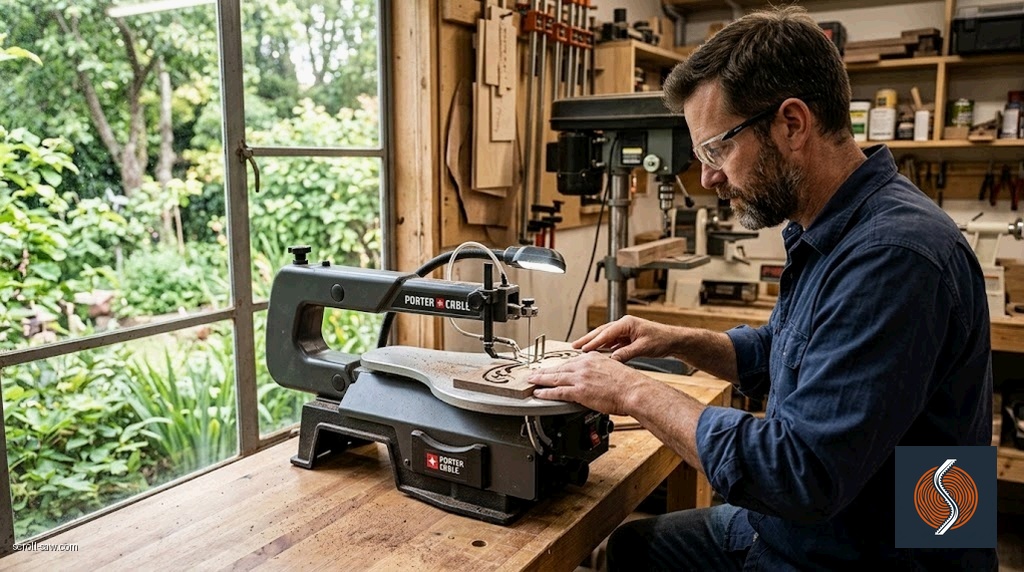
Porter-Cable 18 in Scroll Saw: No Burn, No Wander
Burn stripes along the kerf and blades that wander off the pattern line are the two most common complaints on the Porter-Cable 18-inch 1.6 amp variable speed scroll saw. They look like different problems, but they trace back to the same root cause: the operator has speed, feed, or blade choice out of balance with the material being cut. Getting the three variables lined up fixes both symptoms at the same time.
About the saw
The Porter-Cable 18-inch 1.6 amp variable speed scroll saw is a mid-size benchtop scroll saw with an 18-inch throat, a 1.6 amp motor, variable speed roughly from 400 to 1,600 SPM, and a cast-aluminum tilting table. It uses plain-end scroll saw blades on most units.
The 1.6 amp motor sits between the small hobby-grade motors of Dremel-class saws and the heavier motors of professional saws like the Hegner. That middle position is important: the saw has more power than a small hobby saw in hardwood, less than a professional saw in continuous production, and it rewards operators who match technique to what the motor can actually do.
Where burn comes from
Burn on a scroll saw cut is a scorched stripe along the kerf, usually on the side where the blade dwelled longest. Three causes, in order of likelihood:
Speed too high for the material. At 1,600 SPM in oak, the blade passes through the same cut zone hundreds of times per second. Even a lightly contacting tooth heats the wood to scorch. Drop the speed.
Feed too slow. A hesitating operator lets the blade dwell in one location. The wood at that location heats up. Feed continuously.
Blade dulled. Dull blades skate rather than cut. Friction produces heat. Replace the blade.
On the Porter-Cable 18-inch specifically, burn shows up most often in oak, walnut, maple, and other dense hardwoods. It shows up rarely in pine, poplar, or basswood.
Where blade wander comes from
Blade wander is the cut drifting away from the pattern line. Four causes:
Low tension. An under-tensioned blade bows sideways under feed. Pluck-test after every blade change.
Wrong blade width for the curve. A wide blade forced into a tight curve pushes back sideways.
Feed pressure too high. Pushing harder than the blade can cut forces the blade sideways.
Dull blade. Drifts even under correct tension and feed.
Speed and feed table
Starting points for the Porter-Cable 18-inch 1.6 amp:
| Material | Thickness | Blade | Speed |
|---|---|---|---|
| Baltic birch plywood | 1/8 in | #3 reverse-tooth | 1,000 to 1,300 SPM |
| Baltic birch plywood | 1/4 in | #5 reverse-tooth | 1,100 to 1,400 SPM |
| Baltic birch plywood | 1/2 in | #7 skip-tooth | 1,000 to 1,200 SPM |
| Pine, poplar, basswood | 1/4 to 3/8 in | #5 skip-tooth | 1,200 to 1,500 SPM |
| Pine, poplar, basswood | 1/2 to 1 in | #7 skip-tooth | 1,000 to 1,300 SPM |
| Oak, maple, cherry, walnut | 1/2 in | #5 or #7 precision-ground | 800 to 1,000 SPM |
| Oak, maple, cherry, walnut | 3/4 in | #7 or #9 precision-ground | 700 to 900 SPM |
| Oak, maple, cherry, walnut | 1 in | #9 precision-ground | 600 to 800 SPM |
| Acrylic | 1/8 to 1/4 in | #5 skip-tooth | 500 to 800 SPM |
| Thin brass, aluminum | Up to 20 gauge | Metal-cutting blade | 400 to 600 SPM |
Feed technique
Correct feed on the Porter-Cable 18-inch is steady, light, and continuous. Signs to watch for:
-
Continuous ribbon of shaving from the kerf (correct feed)
-
Motor sound stays consistent under feed (correct feed)
-
Fine dust rather than ribbon (feed too slow or blade dull)
-
Motor drops in pitch under load (feed too fast for material)
-
Blade drifts sideways from pattern line (feed too high or wrong blade)
-
Burn along kerf edge (feed too slow or speed too high)
Blade tension
Pluck-test after every blade change. A #5 plain-end blade under correct tension gives a clear high pluck note. Recheck tension partway through any session running more than 30 minutes.
Small habits
Detension between sessions.
Brush the blade clamps clean at every blade change.
Match speed to material and thickness before starting.
Start the motor before feeding the workpiece.
Feed continuously; hesitation causes burn.
Stock a rotation of three blades: #5 skip-tooth for general work, #3 reverse-tooth for plywood fretwork, #7 skip-tooth or precision-ground for hardwood. Olson makes these in dozen packs at reasonable cost.
When dialing in cannot fix it
A saw that still burns or wanders after correct blade, tension, and speed points at mechanical issues. Check:
-
Loose motor mount bolts
-
Worn upper arm bearings (lateral play)
-
Blade clamp jaws worn or grooved
-
Table not perpendicular to blade at 0 degrees bevel
Who this saw fits
The Porter-Cable 18-inch 1.6 amp fits the hobbyist or light-professional scroller cutting pattern work regularly in wood up to about 1 inch thick. It handles hardwood better than smaller saws and it has enough throat for larger pattern pieces.
It does not fit continuous production hardwood cutting; a heavier saw handles that use.
FAQ
Why does my scroll saw burn oak? Speed too high or feed too slow. Drop speed to 800 to 1,000 SPM and feed continuously.
Why does my blade wander? Low tension, wrong blade width, or too much feed pressure.
What is the best all-purpose blade? A #5 skip-tooth plain-end.
How thick can this saw cut? About 2 inches at 90 degrees on soft wood.
Does this saw take pin-end blades? Plain-end is standard. Adapter available.
How do I check blade tension? Pluck the blade. Clear high note means correct.
Is precision-ground worth the price? In hardwood over 1/2 inch, yes.
References
-
Olson Saw Company. Plain-end scroll saw blade catalog and material selection.
-
Scroll Saw Village. Speed and feed reference for benchtop scroll saws.
-
Porter-Cable. Scroll saw product and service documentation.
Title tag: Porter-Cable 18 in Scroll Saw: No Burn, No Wander Meta description: Dial in the Porter-Cable 18-inch 1.6 amp scroll saw to eliminate burn and blade wander through speed, feed, and blade choice. URL slug: porter-cable-18-in-1-6-amp-variable-speed-scroll-saw Excerpt: Burn and wander on the Porter-Cable 18-inch 1.6 amp scroll saw come from the same three variables. A dial-in guide for speed, feed, and blade selection across wood, plastic, and metal.


