
Rockwell 40-440 Scroll Saw Blades: Size and Material
Rockwell 40-440 Scroll Saw Blades: Size and Material
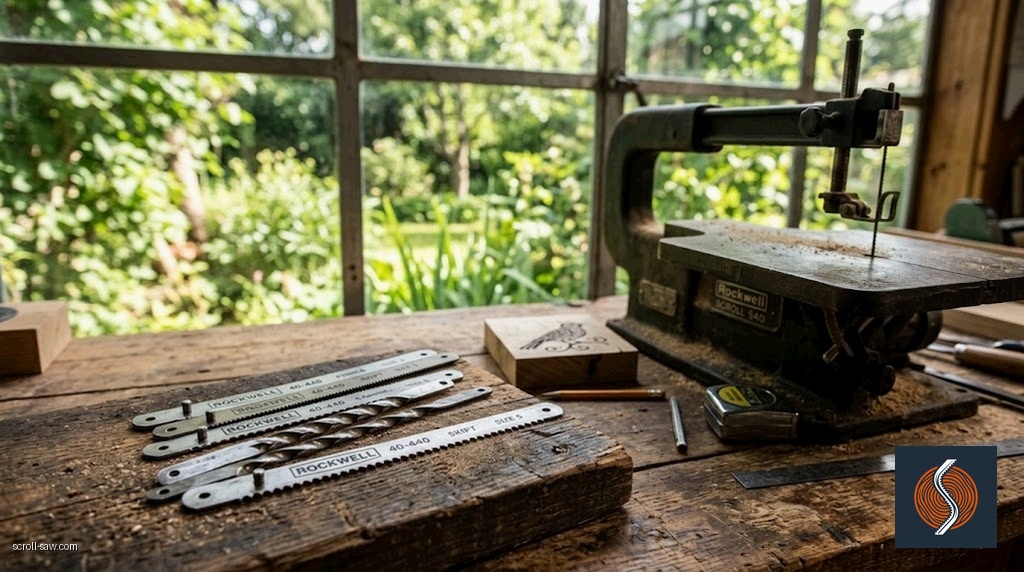
The Rockwell 40-440 is a piece of scroll saw history. Sold in the 1960s and 1970s under Rockwell’s power tool line (later Delta after Rockwell exited the tool business), the 40-440 was a serious benchtop scroll saw for its era. Cast-iron construction, heavy-duty motor, precision blade clamps. The saws still turn up in workshops, and owners who have inherited or restored them run into the same question: which blades fit today, and how do modern blades compare with what Rockwell shipped in the 1970s?
The answer depends on which version of the 40-440 you have. Some units shipped with pin-end blade clamps. Others were sold with plain-end clamps. Check your specific saw before ordering blades.
Blade format
The Rockwell 40-440 uses 5-inch scroll saw blades. That is the length in both pin-end and plain-end configurations.
Pin-end clamps: cross-drilled holes on either side of the clamp. Blades have pins at the ends that seat into these holes.
Plain-end clamps: flat slots with a set screw or cam grip that holds the blade body directly.
Either configuration takes modern 5-inch blades of the matching format.
Size
Blade width, thickness, and kerf vary by blade number:
-
#2/0 to #2: narrow, 0.020 to 0.028 inch wide, kerf 0.022 to 0.028 inch, minimum radius 1/32 to 1/16 inch
-
#3 to #5: medium, 0.030 to 0.038 inch wide, kerf 0.030 to 0.035 inch, minimum radius 3/32 to 1/8 inch
-
#7 to #9: wide, 0.045 to 0.055 inch wide, kerf 0.045 to 0.055 inch, minimum radius 3/16 to 1/4 inch
Wider blades hold straight lines better in thick material. Narrower blades turn tighter curves.
The 40-440’s cast-iron construction gives the saw excellent rigidity, which means blade choice matters more than saw setup for cut quality. A well-tensioned 40-440 with the right blade produces cuts as clean as any modern hobby saw and cleaner than many.
Tooth geometry
Standard configurations available in both pin-end and plain-end for the 40-440:
Standard tooth: all teeth cutting on the down-stroke. Basic and inexpensive.
Skip tooth: alternate teeth removed for chip clearance. The workhorse configuration.
Reverse tooth: bottom teeth reversed to clean the exit face. Excellent for plywood work.
Precision ground: teeth ground rather than milled. Sharper, longer-lasting, more expensive.
Spiral: teeth wrap around the blade for all-directions cutting. Specialty use.
Metal cutting: high TPI for thin non-ferrous sheet.
In plain-end format specifically, additional geometries are available including Pegas Modified Geometry (MGT), reverse-tooth in the fine sizes, and ultra-fine fretwork blades. Plain-end 40-440 owners have wider blade selection than pin-end owners.
Material guide
Baltic birch 1/8 inch, fine fretwork: #3 reverse-tooth at 1,000 to 1,300 SPM.
Baltic birch 1/4 inch pattern work: #5 reverse-tooth or #5 skip-tooth at 1,100 to 1,400 SPM.
Baltic birch 1/2 inch: #7 skip-tooth at 1,000 to 1,200 SPM.
Soft wood 1/4 to 1/2 inch: #5 skip-tooth at 1,200 to 1,400 SPM.
Soft wood 1/2 to 1 inch: #7 skip-tooth at 1,000 to 1,300 SPM.
Hardwood 1/2 inch: #5 or #7 precision-ground at 900 to 1,100 SPM.
Hardwood 3/4 to 1 inch: #7 or #9 precision-ground at 700 to 900 SPM. The 40-440’s cast-iron rigidity handles thick hardwood well.
Acrylic 1/8 to 1/4 inch: #5 skip-tooth at 500 to 800 SPM.
Thin non-ferrous metal: metal-cutting blade at minimum speed.
Where to buy
Olson makes 5-inch scroll saw blades in both pin-end and plain-end formats. A dozen pack of Olson skip-tooth blades covers general work; add reverse-tooth and precision-ground packs for specialty needs.
For premium specialty blades, Pegas (through Bear Woods), Flying Dutchman (through Sloan’s Woodshop), and Niqua are all available.
The 40-440 advantage
The Rockwell 40-440’s cast-iron construction gives the saw two advantages over most modern benchtop saws: rigidity and vibration damping.
Rigidity means the arm holds its position through the blade stroke. Precision-ground blades and fine fretwork blades benefit from this because the blade tracks its intended path without arm flex.
Vibration damping means the saw runs quieter and the cut is smoother. Cast iron absorbs vibration that a lighter aluminum casting would transmit.
A well-maintained 40-440 can outperform many current mid-price benchtop saws for pattern work. The saw’s age is not a limitation for hobby use.
Small habits
Detension between sessions.
Brush the clamps clean at every blade change.
Store blades flat in a divided case.
Wipe the cast-iron table with a light coat of paste wax annually to prevent rust.
Oil the arm pivot at the intervals specified in the owner’s manual (typically annually for hobby use).
Who this saw fits
The 40-440 fits the owner who has one, appreciates its build quality, and wants to keep using it for pattern work. It is not a saw to seek out on the used market unless you know what you are buying and can service it yourself; the market for parts is limited.
For its owners, it is often the last scroll saw they will ever need to buy.
FAQ
What blades fit the Rockwell 40-440? 5-inch scroll saw blades. Check whether your unit has pin-end or plain-end clamps.
Are parts still available for the 40-440? Blades and consumables, yes. Mechanical parts require sourcing from used stock or specialty repairers.
How thick can this saw cut? About 2 inches at 90 degrees on soft wood, more in some models.
Is the 40-440 worth restoring? For hobby use, yes. The cast-iron construction outlasts most modern saws.
Do I need Rockwell-branded blades? No. Any quality 5-inch scroll saw blade of the correct format fits.
How long does a blade last? 30 to 60 minutes of continuous cutting on typical hobby material.
Is the 40-440 quieter than modern saws? Yes, notably. Cast iron damps vibration.
References
-
Olson Saw Company. Scroll saw blade catalog for both pin-end and plain-end formats.
-
Rockwell/Delta legacy parts documentation via ManualsLib.
-
Scroll Saw Woodworking & Crafts forum. Classic scroll saw restoration and use discussions.
Title tag: Rockwell 40-440 Scroll Saw Blades: Size and Material Meta description: Blade size, tooth geometry, and material guide for the Rockwell 40-440 vintage scroll saw. Pin-end and plain-end options. URL slug: rockwell-40-440-scroll-saw-blades Excerpt: Blade selection for the Rockwell 40-440 vintage scroll saw. Size, tooth geometry, and material matching for a cast-iron saw that outlasts most modern hobby machines.


