
Ryobi 16 Inch Variable Speed Scroll Saw: Materials
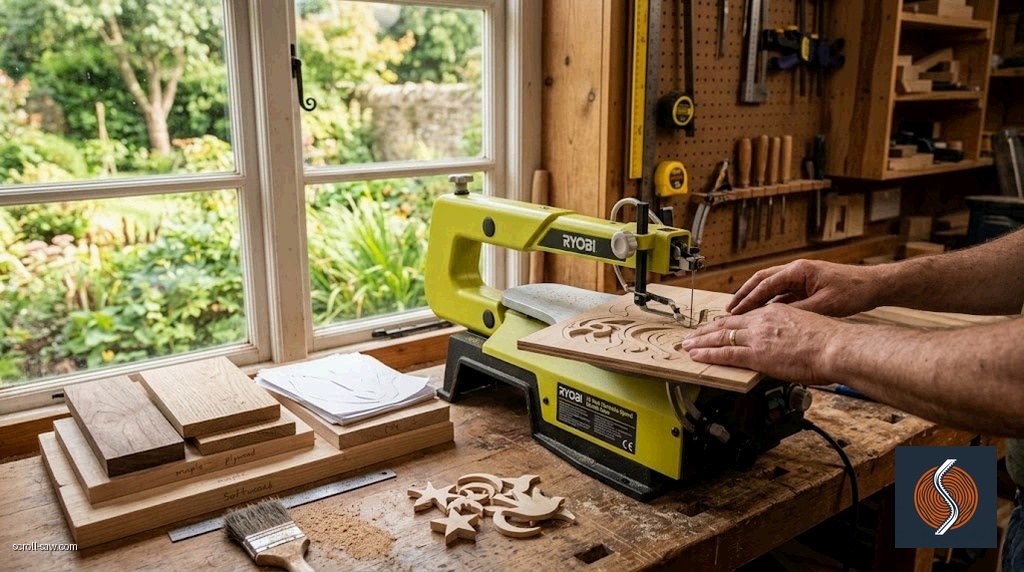
Ryobi 16 Inch Variable Speed Scroll Saw: Materials
A variable speed scroll saw earns its extra cost by handling more than one material. The Ryobi 16-inch variable speed scroll saw does that well when the operator learns the starting points for each material. Wood at one speed, plastic at another, thin metal at another. The saw itself is capable across all three; the operator’s speed choice, blade selection, and feed technique are what change.
This guide covers the starting points on the Ryobi 16-inch variable speed. Wood is the primary use. Plastic and metal are occasional but doable when the setup is right.
The saw
The Ryobi 16-inch variable speed scroll saw has a 16-inch throat, a variable speed motor ranging roughly from 550 to 1,650 SPM depending on model year, and a cast-aluminum tilting table. It uses standard plain-end scroll saw blades on most current models.
The wide speed range is the main practical feature. It lets one saw serve for pattern work in wood, for occasional plastic cutting, and for thin non-ferrous metal.
Wood: the primary use
Wood makes up the majority of most Ryobi 16 owners’ cutting.
Soft wood (pine, poplar, basswood) 1/4 to 1/2 inch: #5 skip-tooth plain-end at 1,200 to 1,500 SPM. Moderate feed.
Soft wood 1/2 to 1 inch: #7 skip-tooth at 1,000 to 1,300 SPM.
Hardwood (oak, maple, cherry, walnut) 1/4 to 1/2 inch: #5 or precision-ground #5 at 900 to 1,100 SPM. Light feed.
Hardwood 1/2 to 3/4 inch: #7 precision-ground at 800 to 1,000 SPM.
Baltic birch plywood 1/8 inch fretwork: #3 reverse-tooth at 1,000 to 1,300 SPM.
Baltic birch 1/4 inch pattern work: #5 reverse-tooth at 1,100 to 1,400 SPM.
Baltic birch 3/8 to 1/2 inch: #5 or #7 skip-tooth at 1,000 to 1,200 SPM.
Plastic
Plastic cutting on a scroll saw requires low speed and steady, continuous feed. Heat is the enemy.
Cast acrylic 1/8 inch: #5 skip-tooth at 500 to 800 SPM. Cast acrylic cuts cleaner than extruded.
Cast acrylic 1/4 inch: #7 skip-tooth at 400 to 700 SPM. Cutting wax on the blade helps prevent weld-back.
Extruded acrylic: cuts easier than cast but chips at exit face. Masking tape on the exit face reduces chip-out.
Polycarbonate: 600 to 900 SPM.
PVC sheet: 500 to 800 SPM. PVC dust is unpleasant; use dust extraction.
Signs of correct plastic cutting: continuous thin shaving from the kerf, clean edge with no melt-back.
Signs of incorrect plastic cutting: melt-back into kerf (speed too high or feed too slow), chip-out (blade too aggressive).
Thin metal
The Ryobi 16 is not a metal saw but it handles occasional thin non-ferrous work.
Brass or copper up to 20 gauge: metal-cutting blade with 30+ TPI at 400 to 600 SPM. Very slow feed. Cutting wax between passes.
Aluminum up to 20 gauge: fine-tooth blade at 500 to 700 SPM.
Metal cutting is occasional on this saw. For regular metal work, a jeweler’s saw or metal bandsaw is right.
Feed technique
Correct feed on the Ryobi 16 is steady, light, and continuous. The blade does the work. Signs to watch:
-
Continuous ribbon shaving (correct feed in wood)
-
Fine dust rather than ribbon (blade dull or feed too slow)
-
Motor pitch drop (feed too fast for material)
-
Blade drifts sideways (wrong blade or tension low)
-
Burn along kerf (speed too high or feed too slow)
Blade tension
Pluck-test after every blade change. A #5 plain-end blade at correct tension gives a clear high pluck note. Recheck partway through long sessions.
Blade stock
-
Two dozen #5 skip-tooth plain-end (primary)
-
One dozen #3 reverse-tooth (plywood fretwork)
-
One dozen #7 skip-tooth or precision-ground (thick or hard)
-
A few metal-cutting blades
Olson plain-end scroll saw blades in dozen packs cover the primary slot at reasonable cost.
Habits
Detension between sessions.
Brush the clamps clean at every blade change.
Match speed to material before starting.
Start the motor before feeding.
Use cutting wax for plastic and metal.
Use dust extraction for plastic and PVC.
When cuts still look wrong
Mechanical issues that cause bad cuts on a Ryobi 16: worn upper arm bearings, loose motor mount, table not square to blade, worn blade clamp jaws.
Who this saw fits
The Ryobi 16-inch variable speed fits the hobbyist cutting pattern work across materials. Wood is the primary use, with plastic and metal occasional. It is not a production saw.
FAQ
Can this saw cut metal? Thin non-ferrous only.
What is the best all-purpose blade? A #5 skip-tooth plain-end.
Why is my acrylic melting? Speed too high or feed too slow.
How thick can this saw cut? About 2 inches at 90 degrees on soft wood.
Does it take pin-end blades? Plain-end is standard; check your specific unit.
How long does a blade last? 30 to 60 minutes of continuous cutting.
Is dust extraction necessary? Helpful for wood, needed for plastic and PVC.
References
-
Ryobi Power Tools. Scroll saw product documentation.
-
Olson Saw Company. Plain-end scroll saw blade catalog.
-
Scroll Saw Village. Speed and feed reference for benchtop saws.
Title tag: Ryobi 16 Inch Variable Speed Scroll Saw: Materials Meta description: Starting points for the Ryobi 16-inch variable speed scroll saw across wood, plastic, and thin metal. URL slug: ryobi-16-inch-variable-speed-scroll-saw Excerpt: Blade, speed, and feed starting points for the Ryobi 16-inch variable speed scroll saw across wood, plastic, and thin non-ferrous metal.


