
WEN 16 Two Direction Variable Speed Scroll Saw Setup
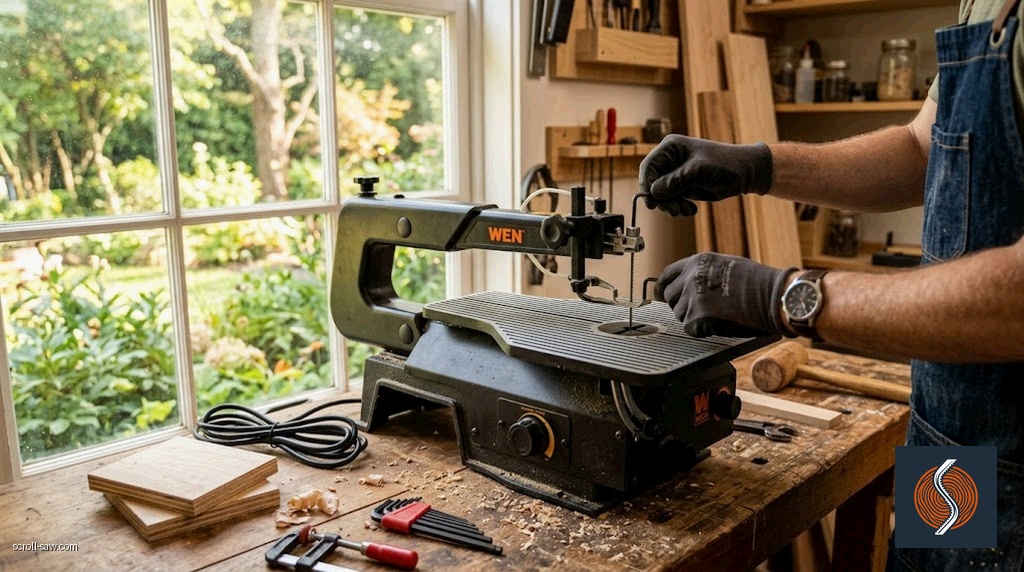
WEN 16 Two Direction Variable Speed Scroll Saw Setup
WEN’s 16-inch scroll saws have earned a spot in a lot of home shops because they hit an unusual price-to-feature ratio. Variable speed, two direction cutting (the blade can be rotated 90 degrees for cross-cutting long stock), tool-free blade change, and a cast-iron base, all in a package that costs less than most competing benchtop saws. The tradeoff is that the motor is modest and the machine rewards careful setup rather than forgiving mistakes.
Getting the WEN 16 to cut well is a matter of matching blade, speed, and feed to what is under the blade. That is true of every scroll saw, but the WEN’s smaller motor makes the matching more important; forcing the saw through material at wrong settings produces exactly the poor-quality complaints that show up in online reviews.
About the saw
The WEN 16-inch two direction variable speed scroll saw (the 3921 and closely related models) has a 16-inch throat, a 1.2 amp motor, variable speed roughly from 400 to 1,600 SPM, and a cast-iron base. It uses standard 5-inch plain-end scroll saw blades with tool-free clamps.
The two-direction cutting feature lets the operator rotate the blade 90 degrees to cross-cut long stock. That is unusual for a benchtop saw and it opens up work that would otherwise require a bandsaw or table saw.
Before starting
Check the saw’s condition. Work the tension mechanism through its range with no blade installed. Look for lateral play in the upper arm. Brush the blade clamps clean. The WEN’s tool-free clamps in particular collect dust that prevents uniform blade grip.
Soft wood: pine, poplar, basswood
Soft wood is where the WEN 16 is happiest.
1/8 to 3/8 inch: #5 skip-tooth at 1,200 to 1,500 SPM. Moderate feed.
1/2 to 3/4 inch: #7 skip-tooth at 1,000 to 1,300 SPM.
1 inch and thicker: #9 skip-tooth at 800 to 1,000 SPM. Practical upper limit for the motor.
Hardwood
Under 1/2 inch hardwood: #5 skip-tooth or precision-ground #5 at 900 to 1,100 SPM. Light feed.
1/2 to 3/4 inch hardwood: #7 precision-ground at 800 to 1,000 SPM. Session length shortens; the motor works harder.
Over 3/4 inch hardwood: within capacity but push the motor lightly. Precision-ground blades reduce load noticeably.
Plywood
Baltic birch 1/8 inch: #3 reverse-tooth at 1,000 to 1,300 SPM.
Baltic birch 1/4 inch: #5 reverse-tooth at 1,100 to 1,400 SPM.
3/8 to 1/2 inch plywood: #5 or #7 skip-tooth at 1,000 to 1,200 SPM.
Acrylic
Cast acrylic 1/8 inch: #5 skip-tooth at 500 to 800 SPM.
Cast acrylic 1/4 inch: #7 skip-tooth at 400 to 700 SPM with cutting wax.
Thin metal
Occasional only. Brass or copper 20 gauge with metal-cutting blade at 400 to 600 SPM.
Blade stock
-
Two dozen #5 skip-tooth plain-end (primary)
-
One dozen #3 reverse-tooth (plywood fretwork)
-
One dozen #7 skip-tooth or precision-ground (thicker/harder)
Olson plain-end scroll saw blades in dozen packs cover the primary slot at reasonable cost.
Feed technique
Steady, light, continuous. The WEN’s modest motor especially rewards light feed. Motor pitch drop under load means feed too fast; back off.
Blade tension
Pluck-test after every blade change. Clear high note for a #5 blade. The WEN’s tension mechanism drifts slightly during long sessions; recheck partway through.
The two-direction feature
Rotating the blade 90 degrees lets the operator feed long stock across the throat rather than into it. This helps for cross-cutting boards longer than the throat depth or for controlled cuts on stock that would otherwise pivot on the small table.
Set the blade rotation with the saw unplugged. Verify tension and blade square after rotation before returning to work.
Small habits
Detension between sessions.
Brush the clamps clean at every blade change.
Start the motor before feeding.
Match speed to material.
Use cutting wax for plastic and metal.
Bolt the saw to a stable bench; the WEN’s cast base is heavy for a benchtop, but bolting eliminates the last bit of vibration.
Who this saw fits
The WEN 16 fits budget-conscious hobby scrollers who want variable speed and cast-iron construction at low price. It does not fit continuous production or heavy hardwood work.
FAQ
What is the two-direction feature? Blade rotates 90 degrees for cross-cutting long stock.
Best all-purpose blade? #5 skip-tooth plain-end.
How thick can it cut? About 2 inches at 90 degrees on soft wood.
Can it cut hardwood? Up to 3/4 inch cleanly.
How long does a blade last? 30 to 60 minutes of continuous cutting.
Are WEN-branded blades required? No. Any quality 5-inch plain-end blade fits.
Is dust extraction needed? Helpful for wood, required for plastics.
References
-
WEN Products. 3921 scroll saw product documentation.
-
Olson Saw Company. Plain-end scroll saw blade catalog.
-
Scroll Saw Village. Speed and feed reference.
Title tag: WEN 16 Two Direction Variable Speed Scroll Saw Setup Meta description: Material-by-material setup for the WEN 16-inch two-direction variable speed scroll saw. Wood, plywood, acrylic, and thin metal. URL slug: wen-16-inch-two-direction-variable-speed-scroll-saw Excerpt: A practical setup guide for the WEN 16-inch two-direction variable speed scroll saw. Blade, speed, and feed for clean cuts across common hobby materials.


