
Delta Scroll Saw Blade Clamp: Match Blade to Work
Delta Scroll Saw Blade Clamp: Match Blade to Work
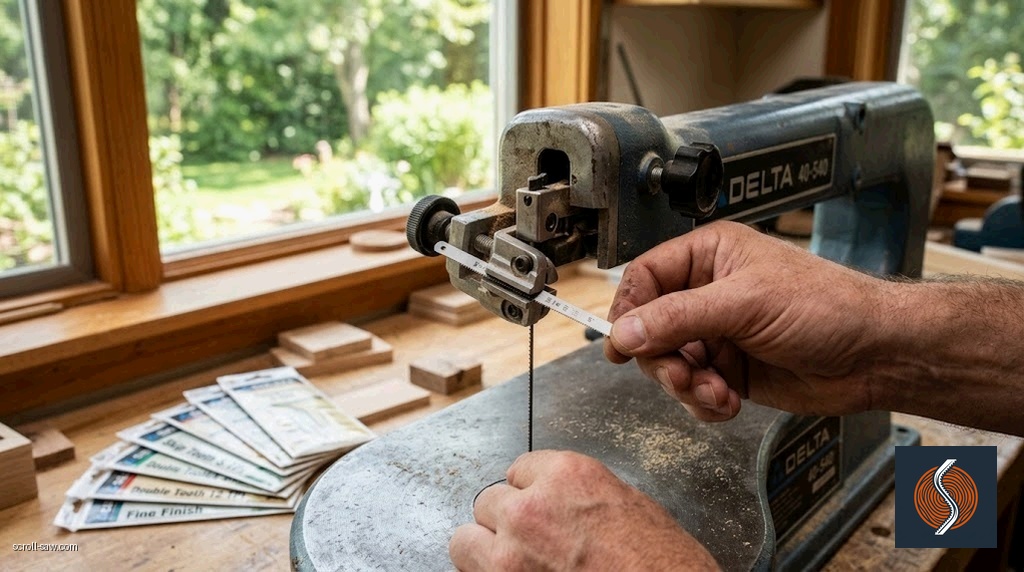
The blade clamp on a Delta scroll saw is the piece that decides whether the blade cuts well or wanders. The clamp holds the blade at each end, transmits tension from the arm, and keeps the blade square through the stroke. When it works, it disappears. When it drifts out of adjustment or wears at the gripping face, cut quality follows.
Delta scroll saws over the decades have used several clamp designs. Older Delta and Rockwell 40-series saws used set-screw clamps with C-shaped fixtures. Newer Delta scroll saws use cam-lever clamps or tool-free thumb clamps. Some Delta units accept both pin-end and plain-end blades through swappable clamp components.
Regardless of clamp style, choosing the right blade for the material is the same question. Blade number sets width, kerf, and TPI, and those three parameters determine how the blade cuts in the material under it.
Blade number basics
Scroll saw blade numbering runs from #2/0 (very fine) up through #12 (very coarse). For most hobby work:
-
#2/0 to #2: 0.020 to 0.028 inch wide, 20 to 25 TPI. Very fine fretwork.
-
#3: 0.030 inch wide, 18 TPI. Fine pattern work.
-
#5: 0.038 inch wide, 12.5 TPI. General purpose.
-
#7: 0.045 inch wide, 11.5 TPI. Thicker or harder material.
-
#9: 0.055 inch wide, 11 TPI. Thick soft wood or hardwood.
-
#12: 0.062 inch wide, 9 TPI. Heavy stock.
Each step wider holds a straighter line and cuts thicker material but requires broader curves.
Matching blade number to material
Baltic birch 1/8 inch: #3 reverse-tooth. Fine teeth, narrow kerf, tight curves.
Baltic birch 1/4 inch: #5 reverse-tooth or #5 skip-tooth. Workhorse for plywood pattern work.
Baltic birch 3/8 to 1/2 inch: #7 skip-tooth. Wider blade holds line in thicker material.
Soft wood (pine, poplar, basswood) 1/4 to 1/2 inch: #5 skip-tooth.
Soft wood 1/2 to 1 inch: #7 skip-tooth. Chip clearance matters in thicker stock.
Soft wood 1 inch and thicker: #9 skip-tooth. The Delta’s capacity handles this depending on the specific model.
Hardwood (oak, maple, cherry, walnut) 1/4 to 1/2 inch: #5 precision-ground or standard skip-tooth. Precision-ground reduces feed pressure.
Hardwood 1/2 to 3/4 inch: #7 precision-ground.
Hardwood 3/4 to 1 inch: #9 precision-ground.
Cast acrylic 1/8 to 1/4 inch: #5 skip-tooth at low speed with cutting wax.
Thin non-ferrous metal: metal-cutting blade with 30+ TPI at minimum speed.
Matching blade to cut radius
Blade width sets minimum turning radius. Match blade width to the tightest inside curve in the pattern.
-
Curves under 1/16 inch: #2 or #2/0 blade.
-
Curves 1/16 to 1/8 inch: #3 blade.
-
Standard pattern curves (1/8 inch or wider): #5 blade.
-
Broad curves and straight cuts: #7 or wider.
A blade wider than the pattern curve pushes back sideways and drifts. A narrower blade turns the curve but wears faster in the thick sections of the cut.
Blade clamp habits on Delta saws
The blade clamp is a wear item. Habits extend clamp life and keep cut quality up:
Brush the clamp faces clean at every blade change. Dust prevents uniform grip.
Check the clamp faces for grooves. Fine grooves clean up with steel wool. Deep grooves indicate the clamp needs replacement.
Do not overtighten set-screw clamps. The screw should grip the blade solidly without deforming the blade body. Overtightening grooves the clamp face faster and can crush the blade at the clamp point.
Detension between sessions. Blades held under tension continuously stress the clamp at the gripping point.
Replace clamps when worn. Delta parts are available through DeWalt Service (which handles legacy Delta service in some regions) and through independent Delta parts specialists.
Blade stock recommendation
A working Delta scroll saw blade drawer:
-
Two dozen #5 skip-tooth in the format your saw uses (pin-end or plain-end)
-
One dozen #3 reverse-tooth
-
One dozen #7 skip-tooth or precision-ground
-
Optional specialty blades (spirals, ultra-fine)
A dozen pack of Olson skip-tooth scroll saw blades covers the primary slot at reasonable cost.
When cut quality drops
Blade clamp wear is one of several causes of cut quality drop on a Delta scroll saw. Work through in order: blade, tension, clamps, arm, motor, table.
If the blade is fresh and correctly tensioned but the cut still wanders, the clamp is a likely suspect. Grooved clamp faces let the blade shift under load, producing wander that no amount of blade adjustment fixes.
FAQ
What blade clamp does my Delta scroll saw use? Depends on the model. Older Delta and Rockwell 40-series use set-screw clamps. Newer Delta saws use cam levers or tool-free clamps.
Can I convert pin-end clamps to plain-end? On some Delta models yes, through swappable clamp components. Check your specific saw.
How often should I replace the clamp? When the gripping face develops deep grooves or when the clamp does not close consistently.
Best all-purpose blade number? #5 in the tooth style suited to your material.
How do I check tension? Pluck the blade with a fingernail. Clear high note means correct.
Do clamp replacements require special tools? No, hand tools handle most Delta clamp replacements.
Are old Delta clamps still available? Parts availability varies by model. Some remain available, others require sourcing from used stock.
References
-
Olson Saw Company. Scroll saw blade catalog and clamp compatibility notes.
-
Delta Power Equipment via DeWalt Service Network.
-
Scroll Saw Woodworking & Crafts forum. Delta clamp discussion archive.
Title tag: Delta Scroll Saw Blade Clamp: Match Blade to Work Meta description: Match blade number to material and thickness on Delta scroll saws. Blade clamp basics and blade selection. URL slug: delta-scroll-saw-blade-clamp Excerpt: How to match scroll saw blade number to material and thickness on Delta scroll saws. Blade clamp compatibility, blade selection, and clamp maintenance.


