
Porter-Cable Scroll Saw with Stand: Choosing Right
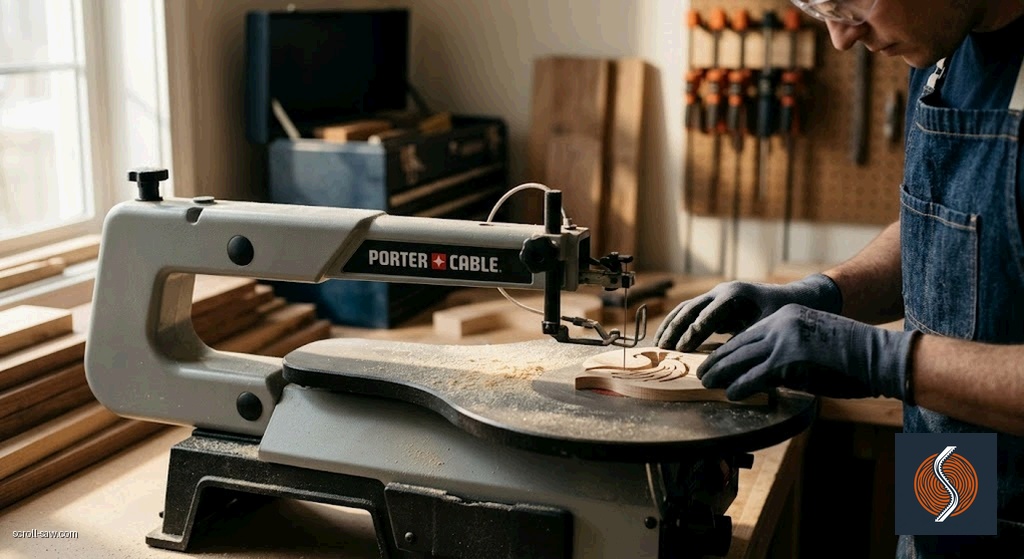
Porter-Cable Scroll Saw with Stand: Choosing Right
A scroll saw on a wobbly bench is a scroll saw that never quite cuts right. Vibration transfers from the saw to whatever surface it sits on, and if that surface flexes, the blade oscillates at frequencies the operator can feel through the workpiece. Getting rid of that vibration usually means adding weight, adding rigidity, or ideally both. A dedicated stand is the practical answer.
Porter-Cable has offered a few stand options over the years, and third-party stands fit the Porter-Cable line as well as they fit any comparable benchtop saw. The choice depends on the specific Porter-Cable model, on how the operator uses the saw, and on how much shop space the setup can occupy.
Why a stand matters
Benchtop scroll saws in the Porter-Cable class weigh 30 to 50 pounds. On a stable workbench, that weight is enough to stay put during normal cutting. On a folding table or a lightly built bench, the saw’s own vibration walks it around and the operator ends up chasing the saw as much as feeding the workpiece.
A stand solves this by giving the saw a permanent, stable base. Purpose-built stands add mass (often through a steel frame or a sand-filled tube) that damps vibration. Some include storage for blades and accessories.
The cost of a scroll saw stand runs from about half of the saw’s cost for a lightweight metal-frame stand up to nearly the saw’s cost for a heavy commercial stand.
Types of stands
Manufacturer-branded stands: Porter-Cable and other saw makers sell dedicated stands designed for their machines. Fit and appearance match the saw. Availability varies with production runs.
Universal metal-frame stands: adjustable height, adjustable width, fits a range of benchtop saws. Common brands: Rockler, Grizzly, generic import.
Cabinet-style stands: enclosed base with storage inside. More expensive but consolidates blade and accessory storage with the saw location.
Shop-built stands: many owners build stands from 2x4 lumber or plywood. Well-built shop stands can outperform commercial stands for stability at low cost.
Mobile stands with casters: for shops where the saw needs to move. Casters reduce stability slightly but the flexibility outweighs the tradeoff in mixed-use shops.
Matching stand to workflow
Continuous scroll work in a dedicated shop: heavy fixed stand or shop-built base. Stability comes first.
Occasional scroll work in a mixed-use shop: mobile stand with casters. The saw stays out of the way when not in use.
Small shop with limited space: cabinet-style stand with storage. Consolidates blade and pattern storage.
Portable setup (classes, demonstrations): lighter manufacturer-branded stand that breaks down or moves easily.
Height matters
Scroll saws work best at a height where the operator can look down at the pattern line without leaning. That is roughly elbow height when standing, or shoulder height when seated on a shop stool.
Most commercial stands set the saw table between 34 and 38 inches. Adjustable-height stands are worth the small extra cost because scrollers often shift between standing and seated work over long sessions.
Bolting the saw down
Regardless of stand type, bolt the saw to the stand. Bolts through the saw’s base castings into the stand top eliminate the last bit of vibration and prevent the saw from walking during aggressive feed.
Use the bolt pattern in the saw’s base. Rubber or cork washers between the saw and the stand top damp vibration slightly and protect the base castings from stand top irregularities.
Foot switches
A stand-mounted or floor foot switch is not required but improves safety and workflow. The operator can start and stop the saw hands-free, which matters when a blade change or workpiece repositioning is needed mid-cut.
Foot switches are inexpensive and wire between the saw and its power source.
Dust extraction
Most scroll saws have a dust extraction port. On a stand, running a hose from the port to a shop vacuum keeps the cut area visible and the shop cleaner. Some cabinet-style stands include dust collection routing built in.
Accessories that live on the stand
A properly outfitted scroll saw stand carries:
-
Divided blade storage case
-
Cutting wax
-
Small square for blade-to-table checks
-
Feather sticks or hold-downs
-
Pattern storage folder
-
Dust brush
Consolidated accessories mean the operator does not walk across the shop for every blade change.
Blade recommendation for the Porter-Cable line
Regardless of stand choice, the blade rotation for a Porter-Cable scroll saw follows the same pattern:
-
Two dozen #5 skip-tooth plain-end (primary)
-
One dozen #3 reverse-tooth (plywood fretwork)
-
One dozen #7 skip-tooth or precision-ground (thicker or harder wood)
Olson plain-end scroll saw blades in dozen packs cover the primary slot at reasonable cost.
FAQ
Does Porter-Cable sell a stand for their scroll saws? Availability varies. Check current Porter-Cable product listings.
Will a universal stand fit a Porter-Cable scroll saw? Most universal metal-frame stands fit the Porter-Cable benchtop line.
How heavy should a scroll saw stand be? As heavy as your shop can accommodate. More weight means less vibration.
Do I need a stand? On a stable workbench, no. On anything lighter, yes.
Should I bolt the saw to the stand? Yes.
What height should the saw table be? Elbow height when standing or shoulder height when seated.
Does a stand include dust extraction? Some do. Check specific stand features.
References
-
Porter-Cable. Scroll saw product and accessory documentation.
-
Rockler. Scroll saw stands and accessories.
-
Scroll Saw Woodworking & Crafts forum. Shop setup and stand discussions.
Title tag: Porter-Cable Scroll Saw with Stand: Choosing Right Meta description: Match a Porter-Cable scroll saw stand to your workflow. Types, heights, and workflow considerations. URL slug: porter-cable-scroll-saw-with-stand Excerpt: Choosing a stand for a Porter-Cable scroll saw. Types, heights, workflow fit, and accessories that make a difference.


