
Sears Craftsman Scroll Saw Blades: TPI and Kerf
Sears Craftsman Scroll Saw Blades: TPI and Kerf
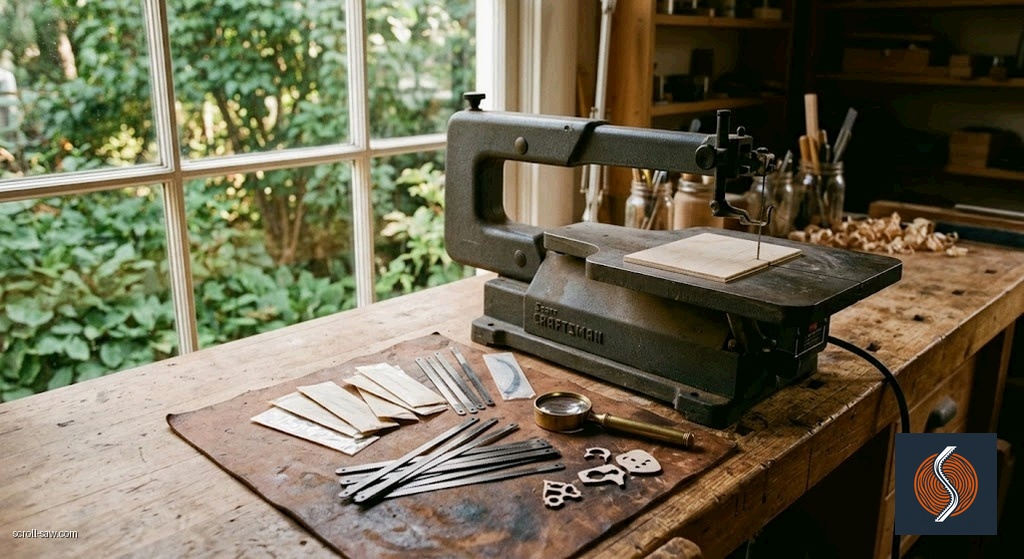
Sears Craftsman scroll saws were the standard American home shop scroll saw for a long stretch of the 20th century. They came with a small pack of blades in the box, a manual that told you how to change them, and no real guide to which blades were right for which cuts. Most owners figured out blade selection through trial and error over years.
This guide condenses that trial-and-error learning into a reference organized around four practical parameters: TPI, kerf, minimum turning radius, and finish quality. Any scroll saw blade can be characterized by these four numbers, and knowing them tells you what a blade will do before you cut with it.
The guide applies to any Sears Craftsman scroll saw that uses standard 5-inch blades in either pin-end or plain-end format.
TPI: teeth per inch
TPI is teeth per inch of blade length. More teeth means finer cuts. Fewer teeth means faster cuts and better chip clearance.
#2/0 blades: 25 TPI. Very fine cuts, slow.
#2 blades: 20 TPI. Fine cuts.
#3 blades: 18 TPI.
#5 blades: 12.5 TPI. Workhorse.
#7 blades: 11.5 TPI.
#9 blades: 11 TPI. Aggressive cuts in thick material.
#12 blades: 9 TPI. Very aggressive.
Metal-cutting blades: 30 to 50 TPI. High TPI matches thin metal.
Higher TPI leaves a finer surface finish. Lower TPI leaves a rougher surface but cuts faster and with less feed pressure.
Kerf: the width of material the blade removes
Kerf is the width of the cut. Wider blade means wider kerf, though the relationship is not exactly linear because tooth set adds slightly to the effective kerf.
Approximate kerf values:
#2/0: 0.022 inch
#3: 0.030 inch
#5: 0.035 inch
#7: 0.045 inch
#9: 0.055 inch
Kerf matters for two reasons. First, for tight-fitting joints (puzzles, interlocking pieces), narrow kerf means tighter fit. Second, kerf represents the wood you cannot save; when cutting close to a pattern edge, kerf affects the finished dimension.
Minimum turning radius
Minimum radius is the tightest inside curve a blade can turn without wandering.
#2/0 to #2 blades: 1/32 to 1/16 inch radius. Very fine fretwork.
#3 blades: 1/16 to 1/8 inch.
#5 blades: 1/8 inch. Standard pattern work.
#7 blades: 3/16 inch.
#9 blades: 1/4 inch. Broad curves and straight cuts.
A blade wider than the pattern’s tightest curve forces sideways and wanders. Match blade width to the tightest curve, not to the material thickness alone.
Finish quality
Finish is how the cut face looks off the saw. Fine tooth blades leave smooth finishes. Coarse tooth blades leave rougher finishes but cut faster.
Skip-tooth blades: moderate finish. Fast cutting.
Standard tooth blades: smooth finish. Slower cutting.
Reverse-tooth blades: smooth finish on both faces (top and bottom).
Precision-ground blades: excellent finish. Slower to dull.
Spiral blades: rough finish but cut in all directions.
For Sears Craftsman scroll saws specifically, finish is affected by the saw’s overall condition. A worn arm bearing produces visible vibration marks even with a good blade. Rule out saw condition before assuming a blade is the issue.
The combined table
| Blade | TPI | Kerf | Min radius | Finish |
|---|---|---|---|---|
| #2/0 | 25 | 0.022 in | 1/32 in | Excellent |
| #3 skip | 18 | 0.030 in | 1/16 in | Moderate |
| #5 skip | 12.5 | 0.035 in | 1/8 in | Moderate |
| #5 reverse | 12.5 | 0.035 in | 1/8 in | Excellent |
| #5 PGT | 12.5 | 0.035 in | 1/8 in | Excellent |
| #7 skip | 11.5 | 0.045 in | 3/16 in | Moderate |
| #7 PGT | 11.5 | 0.045 in | 3/16 in | Excellent |
| #9 skip | 11 | 0.055 in | 1/4 in | Moderate |
Choosing by project
Puzzles in 1/4-inch Baltic birch (tight joints matter): #3 blade for narrow kerf.
Ornaments in 1/8-inch soft wood: #5 skip-tooth for speed.
Name plaques: #5 skip-tooth. Blade change speed matters.
Fine fretwork in Baltic birch: #3 reverse-tooth for clean exit face.
Hardwood pattern pieces: #5 or #7 precision-ground for smooth finish.
Broad curves in 1-inch soft wood: #9 skip-tooth for fast cutting.
Where to buy
Sears no longer stocks Craftsman-branded scroll saw blades in most stores. Modern Olson, Pegas, Flying Dutchman, and Niqua blades in the appropriate format fit.
A dozen pack of Olson skip-tooth blades covers general work at reasonable cost.
For pin-end older Craftsman clamps, check whether the blade pack specifies pin-end.
Small habits
Detension between sessions.
Brush the clamps clean at every blade change.
Store blades flat in a divided case.
Match blade to project before starting.
Rotate partially worn blades to lighter work.
FAQ
What blades fit a Sears Craftsman scroll saw? 5-inch scroll saw blades. Check whether your saw uses pin-end or plain-end.
Best blade for tight puzzle joints? #3 skip-tooth for narrow kerf.
How do I get smooth finish without sanding? Reverse-tooth or precision-ground blades. Reverse-tooth cleans the exit face; precision-ground leaves smooth cuts on both faces.
What TPI for thin metal? 30 to 50 TPI on a metal-cutting blade.
Can I use spiral blades? Yes, in the format your saw uses.
How long does a scroll saw blade last? 30 to 60 minutes of continuous cutting in typical hobby material.
Are Craftsman-branded blades better? No. Modern quality blades from Olson, Pegas, Flying Dutchman, or Niqua are equal or better.
References
-
Olson Saw Company. Scroll saw blade catalog with TPI, kerf, and radius specifications.
-
Sears Craftsman parts and manual archive via ManualsLib.
-
Scroll Saw Village. Blade selection reference.
Title tag: Sears Craftsman Scroll Saw Blades: TPI and Kerf Meta description: TPI, kerf, minimum turning radius, and finish quality for Sears Craftsman scroll saw blades. Practical selection reference. URL slug: sears-craftsman-scroll-saw-blades Excerpt: A parameter-based reference for Sears Craftsman scroll saw blade selection. TPI, kerf, minimum turning radius, and finish quality explained across common blade sizes.


