
Olson Metal Cutting Scroll Saw Blades: TPI Guide
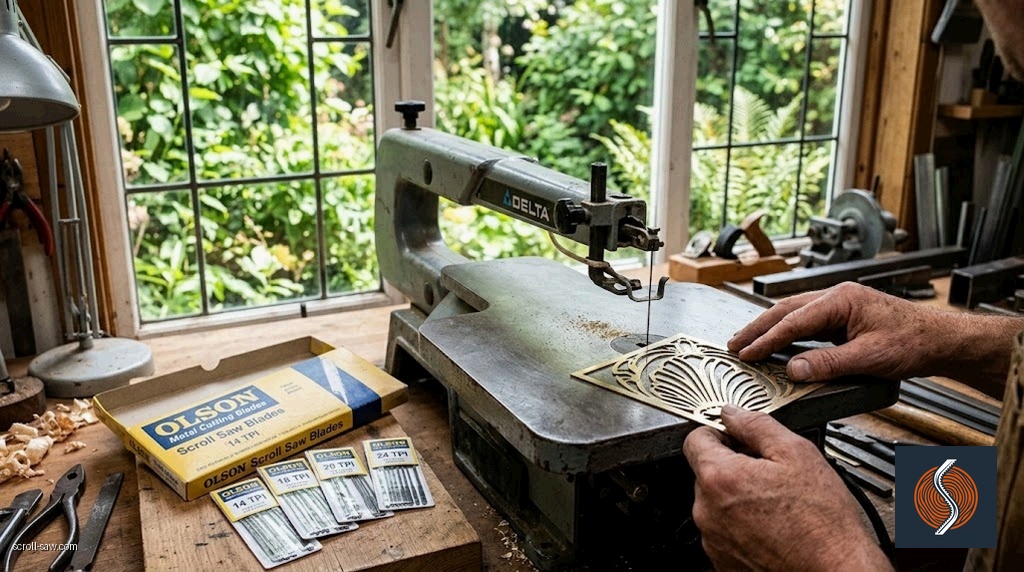
Olson Metal Cutting Scroll Saw Blades: TPI Guide
A scroll saw is not the first tool most workers reach for when cutting metal. A jeweler’s saw handles fine jewelry work. A metal bandsaw handles thick or heavy metal. But for occasional intricate cuts in thin non-ferrous sheet (brass jewelry blanks, aluminum inlay pieces, copper enamel bases), a scroll saw fitted with a metal-cutting blade does the job well and produces cleaner cuts than most alternatives.
Olson makes a range of metal-cutting scroll saw blades. They have higher TPI than wood-cutting blades, tooth geometry designed for metal chip clearance, and blade bodies that tolerate the higher heat of metal cutting. This guide covers Olson’s metal-cutting blade options and how to match them to material and thickness.
Why metal-cutting blades are different
Wood-cutting scroll saw blades have relatively few teeth per inch (9 to 25 TPI) with tooth geometry designed for wood fiber cutting. Feed them into metal and they gall, dull rapidly, and produce ragged cuts.
Metal-cutting blades have 30 to 50 TPI or more. The high tooth count matches the small chip size that thin metal produces. The tooth geometry is designed to shear metal cleanly without galling.
Blade body construction also differs. Metal-cutting blades tolerate the higher friction heat that metal cutting generates without breaking or losing temper.
Olson’s metal-cutting range
Olson makes metal-cutting scroll saw blades in several TPI counts and blade widths.
30 to 32 TPI metal-cutting: for medium-thin non-ferrous sheet. Aluminum up to 20 gauge, brass 22 gauge and above, copper similar.
36 to 40 TPI metal-cutting: for thinner sheet. 24 gauge and thinner brass, copper, aluminum.
48 to 50 TPI ultra-fine metal-cutting: for jewelry-scale work. Very thin gauge, small parts.
Both pin-end and plain-end formats are available.
Matching blade to metal thickness
Brass 18 to 20 gauge (0.040 to 0.032 inch): 30 to 32 TPI blade. Cut at 400 to 600 SPM. Slow feed. Cutting wax generously.
Brass 22 to 24 gauge (0.025 to 0.020 inch): 36 TPI blade. 400 to 600 SPM. Slow steady feed.
Brass 26 gauge and thinner: 48 TPI or finer. 400 to 500 SPM. Very slow feed.
Copper: same TPI as brass at equivalent gauge but expect faster blade dulling. Copper is softer and gums the blade.
Aluminum 18 to 20 gauge: 30 TPI blade. 500 to 700 SPM. Aluminum cuts cleaner than brass but chips can weld to teeth; wax generously.
Aluminum 22 to 24 gauge: 36 TPI. 400 to 600 SPM.
Stainless steel or ferrous metal: Olson’s standard scroll saw metal blades are designed for non-ferrous. Ferrous metals require specialized blades and generally exceed what a scroll saw can handle well. A jeweler’s saw or metal bandsaw is the right tool.
Blade width and pattern radius
Metal-cutting blades come in narrow and wider bodies. Narrower blades turn tighter curves; wider blades hold straight lines better in slightly thicker material.
For jewelry-scale intricate work, use narrow blades.
For thicker sheet with broader pattern shapes, use wider blades.
Cutting technique for metal on a scroll saw
Cutting wax on the blade: apply before starting and reapply every few minutes of cutting. Wax reduces friction, extends blade life, and produces cleaner cuts.
Very slow feed: metal cutting on a scroll saw is not fast. The blade removes small chips per stroke; forcing the feed pushes the blade sideways and dulls it faster.
Low speed: 400 to 600 SPM is the working range. Fast speed generates heat that dulls the blade rapidly and can distort thin sheet.
Firm workpiece support: metal sheet needs to be flat and fully supported. A metal workpiece that flexes during cutting produces bent parts and broken blades.
Auxiliary table or zero-clearance insert: the standard table insert on most scroll saws has an opening larger than the metal-cutting blade needs. A zero-clearance insert made from thin plywood prevents thin metal from dropping through and catching the blade.
When metal cutting on a scroll saw makes sense
Intricate pattern work in thin sheet: scroll saws follow curves better than most alternatives.
Small precision parts: the scroll saw’s steady low-speed operation produces cleaner cuts than a bandsaw.
Occasional non-ferrous work in a general workshop: no need for a dedicated jeweler’s saw.
Enameling and jewelry blanks: standard use case.
When metal cutting on a scroll saw does not make sense
Regular metal work: get a jeweler’s saw or metal bandsaw.
Thick metal (over 20 gauge): exceeds what a scroll saw handles well.
Ferrous metal: scroll saws are not designed for steel or iron.
Fast production: scroll saw metal cutting is slow.
Metal-cutting blade stock
A metal-work-inclusive Olson blade drawer:
-
One dozen 30 to 32 TPI metal-cutting blades (primary metal work)
-
Half dozen 36 to 40 TPI (thinner sheet)
-
A few 48 TPI (very thin or jewelry-scale)
Olson’s standard skip-tooth wood-cutting blades cover the wood work, with metal-cutting blades as a specialty addition.
Small habits with metal blades
Break in new metal blades with a short cut in wood or scrap plastic before starting metal work. The break-in polishes tooth edges.
Apply cutting wax before every cut.
Store metal-cutting blades separately from wood-cutting blades in a labeled section of the divided case.
Expect shorter blade life than wood blades. Metal is harder on blades. Plan for a metal-cutting blade to handle one to three hours of intermittent cutting.
Wipe the saw table clean of metal chips at the end of each session. Metal chips can rust or scratch the table surface.
FAQ
Can I cut steel on a scroll saw? Not practically. Scroll saws are designed for non-ferrous metal, and even that only in thin gauge.
What TPI for brass? 30 to 40 TPI depending on gauge.
Do I need cutting wax? Yes for metal.
What speed for metal cutting? 400 to 600 SPM.
How long does a metal-cutting blade last? 1 to 3 hours of intermittent metal cutting.
Are Olson metal blades available in both pin-end and plain-end? Yes.
Can I cut aluminum sheet metal? Yes, up to about 20 gauge with a metal-cutting blade.
References
-
Olson Saw Company. Metal-cutting scroll saw blade catalog.
-
Scroll Saw Woodworking & Crafts forum. Metal-cutting discussions and technique archive.
-
Ganoksin Project. Jewelry-scale metal cutting reference.
Title tag: Olson Metal Cutting Scroll Saw Blades: TPI Guide Meta description: Match Olson metal-cutting scroll saw blades to material and thickness. TPI, technique, and non-ferrous metal reference. URL slug: olson-metal-cutting-scroll-saw-blades Excerpt: Match Olson metal-cutting scroll saw blades to material and thickness. TPI, cutting technique, and non-ferrous metal reference for scroll saw metal work.


