
Olson Reverse Tooth Scroll Saw Blades: Selection
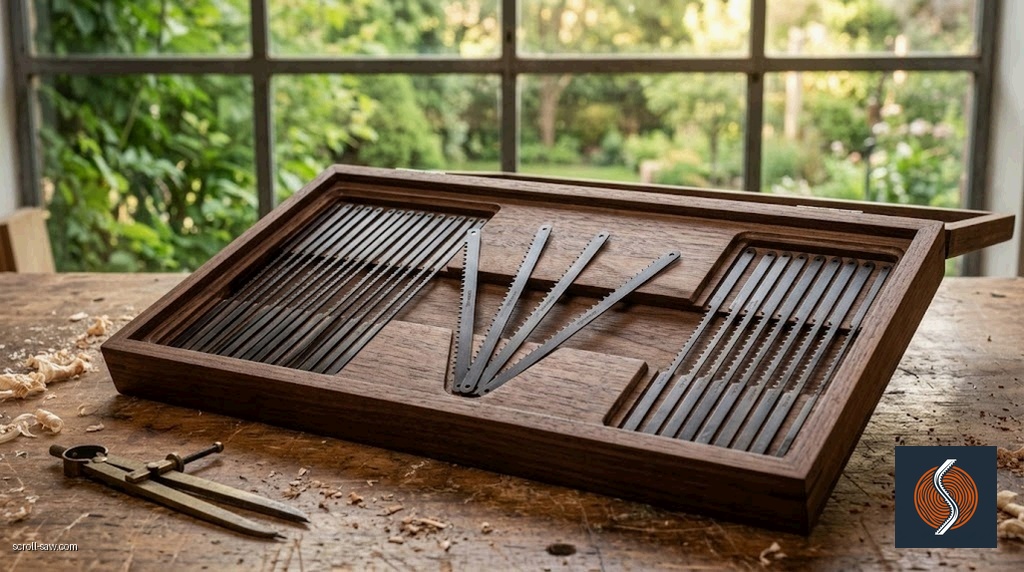
Olson Reverse Tooth Scroll Saw Blades: Selection
One of the most common frustrations in scroll saw pattern work is chip-out on the underside of the workpiece. The blade cuts cleanly on the down-stroke, entering the wood at the top face. On the up-stroke, the blade lifts back through the kerf, and if the fibers at the bottom face are not supported, they tear out. The result is a clean top face and a rough bottom face that needs sanding.
Reverse-tooth blades solve this. A few teeth at the bottom of the blade point upward instead of downward. Those reversed teeth cut on the up-stroke, cleaning the bottom face of the workpiece the same way the majority of teeth clean the top face. The result is a workpiece that comes off the saw with clean edges on both sides.
Olson makes reverse-tooth blades in a range of sizes and formats. This guide covers what to know before choosing them.
How reverse-tooth blades work
On a standard scroll saw blade, all teeth point down. All cutting happens on the down-stroke. The up-stroke lifts the blade back to top position but does no cutting.
On a reverse-tooth blade, most teeth still point down, but the bottom two to five teeth (depending on blade size) point up. Those reversed teeth engage the wood on the up-stroke, cutting the bottom face fibers as the blade travels upward.
The reversed teeth are always at the bottom of the blade. When the blade is installed, the reversed teeth should be positioned so they cut the exit face (the face that would otherwise chip).
Olson reverse-tooth sizes
Olson makes reverse-tooth blades in the standard scroll saw size range:
-
#2/0 to #2: fine, for very detailed plywood fretwork
-
#3: fine to medium, workhorse for Baltic birch fretwork
-
#5: medium, general reverse-tooth for pattern work
-
#7: wider, for thicker plywood or heavier work
-
#9: rare in reverse-tooth; skip-tooth is more common at this size
Blade width, kerf, and minimum turning radius follow standard scroll saw dimensions for each number.
Tooth geometry within reverse-tooth
Olson’s reverse-tooth line is primarily skip-tooth geometry with reversed bottom teeth. The skip-tooth pattern provides chip clearance in the main cutting portion of the blade.
Standard reverse-tooth: skip-tooth with 2 to 4 reversed teeth at the bottom.
Double-reverse: more reversed teeth at the bottom for exceptionally clean exit faces.
Most reverse-tooth blades in the Olson catalog are standard reverse-tooth. Double-reverse is less common but available in select sizes.
When to use reverse-tooth
Plywood pattern work where the underside will show: primary use case. Baltic birch pattern work, name plaques, ornaments where both faces are visible.
Cross-grain cutting in solid wood: cross-grain cuts chip more than with-grain cuts. Reverse-tooth helps.
Any pattern work where sanding the exit face is inconvenient: fine fretwork with many interior cuts is hard to sand cleanly; reverse-tooth reduces the need.
When the pattern requires clean interior corners: reverse teeth clean the exit face inside sharp corners where sanding is difficult.
When not to use reverse-tooth
Thick material where blade life matters: reverse-tooth blades have slightly shorter life than skip-tooth because the up-stroke cutting stresses the reversed teeth. In thick material where blade life is already short, skip-tooth is more economical.
Cuts where only one face is visible: no reason to pay for reverse-tooth if the exit face will not be seen.
Very fine fretwork below #2/0: reverse-tooth in ultra-fine sizes is limited in selection.
Material guide
Baltic birch 1/8 inch: #3 reverse-tooth at 1,000 to 1,300 SPM.
Baltic birch 1/4 inch: #5 reverse-tooth at 1,100 to 1,400 SPM.
Baltic birch 3/8 inch: #5 reverse-tooth at 1,000 to 1,300 SPM.
Baltic birch 1/2 inch: #7 skip-tooth (reverse-tooth becomes less advantageous at this thickness; #7 reverse-tooth is available but skip-tooth handles it well too).
Solid wood cross-grain cuts: match reverse-tooth to thickness the same way you would match skip-tooth.
Hardwood plywood: same sizes as Baltic birch. Hardwood-faced plywood may need slightly slower speed.
Speed and feed
Reverse-tooth blades run at the same speeds as equivalent skip-tooth blades in the same material. The reversed teeth do not require different SPM.
Feed pressure should be slightly lighter than with skip-tooth blades. The reversed teeth engage the wood on the up-stroke, which adds slight resistance; matching that resistance with lighter feed produces the cleanest exit face.
Installation orientation
Install reverse-tooth blades with the reversed teeth at the bottom, so they engage the exit face of the workpiece as the blade rises.
Most of the teeth on the blade point down toward the table. The bottom few teeth point up. Verify orientation before tensioning.
A reverse-tooth blade installed upside down (reversed teeth at the top) does not damage anything but produces no advantage. The reversed teeth would engage air on the up-stroke instead of the workpiece.
Small habits with reverse-tooth
Inspect new blades to confirm the reversed teeth are actually at the bottom. Manufacturing errors occasionally produce blades with the reverse orientation flipped.
Detension between sessions.
Match speed to material.
Feed slightly lighter than with skip-tooth to let the reversed teeth clean the exit face.
Reverse-tooth blade stock
A plywood-heavy Olson blade drawer:
-
One dozen #3 reverse-tooth (Baltic birch fretwork, primary)
-
One dozen #5 reverse-tooth (Baltic birch pattern work)
-
Two dozen #5 skip-tooth (general soft wood)
-
One dozen #7 skip-tooth (thicker material)
Olson skip-tooth blades in dozen packs cover general work; reverse-tooth is added specifically for plywood.
Where reverse-tooth blades are available
Olson reverse-tooth blades come in both pin-end and plain-end formats. Both are widely stocked at Amazon, Home Depot, Rockler, and specialty scroll saw retailers.
For pin-end saws that need very fine reverse-tooth sizes (below #3), stock may be limited. Plain-end has slightly wider fine-size selection.
FAQ
What is a reverse-tooth blade? A scroll saw blade with a few teeth at the bottom pointing upward to clean the exit face on the up-stroke.
Why use reverse-tooth? Cleaner exit face on plywood, less sanding of the underside.
Do reverse-tooth blades work in solid wood? Yes, especially for cross-grain cuts.
Is reverse-tooth worth the small extra cost? For plywood pattern work where the underside shows, yes.
Which way do the reversed teeth face? Up, at the bottom of the blade.
Do reverse-tooth blades last as long as skip-tooth? Slightly shorter life, about 10 percent shorter in equivalent material.
Are Olson reverse-tooth blades available in pin-end? Yes, in medium sizes.
References
-
Olson Saw Company. Reverse-tooth scroll saw blade catalog.
-
Scroll Saw Woodworking & Crafts forum. Reverse-tooth technique discussions.
-
Scroll Saw Village. Plywood fretwork reference.
Title tag: Olson Reverse Tooth Scroll Saw Blades: Selection Meta description: Olson reverse-tooth scroll saw blades. Size, tooth geometry, material matching, and when to use them. URL slug: olson-reverse-tooth-scroll-saw-blades Excerpt: Olson reverse-tooth scroll saw blades clean the exit face on plywood pattern work. Selection guide with sizes, tooth geometry, and material matching.


