
Olson Skip Tooth Scroll Saw Blades: Selection
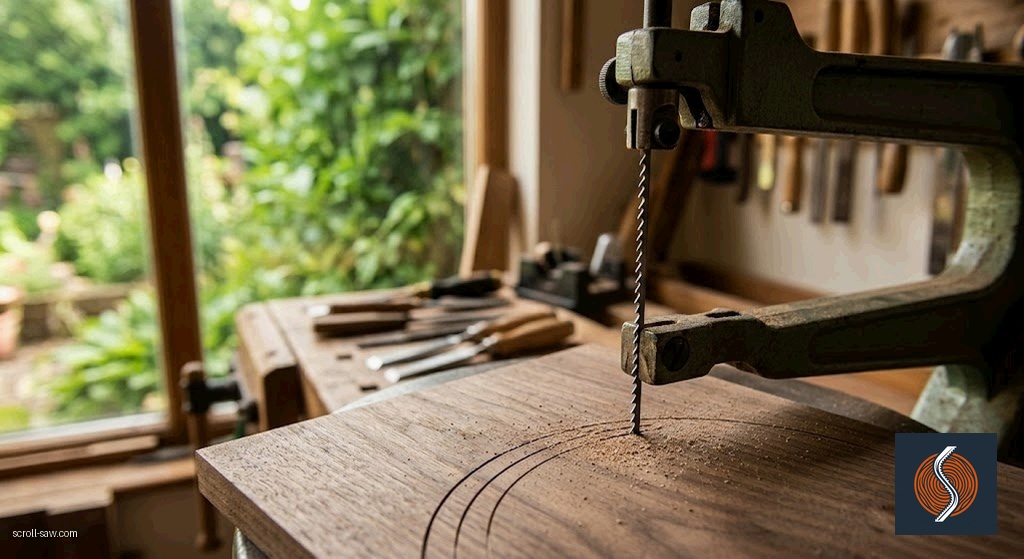
Olson Skip Tooth Scroll Saw Blades: Selection
Skip-tooth blades are the workhorse of scroll saw work. If a scroll saw shop stocks only one blade type, it is skip-tooth. If a manufacturer sells only one blade format, it is skip-tooth. Olson’s skip-tooth line covers the widest range of sizes and formats in the catalog because skip-tooth handles the widest range of practical work.
What makes skip-tooth the standard is the balance it strikes. Enough teeth to cut cleanly, few enough teeth for good chip clearance, tooth spacing that doesn’t clog in wet or resinous wood, and cutting behavior that feels controlled under normal feed. Getting the size right for the material is the main variable; the tooth geometry itself handles most of the rest.
What skip-tooth means
On a skip-tooth scroll saw blade, every second tooth space is empty. Where a standard blade has teeth at positions 1, 2, 3, 4, 5, 6, a skip-tooth blade has teeth at positions 1, 3, 5 with empty gaps at 2, 4, 6.
The empty gaps are called gullets. They clear chips out of the cut as the blade cycles. Larger gullets means faster chip clearance means faster cutting.
Skip-tooth blades have roughly half the TPI of standard-tooth blades of equivalent width. That is not a limitation; the reduced tooth count trades off against better chip clearance and cooler cutting.
Olson skip-tooth sizes
Olson makes skip-tooth blades in the full scroll saw size range:
-
#2/0: very fine, 0.020 inch wide, 25 TPI
-
#2: fine, 0.028 inch wide, 20 TPI
-
#3: fine to medium, 0.030 inch wide, 18 TPI
-
#5: medium, 0.038 inch wide, 12.5 TPI
-
#7: wider, 0.045 inch wide, 11.5 TPI
-
#9: wide, 0.055 inch wide, 11 TPI
-
#12: very wide, 0.062 inch wide, 9 TPI
Blade width sets minimum turning radius. Kerf follows blade width closely.
Clean curves: width to radius match
A blade cannot turn a curve tighter than its width allows. Match blade width to the tightest inside curve in the pattern.
#2/0 to #2: 1/32 to 1/16 inch inside radius. Very fine fretwork.
#3: 1/16 to 1/8 inch. Fine pattern work.
#5: 1/8 inch. Standard pattern curves.
#7: 3/16 inch. Broader pattern work or thicker material.
#9: 1/4 inch. Straight cuts and broad curves.
#12: 3/8 inch or wider. Heavy stock, minimal curves.
A blade wider than the curve you need to turn forces sideways in the cut and drifts. A narrower blade turns the curve but wears faster in the thick sections of the cut.
Controlled feed: how skip-tooth feels
Skip-tooth cuts feel controlled because the large gullets between teeth clear chips promptly. Chip clearance prevents the tooth from packing with material, which is what makes other tooth geometries feel grabby or unpredictable.
Under correct feed pressure, a skip-tooth blade produces a continuous ribbon of shaving from the kerf. The motor sound stays steady. The blade tracks the pattern line without drift.
Signs of incorrect feed:
-
Fine dust rather than ribbon: blade dull or feed too slow.
-
Motor pitch drop: feed too fast for the material.
-
Blade drifts sideways: feed too high or blade too wide for the curve.
-
Burn stripe along kerf: speed too high or feed too slow (with skip-tooth this is less common than with standard-tooth because the gullets prevent heat buildup).
Material guide
Soft wood (pine, poplar, basswood) 1/4 to 1/2 inch: #5 skip-tooth at 1,200 to 1,500 SPM.
Soft wood 1/2 to 1 inch: #7 skip-tooth at 1,000 to 1,300 SPM.
Soft wood 1 inch and thicker: #9 skip-tooth at 800 to 1,000 SPM.
Hardwood 1/4 to 1/2 inch: #5 skip-tooth at 900 to 1,100 SPM.
Hardwood 1/2 to 3/4 inch: #7 skip-tooth at 800 to 1,000 SPM (or precision-ground for cleaner cuts).
Baltic birch plywood 1/4 to 3/8 inch: #5 skip-tooth at 1,100 to 1,400 SPM (or reverse-tooth for cleaner exit face).
Acrylic 1/8 to 1/4 inch: #5 skip-tooth at 500 to 800 SPM.
Very tight curves in soft wood: #2 or #2/0 skip-tooth at 1,000 to 1,200 SPM.
Skip-tooth blade formats
Olson makes skip-tooth blades in:
Pin-end skip-tooth: for older pin-end saws.
Plain-end skip-tooth: for modern saws with plain-end clamps.
Both formats cover the same size range and cut equivalently. Choose based on your saw’s clamps.
Skip-tooth blade stock
Skip-tooth is the primary blade type for almost every scroll saw shop:
-
Two dozen #5 skip-tooth (primary, 70 percent of use)
-
One dozen #3 skip-tooth (fine pattern work in soft wood)
-
One dozen #7 skip-tooth (thicker material)
-
Half dozen #9 (occasional thick cuts)
-
Add reverse-tooth and precision-ground for specialty needs
Olson skip-tooth plain-end blades in dozen packs cover the primary slot at reasonable cost.
Small habits
Break in new blades with a minute of slow-speed cutting in soft wood scrap.
Detension between sessions.
Store blades flat in a divided case.
Match blade to material and curve radius before starting.
Rotate partially worn blades to lighter work.
Brush the clamps clean at every blade change.
When skip-tooth is not the right choice
Plywood pattern work where the exit face shows: reverse-tooth is better for clean underside.
Hardwood over 1/2 inch where cuts must be smooth: precision-ground is better for smoother cuts and longer blade life.
Ultra-fine fretwork (below #2/0): specialty plain-end blades cover this.
Metal cutting: metal-cutting blades have appropriate TPI.
For everything else, skip-tooth is the answer.
FAQ
What is skip-tooth? A scroll saw blade with every second tooth space empty, for better chip clearance.
Best all-purpose scroll saw blade? #5 skip-tooth.
How does skip-tooth compare to standard-tooth? Skip-tooth has half the TPI, better chip clearance, cuts faster and cooler.
Are skip-tooth blades available in both pin-end and plain-end? Yes.
When would I use standard-tooth instead? Rarely. Skip-tooth is the modern standard.
How long does a skip-tooth blade last? 30 to 60 minutes of continuous cutting.
Should I break in new skip-tooth blades? Yes. A minute of slow-speed cutting in soft wood scrap extends useful life.
References
-
Olson Saw Company. Skip-tooth scroll saw blade catalog.
-
Scroll Saw Woodworking & Crafts forum. Skip-tooth technique discussions.
-
Scroll Saw Village. Blade selection reference.
Title tag: Olson Skip Tooth Scroll Saw Blades: Selection Meta description: Choose Olson skip-tooth scroll saw blades for clean curves and controlled feed. Size and material selection guide. URL slug: olson-skip-tooth-scroll-saw-blades Excerpt: Olson skip-tooth scroll saw blades are the workhorse of scroll saw work. How to choose them for clean curves and controlled feed across common materials.


