
Ryobi Scroll Saw Blades for Metal: Selection
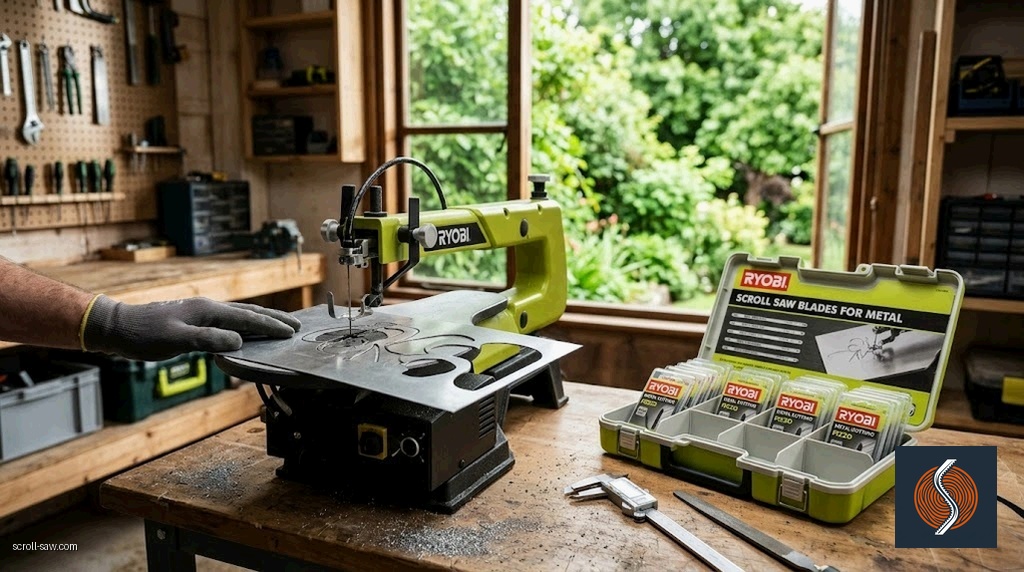
Ryobi Scroll Saw Blades for Metal: Selection
Ryobi scroll saws are designed primarily for wood work, but their variable speed control and cast-aluminum tables let them handle occasional non-ferrous metal cutting when fitted with the right blades. Thin brass sheet for jewelry blanks, copper for enameling bases, aluminum for inlay pieces, all cut cleanly on a Ryobi 16-inch or comparable saw with a metal-cutting scroll saw blade.
Ryobi does not manufacture metal-cutting blades under its own brand. What you use on a Ryobi is a metal-cutting scroll saw blade from Olson, Pegas, or another blade maker, in the format your specific Ryobi saw accepts (usually 5-inch plain-end for current models).
Metal-cutting blade basics
Metal-cutting scroll saw blades differ from wood-cutting blades in three ways:
Higher TPI: 30 to 50 TPI compared to 9 to 25 TPI for wood blades. High tooth count matches the small chip size that thin metal produces.
Tooth geometry for metal chip clearance: designed to shear metal cleanly without galling.
Blade body construction that tolerates metal-cutting heat: better temper retention under friction.
Size options
Fine metal blade (40 to 50 TPI): for very thin sheet, 24 gauge and thinner. Jewelry-scale work.
Medium metal blade (30 to 36 TPI): general non-ferrous metal cutting in 20 to 24 gauge.
Coarse metal blade (20 to 25 TPI): heavier non-ferrous metal up to 18 gauge.
All fit standard Ryobi plain-end clamps in the 5-inch length. Pin-end versions are available for older Ryobi units through Olson.
Matching blade to metal thickness
Brass 18 to 20 gauge (0.040 to 0.032 inch): 30 TPI medium metal blade at 400 to 600 SPM.
Brass 22 to 24 gauge (0.025 to 0.020 inch): 36 TPI blade at 400 to 500 SPM.
Brass 26 gauge and thinner: 40 to 50 TPI fine metal blade at 400 to 500 SPM.
Copper 20 to 24 gauge: same TPI as brass at equivalent gauge. Copper is softer, gums the blade faster; use extra cutting wax.
Aluminum 20 to 24 gauge: 30 to 36 TPI blade at 500 to 700 SPM. Aluminum chips can weld to teeth; extra wax.
Nickel silver, German silver 20 to 24 gauge: medium metal blade at 400 to 500 SPM.
Sterling silver 24 gauge and thinner: fine metal blade at 400 to 500 SPM.
Steel or stainless steel: not practical on a Ryobi scroll saw. Ferrous metals exceed what scroll saw blades handle well; use a jeweler’s saw or metal bandsaw.
Cutting technique for metal on a Ryobi
Cutting wax on the blade: essential. Apply before starting and reapply every few minutes. Beeswax, purpose-made cutting wax, or a candle stub all work.
Slow feed: metal cutting is not fast. The blade removes small chips per stroke. Force the feed and the blade dulls or breaks.
Low SPM: 400 to 600 for most metal work. The Ryobi’s low-speed range handles this well.
Firm workpiece support: metal sheet must be flat and fully supported. A flexing workpiece produces bent parts.
Zero-clearance table insert: prevents thin metal from dropping through the standard opening.
Backing material for thin gauge: sandwich very thin sheet between two pieces of 1/8-inch plywood to keep it flat.
Speed control on Ryobi saws
The Ryobi 16-inch variable speed scroll saws have a speed range from roughly 400 to 1,600 SPM. The lower end of that range is where metal cutting happens.
Set the speed dial to its lowest setting for delicate metal work (400 SPM range). Set slightly higher (500 to 600 SPM) for aluminum, which tolerates slightly more speed than brass or copper.
A speed dial that does not descend below 500 SPM makes some metal work harder. If your Ryobi’s minimum speed is higher than 400 SPM, focus on 20-gauge and heavier work where blade speed is less critical.
Where to buy metal blades for Ryobi saws
Olson metal-cutting blades are the most widely available. Pégas metal blades are premium options through Bear Woods.
Both make 5-inch plain-end scroll saw metal blades. Check your specific Ryobi model for pin-end vs plain-end before ordering; the SC162VS and SC164VS use plain-end, current Ryobi benchtop scroll saws use plain-end, some older Ryobi units may use pin-end.
Standard Olson skip-tooth wood-cutting blades cover the wood work slot; metal-cutting blades are a specialty addition for occasional non-ferrous work.
Small habits for metal work on a Ryobi
Break in new metal blades with a short cut in wood or scrap plastic before starting metal work.
Apply cutting wax before every metal cut.
Store metal-cutting blades separately from wood-cutting blades in the divided case.
Expect 1 to 3 hours of intermittent metal cutting per blade.
Wipe the Ryobi’s table clean of metal chips at the end of each session. Metal chips can rust or scratch the table.
Use dust extraction if available. Metal chips are unpleasant and can be sharp.
When a Ryobi is not the right saw for metal
Regular metal work: a jeweler’s saw or metal bandsaw is more appropriate.
Thick metal (over 18 gauge): exceeds what a scroll saw handles well.
Ferrous metal: scroll saws are not designed for steel.
Production cutting: scroll saw metal cutting is slow.
Blade rotation for occasional metal work
A Ryobi owner who cuts metal occasionally:
-
Two dozen #5 skip-tooth wood blades (primary wood use)
-
Half dozen medium metal-cutting blades (30 TPI)
-
Half dozen fine metal-cutting blades (36 to 40 TPI, for thin gauge)
-
Cutting wax
FAQ
Can a Ryobi cut metal? Thin non-ferrous only. Brass, copper, aluminum up to about 20 gauge with occasional 18-gauge work.
What TPI for brass? 30 to 40 TPI depending on gauge.
Do I need Ryobi-branded metal blades? Ryobi does not make metal-cutting blades. Use Olson or Pegas metal blades.
What speed for metal on a Ryobi? 400 to 600 SPM.
Do I need cutting wax? Yes for metal.
How long does a metal blade last? 1 to 3 hours of intermittent metal cutting.
Can I cut steel on a Ryobi? Not practically.
References
-
Olson Saw Company. Metal-cutting scroll saw blade catalog.
-
Ryobi Power Tools. Scroll saw product documentation.
-
Pégas Scroll Saw Blades via Bear Woods.
Title tag: Ryobi Scroll Saw Blades for Metal: Selection Meta description: Metal-cutting scroll saw blades for Ryobi saws. TPI, material, and technique for thin non-ferrous metal work. URL slug: ryobi-scroll-saw-blades-for-metal Excerpt: Metal-cutting scroll saw blade selection for Ryobi saws. TPI, material matching, and cutting technique for thin non-ferrous metal work.


