
Ryobi Scroll Saw Spiral Blades: Selection
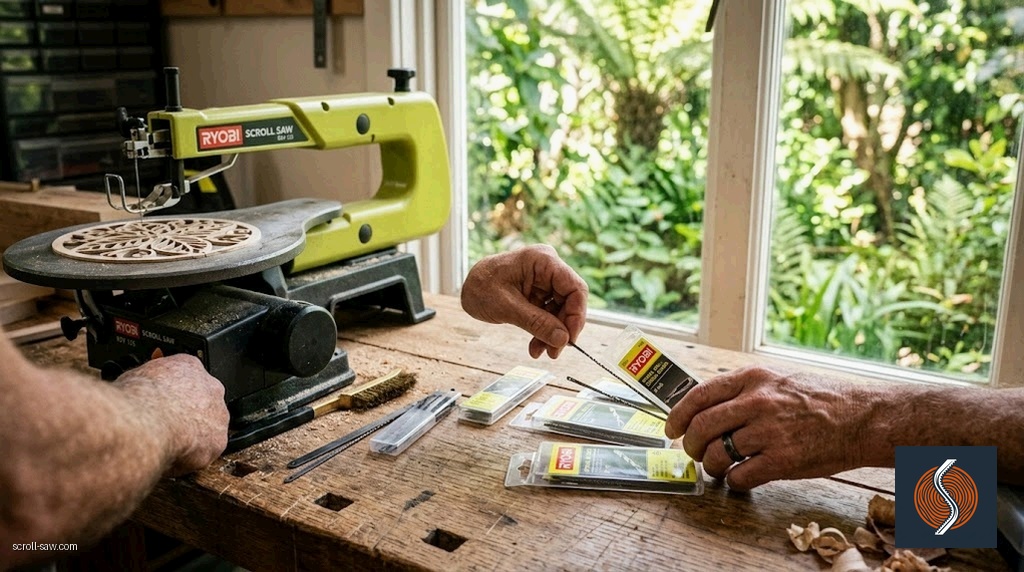
Ryobi Scroll Saw Spiral Blades: Selection
Ryobi scroll saws handle spiral blades the same way any modern scroll saw does: spirals fit the standard 5-inch plain-end clamps, tension the same way as any other blade, and cut in all directions once installed. What matters more than the saw is matching the spiral blade number to the material and thickness you want to cut.
Spirals are specialty blades. They cut sign interiors and sculpted shapes where straight blades cannot follow the pattern. They cut rougher than straight blades and have shorter blade life, but for the work they are designed for, nothing else does the job as well.
What spiral blades do
A standard scroll saw blade has teeth along one edge, cutting on the down-stroke. Turning a corner requires rotating the workpiece so the pattern line stays parallel to the blade.
A spiral blade has teeth wrapping helically around the blade body. Every direction of feed presents cutting teeth. The workpiece can be fed forward, backward, sideways, or in any direction; the blade cuts.
This is uniquely useful for:
Sign interiors: cutting inside letters like B, D, O, and P where the pattern line makes sharp interior turns.
Sculpted three-dimensional shapes: cutting curves in multiple directions on one setup.
Cross-cut curves: where the workpiece is awkward to rotate on a small scroll saw table.
Bevel cuts: with the table tilted, spiral blades cut the intersection of bevels cleanly.
Spiral blade sizes
Spiral blades follow scroll saw sizing loosely because teeth are wrapped rather than in a straight line. Common categories:
Fine spiral (roughly equivalent to a #3 standard blade): 0.038 inch effective width, roughly 35 to 40 TPI equivalent.
Medium spiral (equivalent to a #5 standard blade): 0.045 inch effective width, roughly 20 to 25 TPI equivalent.
Coarse spiral (equivalent to #7 or #9): 0.055 to 0.065 inch effective width, roughly 15 TPI equivalent.
Width here refers to the diameter of the wrapped blade body, which is what determines the effective kerf.
Matching spiral to material and thickness
Baltic birch 1/8 to 1/4 inch, sculpted or sign work: fine spiral at 800 to 1,200 SPM. Light feed.
Baltic birch 3/8 inch, sign interiors: medium spiral at 900 to 1,200 SPM.
Soft wood (pine, poplar, basswood) 1/4 to 1/2 inch, sign work: medium spiral at 1,000 to 1,300 SPM.
Soft wood 1/2 to 3/4 inch, sculpted: medium or coarse spiral at 900 to 1,100 SPM.
Soft wood 3/4 to 1 inch, sculpted: coarse spiral at 800 to 1,000 SPM.
Hardwood (oak, maple, cherry, walnut): spirals cut hardwood but slowly and with short blade life. Match the size the same as soft wood but expect half the blade life. For hardwood pattern work, standard MGT or PGT blades are usually better.
Plywood pattern work with letter interiors: fine to medium spiral at 1,000 to 1,300 SPM.
Plastic: spirals are not the best choice for plastic; standard skip-tooth cuts cleaner in plastic.
Metal: spirals are not designed for metal cutting.
Cutting radius
Spiral blades effectively have zero minimum turning radius because they cut in any direction. Pivot the workpiece around a point without moving it forward and the blade cuts a full-radius arc.
That is the primary advantage of spirals over standard blades. For patterns with interior cuts where the pattern cannot be reoriented, spirals cut where standard blades would require multiple entry points.
Cut quality
Spiral blade cuts have visible tool marks. The finish is rougher than a standard skip-tooth blade of equivalent size because teeth cut in all directions rather than in one direction.
For pieces that will be painted, sanded, or textured further, spiral finish is acceptable. For pieces that need a clean edge off the saw, standard blades are usually better.
Speed and feed on Ryobi with spirals
Ryobi variable-speed scroll saws cover the working range for spirals (roughly 800 to 1,300 SPM depending on material and size).
Feed steady and light. Spirals cut efficiently under light pressure; forced feed makes the blade wander in unexpected directions.
Move the workpiece smoothly. Abrupt direction changes stress the blade unevenly and shorten life.
Watch the blade body vertically. Because spirals cut sideways, a blade that leans indicates the cut is drifting off vertical.
Tension
Spiral blades tension the same as standard blades. Pluck-test for a clear high note.
Blade change
Install spirals the same way as any plain-end blade. There is no top or bottom; the wrapped teeth are symmetrical.
Spirals are delicate. Handle them carefully. Bent or twisted spirals cut poorly and should be replaced.
Small habits with spirals
Break in new spirals with a minute of slow-speed cutting.
Detension between sessions.
Store spirals separately from standard blades in the divided case; they are easily damaged by crushing.
Expect blade life of 15 to 45 minutes of continuous cutting depending on material.
Use cutting wax for resinous wood; the wrapped teeth pack with resin faster than straight teeth.
Spiral blade stock for a Ryobi
For operators who use spirals occasionally:
-
Half dozen medium spiral (primary spiral)
-
Half dozen fine spiral (detailed sign or sculpted work)
-
A few coarse spiral (thicker sculpted work)
Standard Olson skip-tooth wood-cutting blades cover general scroll saw work at reasonable cost; spirals are a specialty addition.
When Ryobi’s saw geometry matters
The 16-inch throat on most Ryobi benchtop scroll saws sets the maximum piece width. For sign work with interior cuts, spirals let you cut interior shapes anywhere in a piece that fits within the throat.
The motor size on the SC162VS and SC164VS is adequate for spiral work in soft wood up to about 1 inch thick and in hardwood up to about 3/4 inch thick. Beyond that, the motor works harder and blade life drops.
FAQ
What size spiral for sign interiors in 1/4-inch soft wood? Fine or medium spiral.
Can I use spirals in hardwood on a Ryobi? Yes but slowly, and expect short blade life.
Do spirals cut cleaner than standard blades? No. Standard blades cut cleaner. Spirals cut where standard blades cannot follow the pattern.
What speed on a Ryobi for spirals? 800 to 1,300 SPM depending on material.
How long does a spiral blade last? 15 to 45 minutes of continuous cutting.
Do I need a special adapter for spirals? No. Spirals fit standard plain-end clamps. Pin-end spirals also exist for older Ryobi units.
Should I use spirals for pattern work with clean lines? No. Use standard skip-tooth or reverse-tooth blades.
References
-
Olson Saw Company. Spiral scroll saw blade catalog.
-
Ryobi Power Tools. Scroll saw product documentation.
-
Scroll Saw Woodworking & Crafts forum. Spiral blade technique archive.
Title tag: Ryobi Scroll Saw Spiral Blades: Selection Meta description: Match spiral scroll saw blades to material and thickness on Ryobi saws. Sign work and sculpted cuts. URL slug: ryobi-scroll-saw-spiral-blades Excerpt: Match spiral scroll saw blade size to material and thickness for Ryobi scroll saws. Sign interiors, sculpted work, and the specialty cuts where spirals earn their place.


