
Craftsman 16 Inch Scroll Saw Manual: Blade Guide
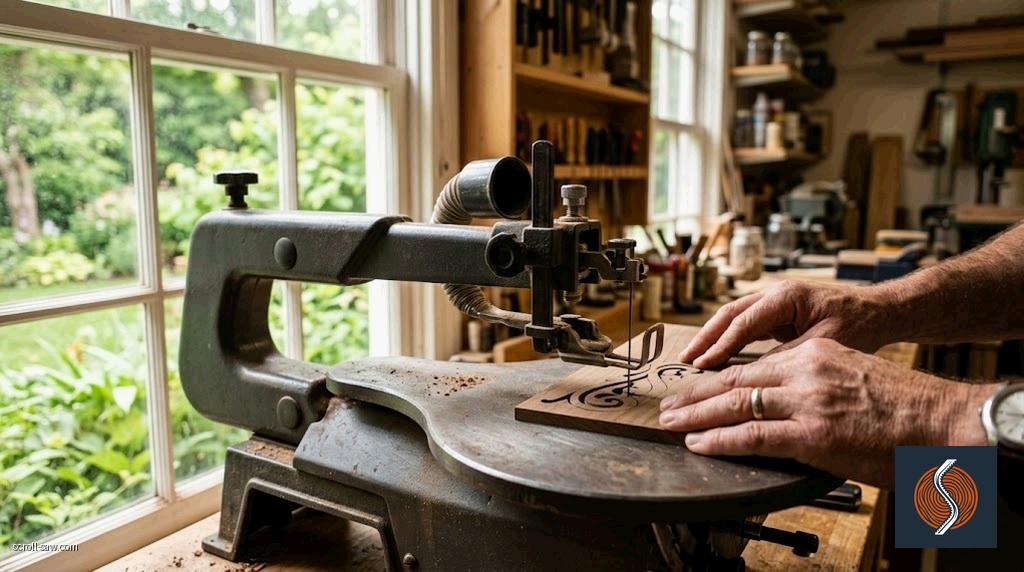
Craftsman 16 Inch Scroll Saw Manual: Blade Guide
The original owner’s manual for a Craftsman 16-inch scroll saw covers the saw’s controls, adjustments, and basic operation. What it usually does not cover in useful depth is blade selection: which blade goes with which material, how to size blades for pattern radius, and how tooth geometry affects finish quality. Owners of older Craftsman 16-inch scroll saws often work through blade selection on their own or from third-party sources.
This guide serves as the blade selection companion to the Craftsman 16-inch manual. It covers size, tooth geometry, and material matching in enough depth to guide practical work.
Craftsman 16-inch scroll saw models
Craftsman sold 16-inch scroll saws under several model numbers across decades. The 16-inch designation refers to the throat depth (the distance from the blade to the back of the arm), which sets the maximum piece dimension the saw can handle for interior cuts.
Older Craftsman 16-inch (1970s to 1980s, 113 series): made by King-Seeley. Rigid steel construction, pin-end blades, often single-speed.
Newer Craftsman 16-inch (1990s to 2000s, 137 series): made by Rexon. Aluminum construction, plain-end or convertible clamps, variable speed.
Both generations produce good cuts when properly maintained and fitted with the right blade.
Blade sizes
#2/0 blade: 0.020 inch wide, 25 TPI. Very fine fretwork, tight curves.
#2 blade: 0.028 inch wide, 20 TPI. Fine work.
#3 blade: 0.030 inch wide, 18 TPI. Workhorse fine size.
#5 blade: 0.038 inch wide, 12.5 TPI. Primary general-purpose size.
#7 blade: 0.045 inch wide, 11.5 TPI. Thicker material.
#9 blade: 0.055 inch wide, 11 TPI. Thick soft wood or hardwood.
#12 blade: 0.062 inch wide, 9 TPI. Heavy stock.
Blade width sets minimum turning radius; narrow blades turn tighter curves.
Tooth geometries
Standard tooth: uniform tooth spacing. Rare in modern scroll saw blades.
Skip-tooth: every second tooth space empty. Better chip clearance. Workhorse geometry.
Double-tooth: paired teeth with gullet between pairs. Fine finish, medium chip clearance.
Reverse-tooth: skip-tooth with a few bottom teeth reversed to clean the exit face on plywood.
Precision-ground: ground rather than milled teeth. Sharper edge, lighter feed, longer life. Higher cost.
Modified geometry (MGT): variable tooth spacing. Fast cutting in hardwood with clean finish. Higher cost.
Spiral: teeth wrap around blade for all-directions cutting.
Metal-cutting: high TPI (30 to 50) for non-ferrous sheet.
Material and thickness guide
Soft wood 1/4 to 1/2 inch, general pattern work: #5 skip-tooth at 1,200 to 1,500 SPM.
Soft wood 1/2 to 1 inch: #7 skip-tooth at 1,000 to 1,300 SPM.
Soft wood 1 to 2 inches: #9 skip-tooth at 800 to 1,000 SPM. The 16-inch Craftsman saws handle this class of work if the motor is in good condition.
Baltic birch 1/8 inch: #3 reverse-tooth at 1,000 to 1,300 SPM.
Baltic birch 1/4 inch: #5 reverse-tooth at 1,100 to 1,400 SPM.
Baltic birch 3/8 to 1/2 inch: #5 or #7 reverse-tooth at 1,000 to 1,300 SPM.
Hardwood 1/4 to 1/2 inch: #5 skip-tooth or precision-ground at 900 to 1,100 SPM.
Hardwood 1/2 to 3/4 inch: #7 precision-ground or MGT at 800 to 1,000 SPM.
Hardwood 3/4 to 1 inch: #9 precision-ground at 700 to 900 SPM.
Cast acrylic 1/8 to 1/4 inch: #5 skip-tooth at 500 to 800 SPM. Cutting wax essential.
Thin non-ferrous metal: 30 to 40 TPI metal-cutting blade at 400 to 600 SPM.
Stack cuts (multiple thin layers): match blade to total stack thickness, not individual layer thickness.
Sculpted or three-dimensional work with cross-cuts: spiral blade at speed appropriate to material.
Sign work with letter interiors: spiral or fine skip-tooth.
Turning radius by blade size
#2/0 to #2: 1/32 to 1/16 inch minimum inside radius.
#3: 1/16 to 1/8 inch.
#5: 1/8 inch.
#7: 3/16 inch.
#9: 1/4 inch.
#12: 3/8 inch or wider.
Blade too wide for the curve drifts sideways in the cut. Blade too narrow for the material wears fast.
Finish quality
Standard skip-tooth: acceptable finish for pattern work. Sanding usually needed for smoothness.
Reverse-tooth: clean finish on both faces (top and bottom). Good for plywood.
Precision-ground: excellent finish, hardwood-friendly.
MGT: excellent finish in hardwood.
Spiral: rough finish; sanding needed.
Standard tooth: smooth finish but slow cutting.
Match finish quality to the project. Painted or textured pieces do not need premium blade finish. Natural-finish hardwood pieces benefit from precision-ground or MGT.
Blade format on Craftsman 16-inch saws
Older 113-series 16-inch: pin-end blades.
Newer 137-series 16-inch: plain-end (some convertible).
Check your specific saw’s clamps before buying blades.
Pin-end blade selection: covers most tooth geometries but specialty formats (precision-ground, MGT, ultra-fine, fine spirals) are limited.
Plain-end blade selection: covers the full modern scroll saw blade range.
Pin-end saw + plain-end blade stock: use a pinless blade adapter (Olson AC49610).
A dozen pack of Olson skip-tooth blades covers general work at reasonable cost. Verify pin-end or plain-end for your specific saw.
Setup habits
Check table square to blade before starting real work.
Unplug for every blade change.
Detension between sessions.
Bolt the saw to a stable bench or stand.
Brush clamps clean at every blade change.
Store blades flat in a divided case.
Small habits for better cuts
Break in new blades with a minute of slow-speed cutting in soft wood scrap.
Match blade size and geometry to material before starting.
Start the motor before feeding.
Feed steady, light, continuous.
Watch chip clearance.
Rotate partially worn blades to lighter work.
FAQ
What blade format does my Craftsman 16-inch scroll saw use? Check the clamps. Older 113s are pin-end; newer 137s are usually plain-end.
Best general-purpose blade for a 16-inch Craftsman? #5 skip-tooth.
Best blade for Baltic birch fretwork? #3 reverse-tooth.
Best blade for hardwood pattern work? #5 precision-ground or MGT.
Can I cut metal on a Craftsman 16-inch? Thin non-ferrous only, with a metal-cutting blade.
How thick can a Craftsman 16-inch saw cut? Usually 2 inches of soft wood or 1 inch of hardwood.
Are original Craftsman 16-inch manuals available? Most are on ManualsLib and other archive sites.
References
-
Craftsman parts and manual archive via ManualsLib.
-
Olson Saw Company. Scroll saw blade catalog with sizes and tooth geometries.
-
Scroll Saw Woodworking & Crafts forum. Craftsman scroll saw discussion archive.
Title tag: Craftsman 16 Inch Scroll Saw Manual: Blade Guide Meta description: Blade selection reference for Craftsman 16-inch scroll saws. Size, tooth geometry, material, and finish quality. URL slug: craftsman-16-inch-scroll-saw-manual Excerpt: A blade selection companion to the Craftsman 16-inch scroll saw manual. Size, tooth geometry, material matching, and finish quality across common blade options.


