
Craftsman 18 Inch Scroll Saw: Selection Guide
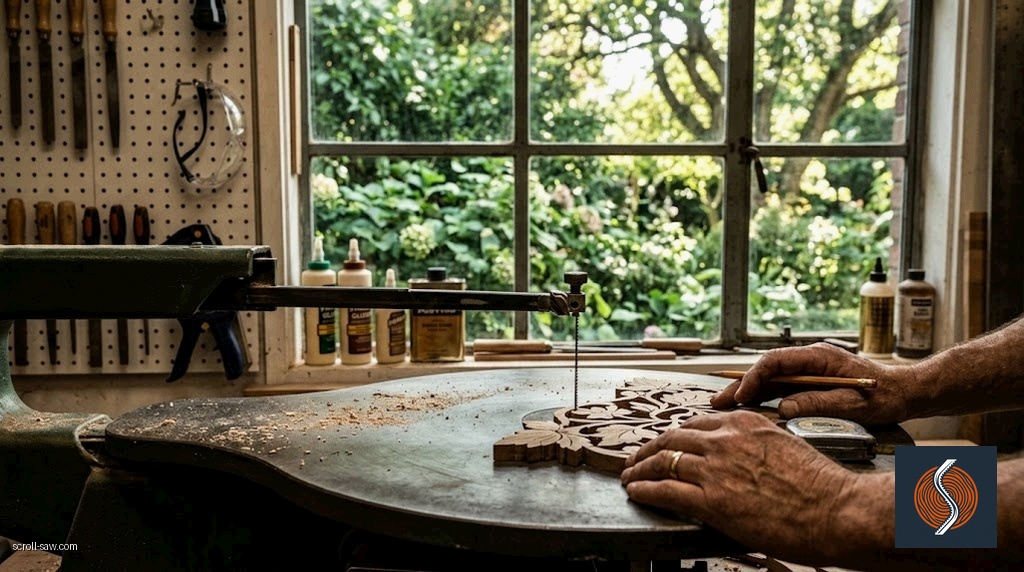
Craftsman 18 Inch Scroll Saw: Selection Guide
The 18-inch throat depth is one of the less common Craftsman scroll saw sizes. Sears carried 18-inch Craftsman scroll saws intermittently, positioned between the popular 16-inch benchtop units and the 20-plus inch professional saws. The 18-inch class handles pattern work that a 16-inch throat cannot quite reach: interior cuts in panels 30 to 36 inches wide, larger fretwork projects, and sign work in wider material.
For most hobby use, a 16-inch is enough. For scrollers who work in wider panels regularly, an 18-inch adds usable capacity without moving to the price tier of professional 20-plus inch saws.
When 18 inches matters
Throat depth sets the maximum reach from the blade to the back of the arm. That determines how far into a panel the blade can cut.
16-inch throat: cuts through the center of a piece up to 32 inches wide.
18-inch throat: cuts through the center of a piece up to 36 inches wide.
20-inch throat: cuts through the center of a piece up to 40 inches wide.
For pieces cut near an edge (where the pattern does not require reaching the center), all throat depths handle larger pieces than the throat suggests.
When 18 inches earns its place:
-
Sign work in 24 to 36 inch panels with interior cuts near the center
-
Large fretwork panels
-
Puzzle work with pieces cut from wide stock
-
Decorative bracket work in wider dimensions
When 16 inches is enough:
-
Ornaments, small plaques, jewelry
-
Puzzles under 24 inches
-
Small fretwork
-
Most hobby work
What to look for in a Craftsman 18-inch
Motor and speed: variable speed is strongly preferred over single-speed. Range should cover roughly 400 to 1,600 SPM.
Arm mechanism: smooth pivot, no play, no unusual noise.
Clamps: check gripping surface for grooves; verify they close firmly.
Table: flat, tilts and locks reliably, blade slot in reasonable condition.
Vibration: run the saw briefly at multiple speeds. Excessive vibration on an 18-inch usually means motor mount issues or arm bearing wear.
Blade format: check whether pin-end or plain-end. Older 18-inch Craftsman may be pin-end; newer are plain-end.
Blade selection for an 18-inch
Same principles as any scroll saw. Match blade size to material and curve radius:
#5 skip-tooth (workhorse): general pattern work, soft wood 1/4 to 1/2 inch. Buy in dozen packs.
#3 skip-tooth or reverse-tooth (fine): Baltic birch fretwork, name plaques with detailed patterns.
#7 skip-tooth (wider): thicker material or harder wood.
#9 skip-tooth (aggressive): thick soft wood or hardwood.
Reverse-tooth #3 or #5: plywood pattern work.
Precision-ground or MGT #5 or #7: hardwood pattern work.
Metal-cutting 30 to 40 TPI: thin non-ferrous sheet.
Spiral: sign interiors and sculpted work.
A dozen pack of Olson skip-tooth blades covers general work.
Setup for an 18-inch
Stand or heavy bench: 18-inch saws are heavier than benchtop 16-inch machines. A heavy bench or purpose-built stand improves stability and reduces walking during aggressive feed.
Height: elbow height for standing work, shoulder height for seated. 18-inch saws often live on stands at 34 to 38 inches.
Dust extraction: connect the extraction port to a shop vacuum. Larger throat saws produce more dust per cut because of the longer cuts they enable.
Foot switch: hands-free start-stop. Not required but improves workflow.
Zero-clearance table insert: for thin material and metal cutting.
Auxiliary lighting: 18-inch saws often position the pattern further from typical bench lighting. A dedicated task light on the saw arm is helpful.
Speed and feed on an 18-inch
Soft wood pattern work: 1,200 to 1,500 SPM.
Hardwood pattern work: 800 to 1,100 SPM.
Plywood fretwork: 1,100 to 1,400 SPM.
Plastic or acrylic: 500 to 800 SPM.
Metal: 400 to 600 SPM.
Feed steady, light, continuous. The 18-inch’s larger frame provides better stability but the same feed principles apply.
Common Craftsman 18-inch models
Specific 18-inch Craftsman model numbers vary. Common in the used market:
Older 113-series 18-inch (1980s to early 1990s): rigid steel construction, pin-end blades, often variable speed.
137-series 18-inch (mid-1990s onward): Rexon-made, plain-end or convertible, variable speed.
Specific model number identifies exact features. Check the model plate on your specific saw.
When an 18-inch is worth the price premium over a 16-inch
An 18-inch scroll saw costs more than a 16-inch new. On the used market, 18-inch models are less common and often command higher prices than 16-inch equivalents.
Worth the premium: you regularly work in panels 24 inches wide or wider with interior cuts near the center.
Not worth the premium: you primarily work in smaller pieces where 16 inches is enough.
For scrollers who occasionally need wider capacity, workarounds exist: cut the pattern near an edge rather than in the center, or split large panels into smaller pieces before cutting.
Maintenance for an 18-inch
Bearings, clamps, motor mount, and mechanism all wear similarly to smaller scroll saws. The 18-inch’s larger arm carries more mass and may develop bearing wear slightly faster than a 16-inch, but replacement parts are the same class.
Unplug for every blade change.
Detension between sessions.
Brush clamps clean.
Check arm bearings periodically.
Empty dust extraction.
Check motor mount tightness annually.
Small habits for better cuts
Break in new blades with a minute of slow cutting.
Match blade to material and curve radius.
Start motor before feeding.
Watch chip clearance.
Check table square after blade changes.
Rotate partially worn blades to lighter work.
When an 18-inch is not the right saw
Very fine detail work: any modern scroll saw handles fine work; 18-inch’s larger throat is unrelated.
Small shop with strict space limits: 18-inch saws take up more space than 16-inch. If space is tight, 16-inch is more practical.
Professional production: dedicated 20-plus inch professional saws (Hegner, Excalibur, Pegas) are the right choice.
FAQ
When does 18 inches matter over 16 inches? Interior cuts in panels wider than 32 inches, or large fretwork projects.
Are Craftsman 18-inch scroll saws still made? Varies by year and retailer. Check current Craftsman offerings.
What blade format? Depends on model. Check clamps.
Best all-purpose blade? #5 skip-tooth.
Do I need a stand for an 18-inch? Recommended. 18-inch saws are heavier and benefit from a purpose-built stand.
Speed range on a Craftsman 18-inch? Usually 400 to 1,600 SPM on variable-speed models.
Are parts available? Varies by model and generation.
References
-
Craftsman parts and manual archive via ManualsLib.
-
Olson Saw Company. Scroll saw blade catalog.
-
Scroll Saw Woodworking & Crafts forum. Craftsman scroll saw discussion archive.
Title tag: Craftsman 18 Inch Scroll Saw: Selection Guide Meta description: Practical guide to Craftsman 18-inch scroll saws. When 18 inches matters, blade selection, and setup. URL slug: craftsman-18-inch-scroll-saw Excerpt: A practical guide to Craftsman 18-inch scroll saws. When 18-inch throat depth earns its place over 16-inch, blade selection, setup, and used-market considerations.


