
Craftsman 20 Inch Scroll Saw: Better Cuts Guide
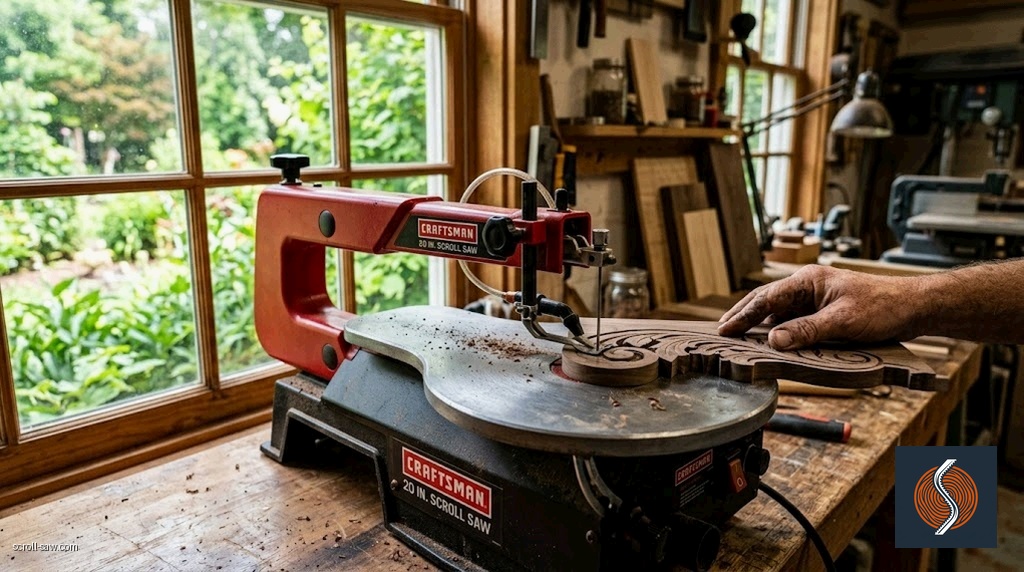
Craftsman 20 Inch Scroll Saw: Better Cuts Guide
Twenty-inch scroll saws sit at the upper end of the benchtop class. Craftsman offered 20-inch scroll saws intermittently across decades, and used units still appear in the market. The 20-inch throat depth accommodates interior cuts in panels up to 40 inches wide, which covers essentially any hobby-scale scroll saw work and much light professional work.
A well-maintained Craftsman 20-inch scroll saw produces cuts as clean as any premium scroll saw when fitted with a good blade. What sometimes limits used units is decades of accumulated wear that shows up as vibration, blade drift, or motor issues. Working through these wear points restores the saw’s cutting quality.
What 20 inches gets you
Interior cuts in wide panels: up to 40 inches wide with the pattern near center. Wider pieces cut with pattern near an edge.
Long unbroken cut lines: fewer restarts and fewer entry points for interior work.
Larger pattern work: architectural fretwork, large signs, decorative brackets.
Stack cutting in wider dimensions: for production of multiple identical pieces.
Reduced pattern rotation: less need to rotate the workpiece during cutting because the throat reaches further.
For scrollers whose work stays in small dimensions, most of this capacity is unused. For scrollers who regularly cut wider pieces or produce larger pattern work, 20 inches is a step up from 16 or 18 inches.
Craftsman 20-inch models
Older Craftsman 20-inch (1970s to 1980s, 113 series): made by King-Seeley. Rigid steel construction, pin-end blades, single-speed on most units. Heavy and stable.
Newer Craftsman 20-inch (1990s to 2000s, 137 series): made by Rexon. Aluminum construction, plain-end or convertible clamps, variable speed.
Both generations produce good cuts when properly maintained.
Common wear on used 20-inch Craftsman scroll saws
Arm bearing wear: the 20-inch arm is longer and heavier than smaller scroll saw arms; bearing wear develops similarly but with slightly higher stress. Play at the pivot produces wobbly cuts.
Motor mount issues: 20-inch saws are heavier and the motor mount bolts can loosen over decades. A loose mount transfers vibration through the frame.
Clamp face grooves: same as any scroll saw. Set-screw clamps develop grooves over time.
Dust and debris in the mechanism: 20-inch saws produce more sawdust per hour because of the longer cuts they enable. Regular cleaning matters more.
Speed controller failure (variable-speed models): after 20 years of use, speed controller electronics can fail. Replacement controller boards are sometimes available.
Blower failure: aftermarket blower replacements are inexpensive.
Restoring a 20-inch Craftsman
Similar procedures to smaller Craftsman scroll saws:
-
Clean the mechanism.
-
Check arm bearings for play; replace if worn.
-
Inspect and restore clamps (steel wool for minor grooves; replace for deep).
-
Tighten motor mount.
-
Replace speed controller if it has failed on variable-speed models.
-
Check power cord and switch.
-
Verify table is flat and square to blade.
A restored Craftsman 20-inch runs like a new scroll saw and produces cuts of equivalent quality.
Blade selection
Blade choice on a 20-inch Craftsman follows the same rules as any scroll saw.
Match blade width to curve radius:
-
Curves under 1/16 inch: #2 or #2/0
-
Curves 1/16 to 1/8 inch: #3
-
Standard curves (1/8 inch or wider): #5
-
Broad curves and straight: #7 or wider
Match tooth geometry to material and finish requirement:
-
General pattern work: skip-tooth
-
Plywood pattern work: reverse-tooth
-
Hardwood pattern work: precision-ground or MGT
-
Sign interiors and sculpted work: spiral
-
Non-ferrous metal: metal-cutting
Match blade size to material thickness:
-
1/4 to 1/2 inch soft wood: #5
-
1/2 to 1 inch soft wood: #7
-
1 to 2 inches soft wood: #9
-
1/4 to 1/2 inch hardwood: #5 precision-ground
-
1/2 to 3/4 inch hardwood: #7 precision-ground
-
3/4 to 1 inch hardwood: #9 precision-ground
A dozen pack of Olson skip-tooth blades covers general work at reasonable cost.
Speed and feed for better cuts
On variable-speed 20-inch Craftsman scroll saws, match speed to material:
Soft wood pattern work: 1,200 to 1,500 SPM.
Hardwood pattern work: 800 to 1,100 SPM.
Plywood fretwork: 1,100 to 1,400 SPM.
Plastic: 500 to 800 SPM.
Metal: 400 to 600 SPM.
Thick material (over 1 inch): reduce speed slightly to give the motor a chance and to keep the blade running cool.
On single-speed 20-inch Craftsman saws (fixed at roughly 1,700 SPM), adjust feed and blade selection to compensate. Lighter feed, sharper blade, coarser tooth geometry all help when the speed is fixed at a rate faster than ideal for the material.
Setup for a 20-inch
Heavy stand or bolted to a heavy bench: 20-inch Craftsman scroll saws weigh 50 to 80 pounds. They need substantial support to prevent walking.
Height: elbow height when standing, shoulder height when seated. 34 to 38 inches for the table.
Dust extraction: 20-inch saws produce more dust; connect the extraction port to a shop vacuum.
Foot switch: hands-free start-stop; useful for long cuts and blade changes.
Auxiliary lighting: a dedicated task light on the saw arm.
Zero-clearance table insert: for thin material and metal.
Small habits for better cuts on a 20-inch
Break in new blades with a minute of slow cutting.
Check table square to blade after every blade change.
Unplug for every blade change.
Detension between sessions.
Start the motor before feeding.
Feed steady, light, continuous.
Watch chip clearance.
Rotate partially worn blades to lighter work.
Bolt the saw to its stand.
Empty dust extraction periodically.
When a 20-inch is worth the space
Yes: regular work in wide panels, larger pattern projects, production of multiple identical pieces from wide stock.
Maybe: shop has the space and the used unit is priced reasonably.
No: primarily small-piece work where 16 inches is enough, and shop space is limited.
For scrollers who occasionally cut wide pieces, splitting the pattern across multiple entry points (or splitting the panel before cutting) works around a smaller throat.
FAQ
Is a 20-inch Craftsman worth using? If in good mechanical condition, yes.
What blade format? Older 113-series is pin-end. Newer 137-series is usually plain-end.
Speed range? Variable-speed models usually 400 to 1,600 SPM. Single-speed at roughly 1,700 SPM.
Best blade for general use? #5 skip-tooth.
Can I cut hardwood on a 20-inch Craftsman? Yes, in appropriate thickness.
Do I need a stand? Recommended. 20-inch saws are heavy and need stable support.
Are parts available for older 20-inch Craftsman? Some through Sears parts direct and independent Craftsman parts specialists.
References
-
Craftsman parts and manual archive via ManualsLib.
-
Olson Saw Company. Scroll saw blade catalog.
-
Scroll Saw Woodworking & Crafts forum. Craftsman 20-inch scroll saw discussions.
Title tag: Craftsman 20 Inch Scroll Saw: Better Cuts Guide Meta description: Get better cuts from a Craftsman 20-inch scroll saw. Restoration, blade selection, speed, and feed. URL slug: craftsman-20-inch-scroll-saw Excerpt: Getting better cuts from a Craftsman 20-inch scroll saw. Common wear on used units, restoration, blade selection, and setup that transforms an old scroll saw into a good-cutting one.


