
Craftsman Scroll Saw Blades: Modern Selection
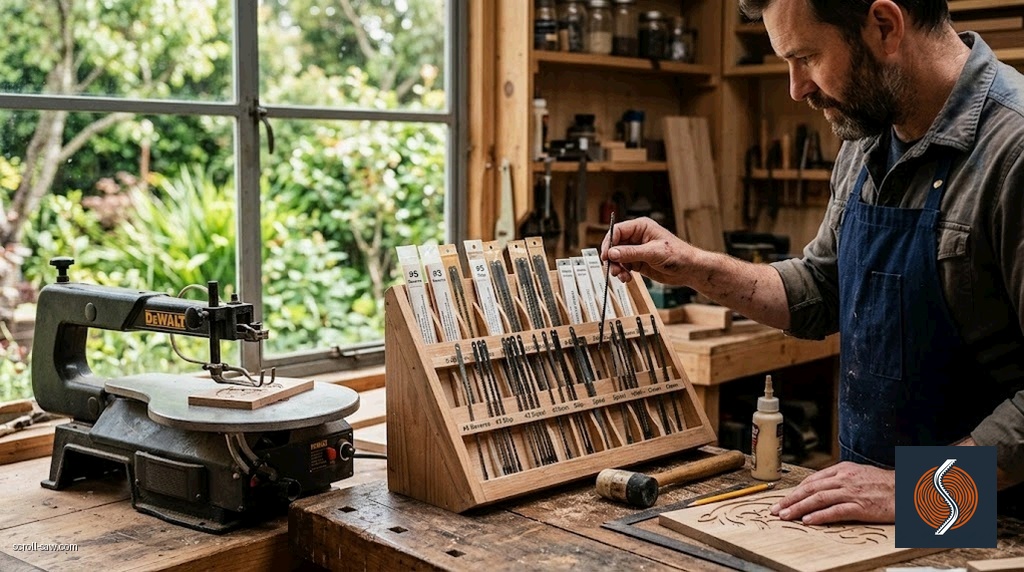
Craftsman Scroll Saw Blades: Modern Selection
Craftsman-branded scroll saw blades were a common sight on Sears store racks for decades. Sears sold blades under the Craftsman name that were manufactured by various third-party blade makers (often Olson) and packaged for Craftsman retail. Sears no longer stocks Craftsman-branded scroll saw blades in most stores, but the machines they were sold with are still in wide use and the blade selection principles for them remain the same.
For a Craftsman scroll saw owner today, the practical question is: which modern scroll saw blades fit my Craftsman, and how do I match them to material and thickness?
What Craftsman-branded blades were
Craftsman scroll saw blades were standard 5-inch scroll saw blades in either pin-end or plain-end format. The blade steel and tooth geometry were made by scroll saw blade specialists under private-label contracts. Olson supplied many of the Craftsman-branded packs over the years.
The blades that came in a Craftsman-branded pack were mechanically equivalent to Olson blades of the same size and geometry sold under the Olson brand. There was nothing Craftsman-specific about them beyond the packaging.
What fits a Craftsman scroll saw today
Any modern scroll saw blade in the correct format fits a Craftsman scroll saw:
Pin-end Craftsman scroll saws (older 113-series, some 137-series): pin-end blades from Olson, Pegas, Niqua, and other manufacturers.
Plain-end Craftsman scroll saws (newer 137-series and later): plain-end blades from any manufacturer.
Convertible clamps: some Craftsman scroll saws accept both formats through swappable clamp components. Check your specific saw.
Pin-end saw + plain-end blade stock: use a pinless blade adapter (Olson AC49610).
Blade sizes
Standard scroll saw blade numbers:
#2/0: 0.020 inch wide, 25 TPI. Very fine fretwork.
#2: 0.028 inch wide, 20 TPI. Fine work.
#3: 0.030 inch wide, 18 TPI.
#5: 0.038 inch wide, 12.5 TPI. Workhorse.
#7: 0.045 inch wide, 11.5 TPI.
#9: 0.055 inch wide, 11 TPI.
#12: 0.062 inch wide, 9 TPI.
Blade width sets minimum turning radius. Narrow blades turn tighter curves; wider blades hold straighter lines in thicker material.
Tooth geometries
Skip-tooth: every second tooth space empty. Better chip clearance. Workhorse geometry for scroll saw work.
Double-tooth: paired teeth with gullet between pairs. Finer finish than skip-tooth.
Reverse-tooth: skip-tooth with a few bottom teeth reversed. Cleans exit face on plywood.
Precision-ground (PGT): ground teeth for sharper edge and longer life. Higher cost.
Modified geometry (MGT): variable tooth spacing. Fast cutting with clean finish in hardwood. Higher cost.
Spiral: teeth wrap around blade for all-directions cutting.
Metal-cutting: high TPI (30 to 50) for non-ferrous sheet.
Material matching
Soft wood (pine, poplar, basswood) 1/4 to 1/2 inch: #5 skip-tooth at 1,200 to 1,500 SPM.
Soft wood 1/2 to 1 inch: #7 skip-tooth at 1,000 to 1,300 SPM.
Soft wood 1 to 2 inches: #9 skip-tooth at 800 to 1,000 SPM.
Baltic birch 1/8 inch: #3 reverse-tooth at 1,000 to 1,300 SPM.
Baltic birch 1/4 inch: #5 reverse-tooth at 1,100 to 1,400 SPM.
Baltic birch 3/8 to 1/2 inch: #5 or #7 reverse-tooth at 1,000 to 1,300 SPM.
Hardwood (oak, maple, cherry, walnut) 1/4 to 1/2 inch: #5 skip-tooth or precision-ground at 900 to 1,100 SPM.
Hardwood 1/2 to 3/4 inch: #7 precision-ground at 800 to 1,000 SPM.
Hardwood 3/4 to 1 inch: #9 precision-ground at 700 to 900 SPM.
Cast acrylic 1/8 to 1/4 inch: #5 skip-tooth at 500 to 800 SPM. Cutting wax essential.
Thin non-ferrous metal: 30 to 40 TPI metal-cutting blade at 400 to 600 SPM.
Sign interiors: spiral blade at speed appropriate to material.
Radius matching
Match blade width to the tightest inside curve in the pattern:
-
Curves under 1/16 inch: #2 or #2/0.
-
Curves 1/16 to 1/8 inch: #3.
-
Standard pattern curves (1/8 inch or wider): #5.
-
Broad curves and straight cuts: #7 or wider.
A blade wider than the pattern’s tightest curve forces sideways in the cut and drifts. A narrower blade turns the curve but wears faster in the thick sections.
Blade stock for a Craftsman scroll saw
A working blade drawer for a Craftsman scroll saw:
-
Two dozen #5 skip-tooth (primary, 70 percent of use)
-
One dozen #3 skip-tooth or reverse-tooth (fine pattern work)
-
One dozen #7 skip-tooth (thicker material)
-
Half dozen #9 skip-tooth (thick cuts, less frequent)
-
Half dozen reverse-tooth #5 (plywood work)
-
Optional: precision-ground or MGT #5 and #7 for hardwood
-
Optional: metal-cutting blades
-
Optional: spirals
A dozen pack of Olson skip-tooth blades covers the primary slot at reasonable cost. Verify pin-end or plain-end format for your specific Craftsman before ordering.
Where to buy scroll saw blades for a Craftsman today
Amazon: Olson blades in most sizes and formats. Some Pegas selection. Widely stocked.
Home Depot and Lowe’s: limited scroll saw blade selection. Basic sizes only.
Rockler and Woodcraft: broader selection including specialty formats.
Bear Woods: full Pegas line and specialty blades.
Sears: no longer a reliable source for Craftsman-branded blades.
Small habits
Break in new blades with a minute of slow cutting.
Match blade to material and curve radius before starting.
Install with teeth pointing down toward the table.
Tension to a clear high pluck note.
Check blade square to table.
Detension between sessions.
Store blades flat in a divided case.
Rotate partially worn blades to lighter work.
When Craftsman-branded blades were adequate
Original Craftsman-branded blade packs were adequate general-purpose scroll saw blades. Modern Olson blades in the same sizes are equivalent (and often actually the same product). Pegas, Flying Dutchman, and Niqua make blades of equal or higher quality in some categories.
For a Craftsman scroll saw owner today, the practical answer is: buy modern scroll saw blades in the right format and size for your work. The Craftsman brand on the pack is not needed.
FAQ
Are Craftsman-branded scroll saw blades still made? Sears no longer stocks Craftsman-branded scroll saw blades in most stores.
What blades fit a Craftsman scroll saw? Standard 5-inch scroll saw blades in the format your saw uses (pin-end or plain-end).
Are Olson blades better than the old Craftsman blades? Equivalent to slightly better. Many of the old Craftsman-branded blades were Olson product.
Best blade for general Craftsman scroll saw use? #5 skip-tooth.
Where do I buy scroll saw blades today? Amazon, Rockler, Woodcraft, Bear Woods, specialty scroll saw retailers.
Do I need a pinless blade adapter? Only if you have a pin-end saw and want to use plain-end specialty blades.
How long does a scroll saw blade last? 30 to 60 minutes of continuous cutting in typical hobby material.
References
-
Olson Saw Company. Scroll saw blade catalog.
-
Pégas Scroll Saw Blades via Bear Woods.
-
Craftsman parts and manual archive via ManualsLib.
Title tag: Craftsman Scroll Saw Blades: Modern Selection Meta description: Match modern scroll saw blades to material and thickness on Craftsman scroll saws. Sizes and tooth geometry. URL slug: craftsman-scroll-saw-blades Excerpt: Craftsman scroll saw blade selection using modern replacements. Match blade number to material and thickness for pin-end and plain-end Craftsman scroll saws.


