
Craftsman Scroll Saw Parts: Selection Guide
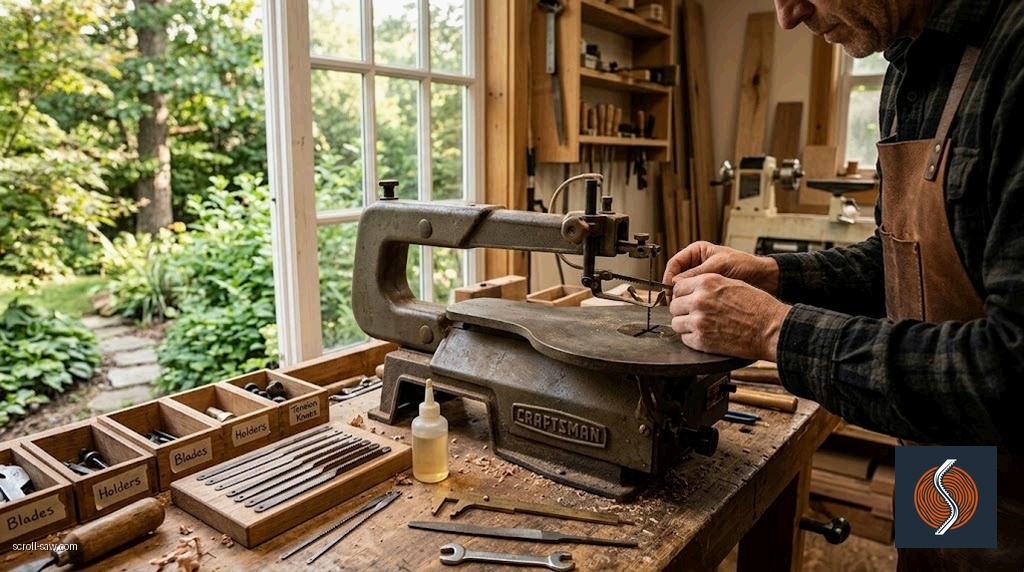
Craftsman Scroll Saw Parts: Selection Guide
Craftsman scroll saws are still in wide use decades after their original sale. Machines from the 1970s through 2000s sit in home shops across the country, cutting well when properly maintained. What limits many of them is parts availability: bearings, clamps, motor brushes, speed controller boards, tension springs, and other components eventually wear out, and the parts that came with the saw were not always still stocked twenty years later.
This guide covers where Craftsman scroll saw parts come from today, what parts are commonly needed, and when a shop-made or aftermarket alternative works as well or better than an original replacement.
Where Craftsman scroll saw parts come from
Sears parts direct: some Craftsman scroll saw parts are still available through Sears’ parts network. Selection depends on the specific model and part. Older 113-series parts are more spotty than newer 137-series parts.
Independent Craftsman parts specialists: several online retailers specialize in legacy Craftsman parts. Availability varies but they are a better source than Sears for older models in many cases.
Rexon: newer Craftsman scroll saws were made by Rexon Industrial. Some parts flow through Rexon’s service network.
Salvaged units: broken Craftsman scroll saws can be parts sources for still-working units of the same model. Estate sales and used-tool dealers sometimes carry non-working units cheaply.
Aftermarket universal parts: bearings, motors, switches, cords, and many other components are standard industrial parts that fit multiple scroll saws. Bearing suppliers, motor rewinders, and electrical parts distributors carry these.
Shop-made parts: some parts (tension springs, small brackets, table inserts) can be made in a shop with basic tools. Aftermarket universal alternatives are often available too.
Common parts that wear out
Arm bearings: sealed ball bearings press-fit into the arm pivot. Wear develops as vertical play at the blade during the stroke. Bearing supplier stocks equivalent bearings by dimension.
Motor brushes (on brushed motors): wear as the motor runs. Replacement brushes are common motor parts.
Motor bearings: same as arm bearings, replaced through bearing suppliers.
Clamps: gripping surfaces develop grooves. Original Craftsman clamps sometimes available; aftermarket universal clamps fit some models.
Set screws in clamps: standard hardware, replaced with correct thread pitch and length.
Blade tension spring: some Craftsman scroll saws use a tension spring that weakens over decades. Springs can be made from replacement stock or sometimes found in original parts inventory.
Power cord: standard 3-conductor cord, easy to replace.
On-off switch: standard rated switch, easy to replace.
Speed controller (variable-speed models): electronic control board. Some replacements available; others require custom electronics work.
Blower: small blower motor that clears dust from the cut line. Aftermarket replacements are inexpensive.
Table insert: the plastic or metal insert around the blade in the table. Easy to make from thin plywood or plastic sheet.
Belt (belt-drive models): standard V-belt or timing belt. Replaced through industrial suppliers by size.
Blade guards: sometimes broken or lost. Aftermarket or shop-made replacements are usable.
When to buy an original replacement
Yes: precision parts like motor and speed controller. Original replacements have known specifications and fit.
Maybe: clamps and tension mechanism. Original replacements are often better but aftermarket universal parts may work.
Rarely: bearings, switches, cords, small hardware. Universal replacements are usually as good or better than original parts.
When to make a shop-made part
Yes: table inserts, blade guards, tension springs, dust chutes, simple brackets.
Maybe: complex castings that no one stocks anymore. A shop with metalworking capability can sometimes replicate these.
No: motor internals, speed controllers, precision-fit components.
Setup and maintenance to reduce parts needs
Detension between sessions: reduces stress on the tension spring and clamps.
Brush clamps clean at every blade change: keeps gripping surfaces flat and extends clamp life.
Unplug for every blade change: safety, and reduces risk of electrical damage.
Empty dust extraction: prevents dust from packing into the mechanism.
Check motor mount annually: loose mounts wear the mount bolts and cause vibration.
Bolt saw to bench or stand: reduces walking during aggressive feed.
Oil pivot points if the manual specifies: many modern Craftsman scroll saws use sealed bearings that do not need lubrication, but check your manual.
Cover the saw when not in use: reduces dust ingress.
Blade selection reduces mechanical stress
Correct blade selection reduces load on the saw’s mechanism. Overloading with too-narrow or too-fine a blade in thick material forces the operator into higher feed pressures that wear clamps, bearings, and motor faster.
Match blade size to material: #5 for 1/4 to 1/2 inch soft wood, #7 for thicker, #9 for very thick.
Match tooth geometry to material: skip-tooth for general work, reverse-tooth for plywood, precision-ground for hardwood.
Match blade width to curve radius: wider blade for broader curves, narrower blade for tighter curves.
A dozen pack of Olson skip-tooth blades covers general work at reasonable cost.
Identifying your specific model
Craftsman scroll saw model numbers appear on a metal plate typically at the base of the saw. Common formats:
-
113.NNNNNN (King-Seeley manufactured, older)
-
137.NNNNNN (Rexon manufactured, newer)
-
Other prefixes for other manufacturers
Search by exact model number when looking for parts. Manuals with parts diagrams are archived at ManualsLib and similar sites.
When to give up on parts
Motor burned or seized: replacement motor is often the whole saw’s value or more. Consider a new scroll saw.
Frame casting cracked: usually not economically repairable.
Multiple worn components at once: the total cost of parts and labor may exceed the used saw’s value.
For a well-cared-for Craftsman scroll saw with one or two worn components, parts and repair are worth it. For a saw that needs multiple major components, buying a new WEN or Ryobi may be more economical.
FAQ
Where do I find parts for old Craftsman scroll saws? Sears parts direct, independent Craftsman parts specialists, salvaged units, and aftermarket universal parts.
Are 113-series parts still available? Some. Availability varies by specific model number.
Can I use aftermarket bearings? Yes. Match dimensions to the original bearings.
How do I identify my specific Craftsman scroll saw model? Check the model plate at the base of the saw.
What’s the most common part that wears out? Arm bearings and blade clamps.
Is it worth restoring a Craftsman scroll saw? Depends on the specific machine’s condition and the parts needed.
Do I need original Craftsman parts? Only for precision components. Most parts have aftermarket equivalents.
References
-
Craftsman parts and manual archive via ManualsLib.
-
Sears Parts Direct via Sears legacy parts network.
-
Scroll Saw Woodworking & Crafts forum. Craftsman scroll saw restoration discussions.
Title tag: Craftsman Scroll Saw Parts: Selection Guide Meta description: Where to find Craftsman scroll saw parts today. Common wear items, alternatives, and when to restore. URL slug: craftsman-scroll-saw-parts Excerpt: Where to find Craftsman scroll saw parts today. Common wear items, aftermarket alternatives, and when a shop-made or salvaged part works as well as an original replacement.


