
Craftsman 315 Scroll Saw: Blade Selection Guide
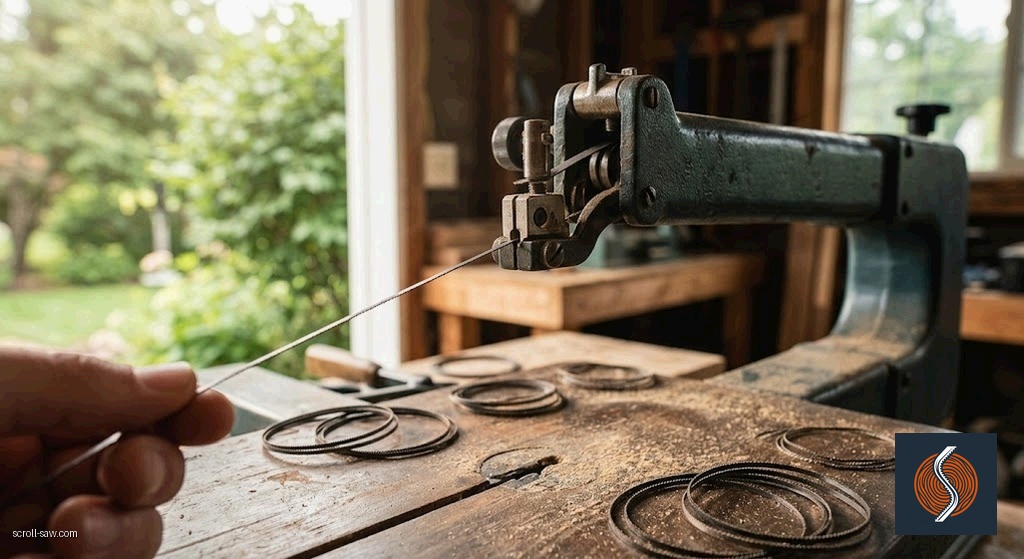
Craftsman 315 Scroll Saw: Blade Selection Guide
Craftsman scroll saws with a 315 model prefix identify machines manufactured by Ryobi under contract to Sears. The 315 designation appears on saws sold in the 1990s and 2000s, a slightly earlier era than the Rexon-made 137 series. The 315 machines share design elements with Ryobi’s own-branded scroll saws from that period.
For an owner of a Craftsman 315 scroll saw today, the practical questions are the same as for any older Craftsman: what blades fit, how to size them for material, and how to get the best cut quality from an aging machine.
What the 315 offers
Throat depth: usually 16 inches, though 20-inch 315 models existed.
Variable speed: on most 315 models, roughly 400 to 1,600 SPM.
Blade format: mostly plain-end on 315 models, though some units accept both formats through swappable clamps.
Cast-aluminum table: tilts for bevel cuts.
Ryobi-based mechanism: similar to Ryobi-branded scroll saws from the same era.
Check the specific 315 model number on your saw’s data plate for exact features.
Blade size (TPI and width)
Standard scroll saw blade sizes fit the 315:
#2/0: 0.020 inch wide, 25 TPI. Very fine fretwork.
#2: 0.028 inch wide, 20 TPI.
#3: 0.030 inch wide, 18 TPI.
#5: 0.038 inch wide, 12.5 TPI. Workhorse.
#7: 0.045 inch wide, 11.5 TPI.
#9: 0.055 inch wide, 11 TPI.
#12: 0.062 inch wide, 9 TPI.
Blade width sets minimum turning radius. Higher TPI means finer finish and slower cutting.
Kerf
Kerf is the width of material the blade removes. Approximate kerf values:
-
#3 skip-tooth: 0.030 inch
-
#5 skip-tooth: 0.035 inch
-
#7 skip-tooth: 0.045 inch
-
#9 skip-tooth: 0.055 inch
Kerf matters for tight-fitting joints (puzzles, interlocking pieces). Narrow kerf means tighter fit; wider kerf means looser fit.
Turning radius
Minimum inside radius by blade size:
-
#2/0 to #2: 1/32 to 1/16 inch
-
#3: 1/16 to 1/8 inch
-
#5: 1/8 inch
-
#7: 3/16 inch
-
#9: 1/4 inch
-
#12: 3/8 inch or wider
Match blade width to the tightest inside curve in the pattern.
Finish quality by tooth geometry
Standard tooth: smooth finish but slow cutting.
Skip-tooth: moderate finish, fast cutting. Workhorse for general work.
Reverse-tooth: clean finish on both faces (top and bottom), good for plywood.
Precision-ground (PGT): excellent finish, longer blade life, higher cost. Best for hardwood.
Modified geometry (MGT): excellent finish in hardwood, fast cutting, higher cost.
Double-tooth: fine finish with medium chip clearance.
Spiral: rough finish; requires sanding.
Material and thickness on a 315
Soft wood 1/4 to 1/2 inch: #5 skip-tooth at 1,200 to 1,500 SPM.
Soft wood 1/2 to 1 inch: #7 skip-tooth at 1,000 to 1,300 SPM.
Soft wood 1 to 2 inches: #9 skip-tooth at 800 to 1,000 SPM.
Baltic birch 1/8 inch: #3 reverse-tooth at 1,000 to 1,300 SPM.
Baltic birch 1/4 inch: #5 reverse-tooth at 1,100 to 1,400 SPM.
Baltic birch 3/8 to 1/2 inch: #5 or #7 reverse-tooth at 1,000 to 1,300 SPM.
Hardwood 1/4 to 1/2 inch: #5 precision-ground or MGT at 900 to 1,100 SPM.
Hardwood 1/2 to 3/4 inch: #7 precision-ground at 800 to 1,000 SPM.
Hardwood 3/4 to 1 inch: #9 precision-ground at 700 to 900 SPM.
Cast acrylic 1/8 to 1/4 inch: #5 skip-tooth at 500 to 800 SPM. Cutting wax essential.
Thin non-ferrous metal: 30 to 40 TPI metal-cutting blade at 400 to 600 SPM.
Speed control on the 315
Most 315 models are variable-speed. Adjust before starting.
Watch motor sound and chip clearance during the cut. Adjust feed or speed if either is off.
Motor pitch drop: feed too fast for the material.
Fine dust rather than shavings: blade dull or feed too slow.
Burn stripes on the cut face: speed too high or feed too slow.
Setup and maintenance for a 315
Unplug for every blade change.
Detension between sessions.
Brush clamps clean at every blade change.
Check arm bearings for play periodically.
Check motor mount tightness annually.
Bolt the saw to a bench or stand.
Empty dust extraction.
Set up dedicated task lighting.
Blade format on a 315
Mostly plain-end. Some 315 units are pin-end. Check the clamps on your specific saw.
Plain-end: widest modern selection.
Pin-end: covers standard geometries; specialty formats limited.
Pin-end saw + plain-end blade stock: use a pinless blade adapter (Olson AC49610).
A dozen pack of Olson skip-tooth blades covers general work.
Parts and service for a 315
Ryobi-manufactured Craftsman parts flow through Ryobi’s service network and through Sears parts direct.
Common parts: bearings, motor components, clamps, table inserts, blower units.
Sometimes available: speed controllers, unique casting components.
Aftermarket alternatives: many parts are standard industrial components.
Small habits for better cuts on a 315
Break in new blades with a minute of slow cutting.
Match blade size and geometry to material.
Check blade square to table.
Start motor before feeding.
Feed steady, light, continuous.
Watch chip clearance.
Rotate partially worn blades to lighter work.
Store blades flat in a divided case.
When a 315 is worth restoring
Yes: motor runs smoothly, arm has no significant play, castings intact, clamps grip firmly or can be restored.
Maybe: motor sounds rough (bearings replaceable), arm has minor wear.
No: motor burned, castings cracked, missing major components.
For a working or restorable Craftsman 315 in good structural condition, restoration cost is much lower than a new saw.
FAQ
Who manufactured the Craftsman 315 series? Ryobi under contract to Sears.
What blade format on a 315? Mostly plain-end. Check the clamps.
Are 315 saws still made? No. Machines exist on the used market.
Best blade for general use? #5 skip-tooth.
Speed range? Usually 400 to 1,600 SPM.
Can I cut hardwood? Yes, in appropriate thickness.
Are parts available? Some, through Ryobi’s service network and Sears parts direct.
References
-
Craftsman parts and manual archive via ManualsLib.
-
Ryobi Power Tools. Scroll saw product documentation.
-
Olson Saw Company. Scroll saw blade catalog.
Title tag: Craftsman 315 Scroll Saw: Blade Selection Guide Meta description: TPI, kerf, radius, and finish on Craftsman 315 scroll saws. Blade selection and setup reference. URL slug: craftsman-315-scroll-saw Excerpt: TPI, kerf, minimum turning radius, and finish quality across common blade options for Craftsman 315 (Ryobi-made) scroll saws. Blade selection and setup reference.


