
Craftsman Contractor Series Scroll Saw: Better Cuts
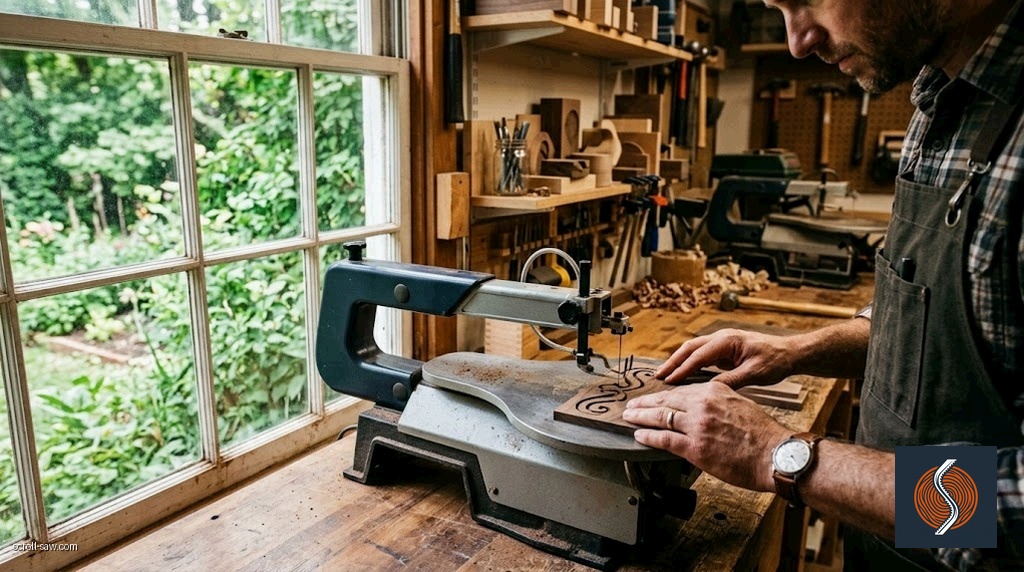
Craftsman Contractor Series Scroll Saw: Better Cuts
The Craftsman Contractor Series scroll saws were positioned as heavier-duty versions of the standard Craftsman benchtop line. Sold in the 1990s and 2000s, the Contractor Series units generally featured heavier construction, more powerful motors, and larger throats than the entry-level Craftsman scroll saws of the same era.
For owners of a Craftsman Contractor Series scroll saw today, the machine represents good raw material for scroll saw work. Getting the most out of it means understanding what makes the Contractor line different and adjusting technique and blade choice to take advantage of the extra capacity.
What Contractor Series meant
Heavier motor: usually a higher-wattage motor than the entry Craftsman scroll saw of the same year.
Larger throat: often 18 or 20 inches versus 16 inches on entry models.
Rigid frame: heavier casting and less vibration.
Variable speed: standard on Contractor models.
Plain-end or convertible clamps: modern format.
Cast-aluminum table: tilts for bevel cuts.
Dust extraction and blower: standard features.
Cutting capacity: often 2 to 2.5 inches of soft wood, 1 to 1.5 inches of hardwood.
The extra capacity matters most for scrollers who work in thicker stock or larger panels.
Where Contractor Series machines excel
Hardwood work: heavier motor and rigid frame handle dense wood better than lighter benchtop scroll saws.
Thick soft wood: 1.5 to 2 inch thick basswood and pine cut smoothly.
Larger pattern panels: 18 to 20 inch throat handles interior cuts in wider stock.
Stack cutting: heavier motor and stable frame reduce vibration when cutting stacked layers of thin material.
Long production sessions: the heavier construction runs cooler than a light benchtop unit under sustained use.
Where the Contractor line still has limits
Very thick material (over 2 inches): motor works harder. Slow feed, sharp blade, patience.
Very fine fretwork: any modern scroll saw handles fine work; the Contractor’s larger frame is unrelated.
Production-grade cutting: professional 20-plus inch scroll saws (Hegner, Excalibur, current Pegas) are still a step up for daily production use.
Getting better cuts: setup
Check the table is square to the blade. Adjust if not.
Bolt the saw to a heavy stand or bench. Contractor Series saws are heavier than entry benchtop units and their motor produces more vibration under load.
Verify arm bearings have no play. On used Contractor Series machines, bearing wear is common.
Check motor mount tightness. Loose mounts on a heavier motor produce more vibration than on a lighter motor.
Connect dust extraction to a shop vacuum. The Contractor Series’ higher-capacity work produces more dust.
Set up dedicated task lighting.
Ensure the blower is functional and directed at the cut line.
Getting better cuts: blade selection
Soft wood 1/4 to 1/2 inch, general pattern: #5 skip-tooth at 1,200 to 1,500 SPM.
Soft wood 1/2 to 1 inch: #7 skip-tooth at 1,000 to 1,300 SPM.
Soft wood 1 to 2 inches: #9 skip-tooth at 800 to 1,000 SPM. The Contractor line handles this well.
Baltic birch pattern work: reverse-tooth in appropriate size.
Hardwood 1/4 to 1/2 inch: #5 precision-ground or MGT at 900 to 1,100 SPM.
Hardwood 1/2 to 3/4 inch: #7 precision-ground at 800 to 1,000 SPM.
Hardwood 3/4 to 1 inch: #9 precision-ground at 700 to 900 SPM. The Contractor’s heavier motor helps here.
Hardwood 1 to 1.5 inches (near capacity): #9 or #12 precision-ground at 600 to 800 SPM. Reduce feed pressure.
Cast acrylic: #5 skip-tooth at 500 to 800 SPM. Cutting wax essential.
Thin non-ferrous metal: 30 to 40 TPI metal-cutting blade at 400 to 600 SPM.
A dozen pack of Olson skip-tooth blades covers the primary slot at reasonable cost.
Getting better cuts: speed and feed
Match speed to material: fast for soft wood, slow for hardwood, very slow for plastic and metal.
Feed steady, light, continuous: forced feed drifts the blade regardless of the machine’s capacity.
Watch chip clearance: continuous ribbon shavings mean correct feed. Fine dust means blade dull or feed too slow. Chip packing means blade wrong for material.
Watch motor sound: pitch drop under load means feed too fast for the material.
Reduce speed near capacity: for material near the Contractor’s rated maximum thickness, slow the speed slightly. Keeps the blade cool and prevents motor overload.
Getting better cuts: technique
Break in new blades with a minute of slow cutting.
Set proper tension by pluck test.
Check blade square to table after installation.
Start motor before feeding.
Follow the pattern line by watching the blade at the cut point, not the line ahead. Anticipating too far forward causes drift.
Pause at complex direction changes. Let the blade cut through the change before proceeding.
Rotate the workpiece rather than the blade. The blade stays on line; the workpiece pivots.
Small habits
Detension between sessions.
Brush clamps clean at every blade change.
Unplug for every blade change.
Empty dust extraction periodically.
Store blades flat in a divided case.
Rotate partially worn blades to lighter work.
Check arm bearings and motor mount periodically.
Common wear on Contractor Series scroll saws
Same as any older Craftsman scroll saw:
Arm bearings: play at pivot after long service.
Clamps: grooves in gripping surface.
Motor bearings: worn after heavy use.
Motor brushes (brushed motors): normal wear item.
Speed controller: electronic controllers can fail after long service.
Blower: aftermarket replacements inexpensive.
A Contractor Series scroll saw that has served for 15 to 25 years may have several of these worn simultaneously. Working through them systematically restores the machine.
When a Contractor Series is worth the investment
Yes: motor runs smoothly, arm has no significant play, castings intact.
Maybe: multiple worn components but structurally sound.
No: motor burned, castings cracked, missing major parts.
For a Craftsman Contractor Series scroll saw in good structural condition, the machine represents heavier-duty capability than most current benchtop scroll saws at similar restored cost.
FAQ
What made Contractor Series different? Heavier motor, larger throat, rigid frame, standard variable speed.
Are Contractor Series saws still made? Current Craftsman offerings differ. Check current listings.
Best blade for a Contractor Series? #5 skip-tooth for general work; precision-ground for hardwood.
Can it cut hardwood well? Yes, better than lighter benchtop scroll saws.
What is the cutting capacity? Usually 2 to 2.5 inches soft wood or 1 to 1.5 inches hardwood.
Do I need a stand? Recommended. The heavier motor benefits from stable support.
Speed range? Usually 400 to 1,600 SPM.
References
-
Craftsman parts and manual archive via ManualsLib.
-
Olson Saw Company. Scroll saw blade catalog.
-
Scroll Saw Woodworking & Crafts forum. Craftsman Contractor Series discussions.
Title tag: Craftsman Contractor Series Scroll Saw: Better Cuts Meta description: Get better cuts from a Craftsman Contractor Series scroll saw. Blade selection, setup, and technique. URL slug: craftsman-contractor-series-scroll-saw Excerpt: Getting better cuts from a Craftsman Contractor Series scroll saw. Blade selection, setup, and technique for the heavier-duty Craftsman scroll saw line.


