
Scroll Saw Name Patterns: Font Choice, Wood, and Bridge Planning
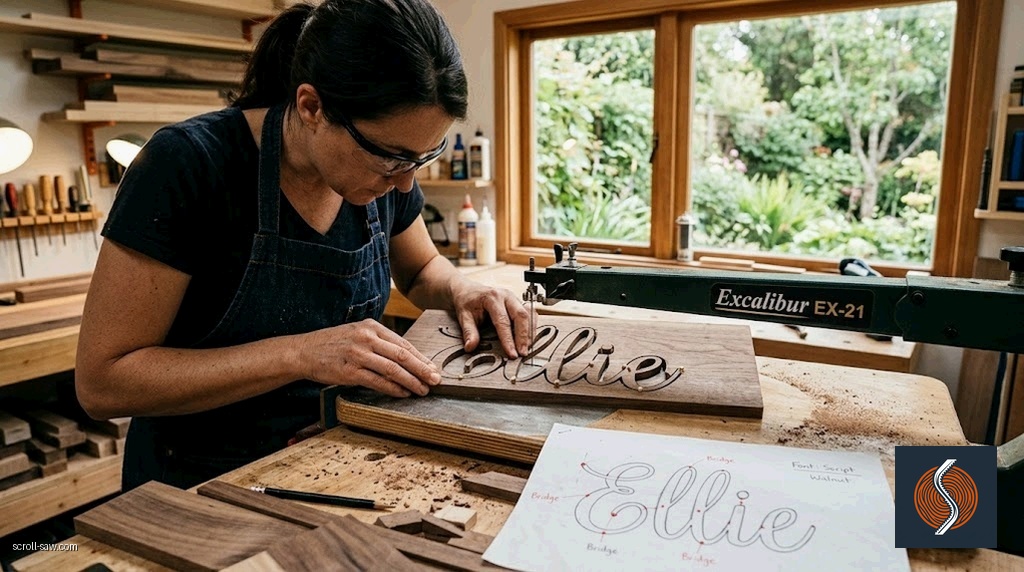
Scroll Saw Name Patterns: Font Choice, Wood, and Bridge Planning
A scroll saw name pattern is a pattern that spells a name or word using letter shapes. Common uses include nursery decor (baby names), keepsake pieces (family names), signage (last names above doors), and gift personalization.
The technical challenge is the letters themselves. Standard fonts have interior holes (O, D, P, B, R) that require either stencil-style bridges or a connected script that keeps interior spaces attached to the perimeter.
Short answer: use stencil-style fonts or connected script fonts for scroll saw work, 1/4-inch to 1/2-inch stock, #5 or #3 blade depending on font size, verify all bridges are at least 1/8 inch wide.
Font selection
Not every font works for scroll saw cutting. Standard fonts have letters with isolated interior regions (the hole in O, D, P, B, R, Q, and the space in A) that fall out when cut.
Stencil fonts. Fonts designed with built-in bridges that connect interior regions to the letter’s exterior. Standard for scroll saw name work. Examples: various stencil fonts, some serif fonts marked for laser/CNC cutting.
Connected script fonts. Cursive fonts where letters connect to each other, and where the flourishes provide natural bridges for interior spaces. The connection between letters holds the name together as a single piece.
Modified standard fonts. Take a standard font and manually add bridges. Time-consuming but allows any font.
Custom hand-drawn. Design the letters yourself with bridges built in.
Avoid: standard serif or sans-serif fonts without modification. The interior spaces fall out.
Popular fonts for scroll saw names
Bookman stencil. Serif letters with clear bridges. Traditional appearance.
Arial stencil. Sans-serif letters with clear bridges. Modern appearance.
Various cursive fonts. Connected script with natural flow. Elegant for baby names and family names.
Fancy script (with flourishes). Elaborate cursive with decorative elements. Reads as high-end.
Custom scroll saw fonts. Some pattern designers offer scroll saw-specific font collections.
Stock selection
1/4-inch Baltic birch plywood. Default for painted name pieces. Handles thin letter strokes without splitting.
1/2-inch hardwood (maple, cherry, walnut, oak). Heirloom pieces. Grain direction matters—see below.
3/4-inch stock. Substantial wall-hung pieces. Longer cut time but reads as fine woodworking.
Solid pine or basswood. Painted country-style pieces. Cost-effective for craft fair inventory.
Grain direction
For solid wood name pieces, grain direction affects letter integrity:
Long horizontal name: grain runs horizontally, along the name’s length. Vertical letter strokes are perpendicular to grain but supported by their length. Descenders (g, j, p, q, y) are supported by the horizontal grain.
Vertical stack of letters: grain runs vertically. Each letter’s vertical strokes align with grain.
Curved or wavy name: grain along the average direction of the name.
Baltic birch plywood eliminates most grain-direction failures. Solid wood requires attention.
Blade choice
Large letters (2+ inches tall): #5 reverse-tooth. Olson FR49202.
Medium letters (1-2 inches): #3 reverse-tooth for cleaner curves and tighter corners.
Small letters (under 1 inch): #2/0 for very fine detail. Slower but cleaner.
Thicker stock (1/2 inch and up): #7 skip-tooth. Olson FR49400.
Pattern preparation
-
Type or write the name in your chosen font.
-
Set the size to intended final size.
-
Verify every interior region has a bridge to the letter’s exterior or to the letter’s connections.
-
Verify all strokes are at least 1/8 inch wide at intended print scale.
-
Print the pattern.
Bridge width verification
At final print size:
-
Letter strokes: 1/8 inch minimum. Thinner strokes break during cutting or finishing.
-
Interior bridges: 1/8 inch minimum. Same reason.
-
Connections between letters (in cursive): 1/8 inch minimum. Especially critical because these connections hold the name together as one piece.
If any dimension is below 1/8 inch at your intended final size, either enlarge the name or choose a bolder font.
Pattern attachment
Light 3M Super 77. Two seconds from eight inches. Verify pattern is flat and well-adhered before cutting.
For clear-finish stock, first apply ScotchBlue Painter’s Tape 2090 to the wood surface.
Cutting sequence
-
Drill interior entry holes for each isolated interior region (holes in O, D, P, B, R, Q, and the space in A). Use 1/16-inch bit.
-
Cut interior regions first. Thread blade through each entry hole and cut the interior boundary. Return to entry hole to complete each interior cut.
-
Cut exterior boundary last. Around the whole name.
-
Sand while pattern attached.
-
Peel pattern.
Finishing
Clear satin polyurethane over hardwood. Reads as fine woodworking. Best for heirloom names.
Solid color paint. Reads as decorative craft. Nursery names traditionally painted.
Stain and clear. Traditional woodworking look.
Multiple colors. Different colors for different letters or for decorative elements around the name.
Metallic paint or leaf. Reads as premium. Silver or gold for special occasion names.
Common name applications
Baby names for nurseries. Sized 6-24 inches wide. Painted in nursery colors or stained.
Family name over front door. Sized 12-24 inches wide. Heirloom hardwood, weather-resistant finish.
Kids’ bedroom door names. Small, painted in the child’s favorite color.
Wedding gifts. Couple’s shared name, dated with wedding year.
Business signage. Company or family business names. Professional finish.
Wall décor throughout the house. Family name in dining room, quotes in bedrooms.
Where to source patterns and fonts
Steve Good’s blog has letter pattern generators and font recommendations.
Many pattern designers offer scroll saw-specific font collections.
Standard word processors can produce stencil-style fonts that work directly.
For custom hand-drawn fonts: any drawing software.
Common problems and fixes
Letters fell apart during cutting. Interior bridges missing or too thin. Use stencil font; verify bridges.
Name doesn’t hold together as a piece. Cursive connections too thin or not present. Use connected script, or add a backing plate that holds separate letters together.
Font unreadable. Font too decorative for the size, or too fine for scroll saw. Try a bolder stencil font.
Pattern lines burned onto wood. Spray adhesive residue. Sand before pattern removal or wipe with alcohol.
Different letters in the same name look inconsistent. Font mixing (used different fonts). Use one font throughout.
Letter O looks like C. Cutting bridge broke through the letter. Verify bridge integrity before finishing cut.
Frequently asked questions
Do I need a special font for scroll saw work? Stencil-style fonts have built-in bridges. Connected cursive works without stencil bridges. Standard fonts require manual bridge addition.
How large should letters be? Minimum readable at intended viewing distance. Nursery names: 4-8 inches tall per letter. Door names: 6-12 inches. Room signage: 10-24 inches.
Can I cut names in solid wood? Yes with grain planning. Grain along the name’s length. Baltic birch plywood is more forgiving.
How many letters can I cut in one name piece? Limited by scroll saw throat and stock size. Most names (up to 12 characters) fit within a 16-inch scroll saw’s throat comfortably.
Should I paint or stain? Depends on style. Country/nursery: paint. Fine woodworking/heirloom: stain and clear. Modern: solid color paint.
Can I sell name pieces? Yes. Custom name work is a strong scroll saw market. Prices vary; typical $25-100 depending on size and complexity.
How do I attach a name piece to the wall? Small picture hangers on the back, or command strips for lightweight pieces. Heavier pieces need proper wall anchors.
References
-
Fox Chapel Publishing, Big Book of Scroll Saw Woodworking.
-
Steve Good, Scrollsaw Workshop (blog).


