
Craftsman 16 Inch Scroll Saw Single Speed: Guide
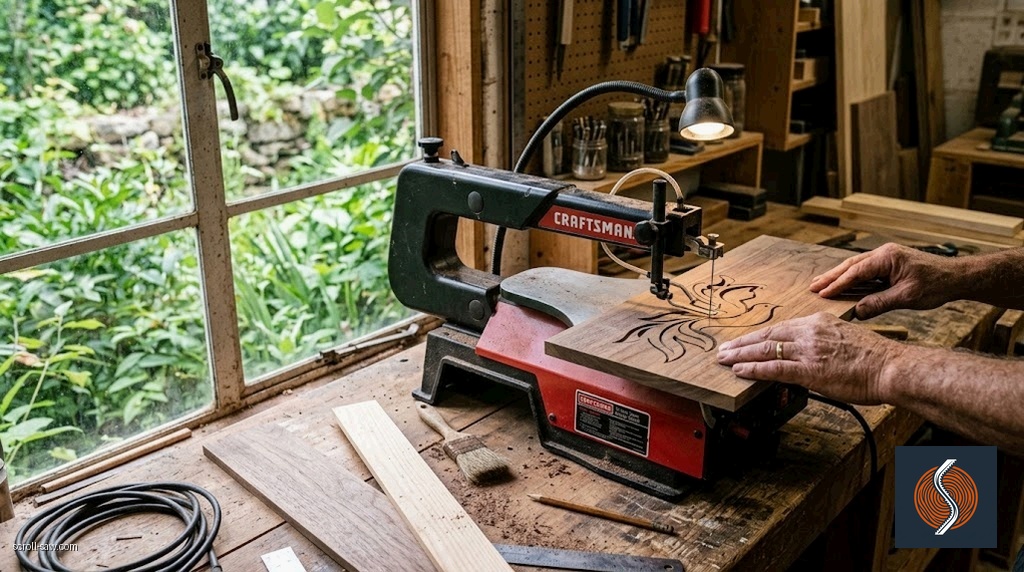
Craftsman 16 Inch Scroll Saw Single Speed: Guide
Single-speed 16-inch Craftsman scroll saws sit at the older end of the Craftsman scroll saw line. Sears sold single-speed 16-inch units through the 1970s and 1980s, before variable-speed became standard on Craftsman scroll saws. On the used market, single-speed units are common and often less expensive than variable-speed equivalents from the same era.
A single-speed 16-inch Craftsman is a workable machine for many scroll saw tasks. What limits it is the fixed cutting speed (usually around 1,700 SPM), which is too fast for some materials (hardwood, plastic, metal) and requires adjusting technique and blade selection to compensate.
What to check before buying
Motor condition: plug in and run the motor briefly. It should start smoothly, run without unusual noise or burning smell. Bearing whine is minor and repairable; deeper motor issues are expensive to fix on an old saw.
Arm mechanism: pivot the arm by hand with the power off. Smooth motion without binding. No play at the pivot point. No unusual sounds during pivot.
Table condition: flat, not warped, tilts and locks reliably. Blade slot in reasonable condition (not gouged widely).
Clamps: gripping surfaces should be flat without deep grooves. Minor grooves clean up with steel wool.
Tension mechanism: moves smoothly and holds firmly. Weak tension springs are replaceable.
Power cord: not frayed or repaired with tape. Standard 3-conductor cord easy to replace if needed.
Switch: functions reliably.
Vibration: run the saw briefly at operating speed. Excessive vibration indicates motor mount issues, arm bearing wear, or missing dampening.
Missing components: blade guard, table insert, tension knob, or dust chute. Small components are replaceable; missing motor or castings are dealbreakers.
Common issues on used single-speed 16-inch Craftsman
Arm bearing wear: play at pivot produces wobbly cuts. Replaceable with standard sealed ball bearings.
Grooved clamp faces: set-screw clamps develop grooves over decades. Replace or restore.
Loose motor mount: bolts loosen over years. Tighten to snug plus a quarter turn.
Dust-clogged mechanism: sawdust packs into the arm mechanism. Vacuum and wipe clean.
Weak tension spring: replace with equivalent spring stock.
Damaged power cord: replace with standard 3-conductor 16-gauge cord.
Failing switch: replace with equivalent rated switch.
All of these are within reach of a moderately handy owner.
Working with fixed 1,700 SPM
Single-speed at 1,700 SPM is faster than ideal for some materials. Adjust technique to compensate.
Soft wood: 1,700 SPM matches well. Cut at normal feed.
Hardwood: 1,700 SPM is slightly fast. Reduce feed pressure. Use coarser blade (#7 or #9) that runs cooler at high speed. Precision-ground blades tolerate higher speed than milled blades.
Plywood: 1,700 SPM works fine.
Cast acrylic: 1,700 SPM is too fast; the blade heats and melts the acrylic. Consider adding an aftermarket motor speed controller to slow the saw for plastic work, or work at slow feed with cutting wax generously applied.
Thin non-ferrous metal: 1,700 SPM is too fast for metal work. Metal-cutting needs 400 to 600 SPM. Add a motor speed controller or cut metal on a different saw.
Adding a speed controller
Aftermarket motor speed controllers for scroll saw motors are available from industrial electrical suppliers. Installation requires basic electrical wiring skill.
Common options:
Universal AC motor speed control: wires between the saw and the power source. Provides variable speed from roughly 30 percent to 100 percent of motor rated speed.
Router speed controller: some router speed controllers work with scroll saw motors of similar wattage.
Before installing, verify the motor type. Universally controlled speed controls work with brushed motors and universal motors. Induction motors (rare in scroll saws but present in some older units) do not tolerate all controller types.
Blade selection for a single-speed 16-inch
Same blade principles as any scroll saw, adjusted for the fixed speed:
#5 skip-tooth (workhorse): general pattern work in soft wood.
#3 skip-tooth or reverse-tooth (fine): fine fretwork.
#7 skip-tooth (thicker material): hardwood or thick soft wood.
#9 skip-tooth (aggressive): thick soft wood.
Precision-ground blades: better for hardwood at high speed than milled blades.
Metal-cutting blades: only useful if a speed controller is installed.
A dozen pack of Olson skip-tooth blades covers general work. Verify pin-end or plain-end for your specific saw.
Setup for a single-speed 16-inch
Bolt the saw to a heavy bench or stand.
Check table square to blade after every blade change.
Unplug for every blade change.
Detension between sessions.
Brush clamps clean.
Connect dust extraction if the saw has a port.
Set up dedicated task lighting.
When to buy a single-speed vs a variable-speed used unit
Single-speed: cheaper on the used market. Fine for soft wood pattern work. Add a speed controller if plastic or metal work is planned.
Variable-speed: more flexible. Better for hardwood, plastic, and metal work. Costs more used.
For a scroller who primarily works in soft wood, a single-speed unit at a lower price is a reasonable choice. For a scroller who works with multiple materials, variable-speed pays for itself.
When a single-speed 16-inch is not worth repairing
Motor burned or seized: replacement cost exceeds saw value.
Cracked frame castings: not economically repairable.
Multiple worn components at once: total repair cost approaches or exceeds a new WEN or Ryobi 16-inch.
For a well-maintained single-speed 16-inch in good structural condition, a modest investment restores it to good working order.
Small habits for better cuts
Match blade to material.
Adjust feed to compensate for high speed in hard material.
Break in new blades with a minute of light cutting.
Watch chip clearance.
Rotate partially worn blades to lighter work.
Store blades flat in a divided case.
FAQ
What speed does a single-speed Craftsman 16-inch run at? About 1,700 SPM.
Can I convert to variable-speed? With an aftermarket motor speed controller, yes.
Best blade for single-speed? #5 skip-tooth for general work.
Should I buy a single-speed used unit? Depends on price and condition. Single-speed is fine for soft wood work.
What to check before buying used? Motor condition, arm play, table flatness, clamp condition.
Are parts available? Some, through Sears parts direct and independent specialists.
Can it cut hardwood? Yes, with adjusted feed and coarser or precision-ground blades.
References
-
Craftsman parts and manual archive via ManualsLib.
-
Olson Saw Company. Scroll saw blade catalog.
-
Scroll Saw Woodworking & Crafts forum. Vintage Craftsman scroll saw restoration discussions.
Title tag: Craftsman 16 Inch Scroll Saw Single Speed: Guide Meta description: What to check before buying or repairing a single-speed Craftsman 16-inch scroll saw. Setup and blade selection. URL slug: craftsman-16-inch-scroll-saw-single-speed Excerpt: What to check before buying or repairing a single-speed Craftsman 16-inch scroll saw. Common wear, technique for the fixed 1,700 SPM, and blade selection.


