
Craftsman 16 Scroll Saw Manual: Model and Parts
Craftsman 16 Scroll Saw Manual: Model and Parts
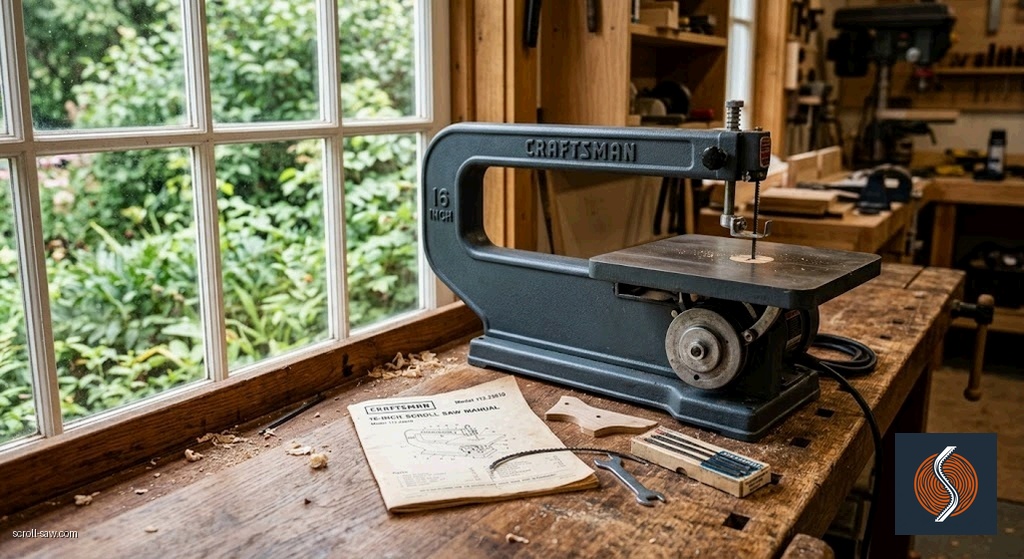
The owner’s manual for a Craftsman 16-inch scroll saw is one of the more useful documents to have when maintaining or repairing an older machine. Original manuals include model-specific specifications, exploded parts diagrams, adjustment procedures, and troubleshooting steps. Without the manual, an owner has to guess at correct settings and part numbers.
Craftsman 16-inch scroll saw manuals are archived at several online sources. Finding the right manual requires knowing the exact model number and revision level of your saw.
Identifying your specific model
Model number plate: usually on the base of the saw, sometimes on the motor housing. Look for a metal or plastic plate stamped with model information.
Common format: 113.NNNNNN, 137.NNNNNN, or 315.NNNNNN where NNNNNN is the specific model number.
Alternative format: some Craftsman scroll saws have a shorter model number like 21602 without the manufacturer prefix. The manufacturer prefix identifies who made the saw under contract to Sears (113 King-Seeley, 137 Rexon, 315 Ryobi).
Revision indicator: some Craftsman scroll saw manuals have revision letters or dates. A model may have gone through multiple revisions with parts changes; the manual for your revision is the one that matches your saw.
Serial number: appears alongside the model number. Sometimes needed to narrow down which manual revision matches.
Where to find Craftsman 16-inch scroll saw manuals
Sears Parts Direct: some manuals available for download. Search by exact model number.
ManualsLib: large archive of user-uploaded manuals for many Craftsman scroll saw model numbers. Search by full model number.
ManualOwl and similar sites: additional archives with variable coverage.
Craftsman parts specialist websites: some carry manual PDFs for older models.
Craftsman scroll saw forums: users sometimes share manual scans for models that are hard to find elsewhere. Scroll Saw Village and Scroll Saw Woodworking & Crafts forums have relevant threads.
What the manual contains
Specifications: motor power, speed range, cutting capacity, dimensions, weight.
Assembly instructions: for new-in-box setup. Useful when reassembling a saw after disassembly.
Adjustment procedures: how to square the table, adjust bevel stops, set blade tension, align the arm.
Blade change procedure: step-by-step for the specific saw’s clamp design.
Operating instructions: safety precautions, correct feed technique.
Maintenance schedule: lubrication points, wear items, inspection intervals.
Troubleshooting: common problems and their fixes.
Exploded parts diagrams: numbered parts with reference designations. Essential when ordering replacement parts.
Parts list: matches part numbers to the exploded diagrams.
Wiring diagram: for electrical repairs on variable-speed models.
Parts identification from the manual
With the manual and exploded parts diagrams, ordering the right replacement part is straightforward:
-
Identify the part number from the exploded diagram.
-
Look up the part number in the parts list.
-
Order by that part number.
Without the manual, part identification requires describing the part physically to a parts specialist, which is uncertain and often results in the wrong part arriving.
Common parts and their manual reference
Arm bearings: usually listed as “pivot bearing” or “arm bearing” in the parts list. Part numbers vary by model.
Clamps: “upper blade clamp” and “lower blade clamp” or similar. Sometimes sold as an assembly.
Tension mechanism: “tension spring,” “tension knob,” “tension assembly.”
Motor: full motor assembly or motor components (brushes, bearings).
Switch: on-off switch by part number.
Power cord: specific cord assembly.
Blower: blower motor or blower assembly.
Table insert: replacement insert.
Speed controller (variable-speed models): electronic control board.
Belt (belt-drive models): specific belt size.
When the manual is missing
Options when the original manual is not available:
Generic scroll saw manual: for basic operation and adjustment procedures that are universal across scroll saws. Not useful for specific parts identification.
Manual from a similar model: many Craftsman 16-inch scroll saws share design elements with related models. A related-model manual may cover most of the specifics.
Direct measurement of the saw’s dimensions: for bearings, springs, and hardware that can be sourced by dimension rather than part number.
Photos of the saw’s mechanism: helpful when consulting a parts specialist or online forum.
Forum help: post photos and model information on Scroll Saw Woodworking & Crafts forum or similar sites. Users familiar with the specific model can often identify parts.
What the manual does not always cover
Blade selection reference: manuals rarely include detailed blade sizing guidance. For blade selection, consult external references like Olson’s catalog or general scroll saw blade guides.
Speed-material charts: some manuals include basic speed guidance but not always with the detail an experienced scroller wants.
Modification instructions: for aftermarket motor speed controllers or other upgrades. Not covered in the original manual.
Restoration procedures: for extensive rebuilds of worn machines. Not covered.
Verifying manual matches saw
Before trusting a downloaded manual, verify it matches your saw:
-
Model number on the plate matches the manual’s cover.
-
Photos or diagrams in the manual match the visible features of your saw.
-
Number of speed settings matches (single-speed vs variable-speed).
-
Blade format matches (pin-end vs plain-end).
-
Motor placement matches.
A manual for a similar but different model can lead to wrong part numbers and incorrect adjustment procedures.
Blade recommendations from the manual
Craftsman scroll saw manuals often included a basic blade recommendation chart matching blade number to material. These charts are useful starting points but not always current with modern blade options.
For a scroller with a Craftsman 16-inch scroll saw, the practical blade drawer:
-
#5 skip-tooth (workhorse)
-
#3 skip-tooth or reverse-tooth (fine work)
-
#7 skip-tooth (thicker material)
-
Reverse-tooth #5 (plywood)
-
Optional precision-ground or MGT (hardwood)
-
Optional spirals (sign or sculpted work)
-
Optional metal-cutting (non-ferrous sheet)
A dozen pack of Olson skip-tooth blades covers general work.
FAQ
Where do I find a Craftsman 16-inch scroll saw manual? Sears Parts Direct, ManualsLib, and other online archives.
What information does the manual contain? Specifications, adjustment procedures, parts diagrams, troubleshooting.
Do I need the exact manual for my model? Strongly recommended. Similar-model manuals can differ in specifics.
How do I identify my model? The model plate on the saw’s base or motor housing.
Are old manuals still available? Many are archived online.
What if I cannot find the manual? Generic scroll saw operation reference plus forum help for specific parts.
Do manuals include blade selection guidance? Basic charts sometimes; not always current with modern blade options.
References
-
Craftsman parts and manual archive via ManualsLib.
-
Sears Parts Direct via Sears legacy parts network.
-
Scroll Saw Woodworking & Crafts forum. Manual identification discussions.
Title tag: Craftsman 16 Scroll Saw Manual: Model and Parts Meta description: Find and use the Craftsman 16-inch scroll saw manual. Model identification and parts checks. URL slug: craftsman-16-scroll-saw-manual Excerpt: Find and use the Craftsman 16-inch scroll saw manual for setup, adjustment, and parts identification. Model number checks, revision notes, and what to do when the manual is missing.


