
Craftsman 16 Scroll Saw Model 137: Overview
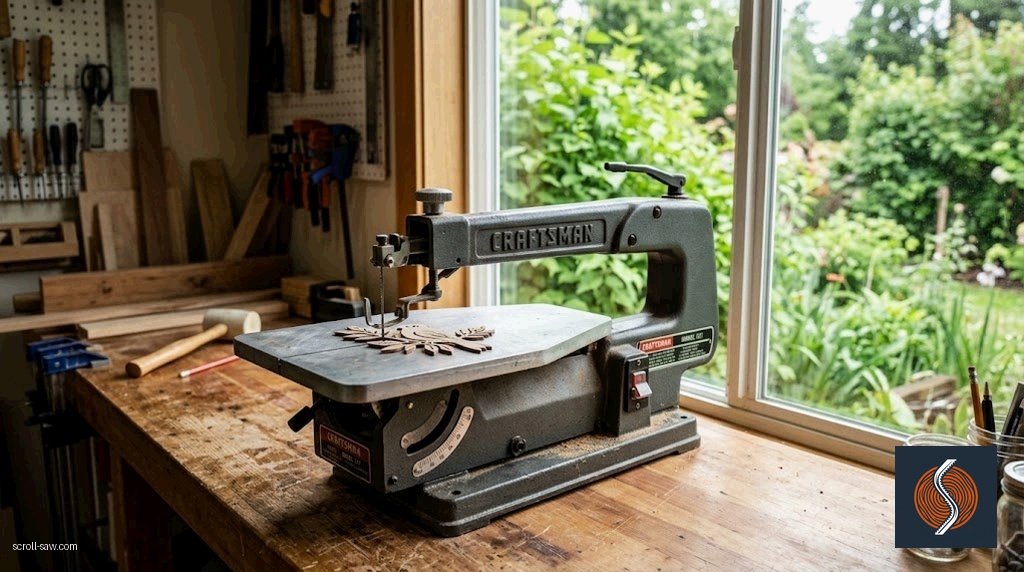
Craftsman 16 Scroll Saw Model 137: Overview
Craftsman 16-inch scroll saws with a 137 model prefix identify machines manufactured by Rexon Industrial under contract to Sears. Rexon is a Taiwanese power tool manufacturer that produced many Craftsman-branded tools during the transition period from the late 1990s through the 2000s. The 137 designation replaced the older 113 series that had been made by King-Seeley.
A Craftsman 16-inch 137-series scroll saw represents a modern feature set: variable speed, plain-end clamps, cast-aluminum construction, dust extraction, and blower. Owners today have a machine that is 20 to 30 years old and generally still capable of good work.
Speed range on 137 scroll saws
Most Craftsman 16-inch 137 scroll saws offer variable speed from roughly 400 SPM to 1,600 SPM. Specific ranges vary by model:
Low end (400 to 500 SPM): appropriate for plastic and metal cutting.
Mid range (700 to 1,100 SPM): hardwood pattern work.
Upper range (1,200 to 1,500 SPM): soft wood and plywood pattern work.
Maximum (1,600 SPM): fast cutting in soft material.
Speed control is via a dial or slider that adjusts an electronic controller. On some 137 units, the dial position corresponds directly to a fixed speed reading; on others, the correspondence is approximate.
Speed adjustment during cutting: some 137 units allow speed adjustment while the motor runs. Others require stopping to adjust. Check your specific saw.
Arm design
137-series Craftsman 16-inch scroll saws use a parallel-arm design in most models. The arm pivots at the rear and the blade moves nearly vertically at the front.
Parallel arm design:
-
The upper and lower arm segments move in parallel.
-
Blade travel is nearly vertical, with only slight fore-aft motion.
-
Less prone to blade tipping than older C-arm designs.
-
More expensive to manufacture than C-arm.
Alternative arm designs (found on some 137 variants):
- Modified parallel-link designs with slightly different arm geometry.
The practical difference for scrollers is minor. A well-adjusted parallel-arm 137 scroll saw produces cuts as clean as any premium scroll saw when fitted with a good blade.
Ownership notes
Age-related wear: after 20 to 30 years, most 137 units show some wear.
Arm bearings: play at pivot points is the most common wear issue. Replaceable with standard sealed ball bearings.
Speed controller degradation: electronic controllers can drift or fail after long service. Replacement controllers sometimes available.
Motor bearing wear: eventual replacement item.
Motor brush wear (brushed motors): normal wear item.
Clamp face grooves: set-screw clamps develop grooves over time.
Blower failure: aftermarket replacements inexpensive.
Dust extraction port clogging: clean periodically.
Table tilt lock wear: bevel adjustment mechanism can wear over time.
Blade format on 137 saws
Most 137 units use plain-end blades. Some accept both pin-end and plain-end through convertible clamps.
Plain-end selection: widest modern selection. Skip-tooth, reverse-tooth, precision-ground, MGT, spiral, metal-cutting all available.
Pin-end on convertible 137 units: standard geometries available.
A dozen pack of Olson skip-tooth blades covers general work.
Material and speed matching
Soft wood 1/4 to 1/2 inch, general pattern work: #5 skip-tooth at 1,200 to 1,500 SPM.
Soft wood 1/2 to 1 inch: #7 skip-tooth at 1,000 to 1,300 SPM.
Soft wood 1 to 2 inches: #9 skip-tooth at 800 to 1,000 SPM.
Baltic birch pattern work: reverse-tooth in appropriate size.
Hardwood 1/4 to 1/2 inch: #5 precision-ground or MGT at 900 to 1,100 SPM.
Hardwood 1/2 to 3/4 inch: #7 precision-ground at 800 to 1,000 SPM.
Hardwood 3/4 to 1 inch: #9 precision-ground at 700 to 900 SPM.
Cast acrylic: #5 skip-tooth at 500 to 800 SPM.
Thin non-ferrous metal: 30 to 40 TPI metal-cutting blade at 400 to 600 SPM.
Setup for a 137
Bolt the saw to a heavy bench or stand.
Check table square to blade after every blade change.
Set speed before starting.
Connect dust extraction port to a shop vacuum.
Ensure blower is functional.
Set up dedicated task lighting.
Use zero-clearance table insert for thin material.
Parts support for 137 saws
Rexon service network: some 137 parts flow through Rexon’s service network.
Sears Parts Direct: some 137 parts still available.
Independent Craftsman parts specialists: variable availability.
Aftermarket universal parts: bearings, switches, cords, blowers common as universal parts.
Bearing suppliers: arm bearings and motor bearings sourced by dimension.
Small habits
Unplug for every blade change.
Detension between sessions.
Brush clamps clean at every blade change.
Match blade to material and curve radius.
Break in new blades with a minute of slow cutting.
Watch chip clearance during cuts.
Rotate partially worn blades to lighter work.
Check arm bearing condition periodically.
Empty dust extraction.
When a 137 is worth investing in
Yes: motor runs smoothly, arm has no significant play, castings intact.
Maybe: several worn components but structurally sound. Add up parts cost and compare to new saw.
No: motor burned, castings cracked, missing major parts.
FAQ
Who manufactured the Craftsman 137 series? Rexon Industrial.
Speed range on a 137? Usually 400 to 1,600 SPM.
Arm design? Parallel arm on most models.
Best blade? #5 skip-tooth for general work.
Are parts available? Some, from multiple sources.
Blade format? Mostly plain-end.
Can I adjust speed while cutting? Depends on the specific model.
References
-
Craftsman parts and manual archive via ManualsLib.
-
Olson Saw Company. Scroll saw blade catalog.
-
Scroll Saw Woodworking & Crafts forum. Craftsman 137 scroll saw discussions.
Title tag: Craftsman 16 Scroll Saw Model 137: Overview Meta description: Speed range, arm design, and ownership notes for Craftsman 16-inch Model 137 scroll saws. URL slug: craftsman-16-scroll-saw-model-137 Excerpt: Speed range, arm design, and ownership notes for the Craftsman 16-inch Model 137 scroll saw. Rexon manufacturing, common wear, and blade selection.


