
Craftsman 16 Scroll Saw Model 315: Setup Guide
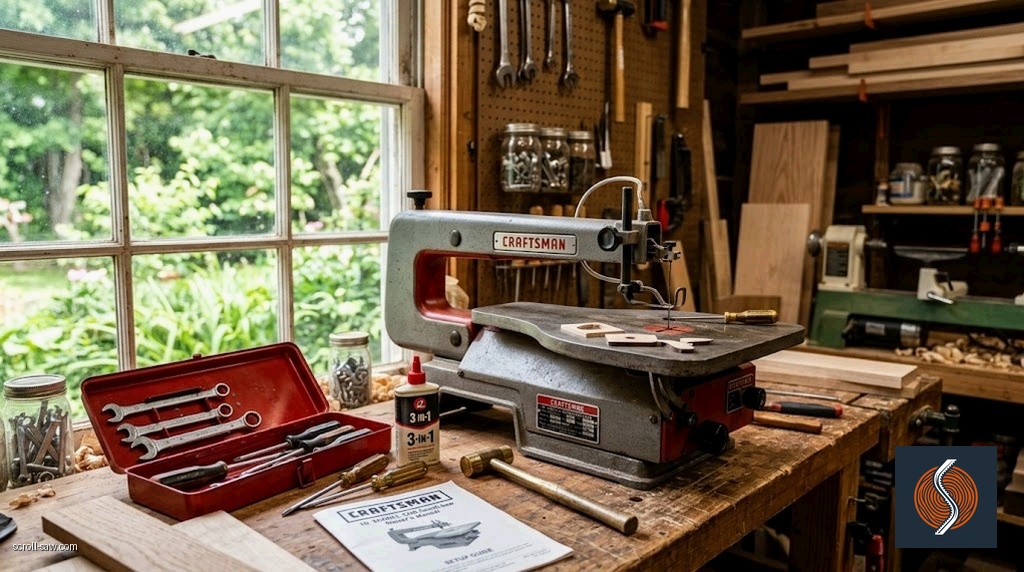
Craftsman 16 Scroll Saw Model 315: Setup Guide
Craftsman 16-inch scroll saws with a 315 model prefix identify machines manufactured by Ryobi under contract to Sears. Ryobi produced Craftsman-branded scroll saws in the 1990s and early 2000s. The 315 designation and the manufacturing relationship overlap with Ryobi’s own-branded scroll saws of that era, and the machines share many design elements.
This guide covers setup, limits, and service for the Craftsman 16-inch Model 315 scroll saw.
What the 315 offers
Manufacturer: Ryobi.
Era: 1990s and early 2000s.
Model numbers: 315.NNNNNN where NNNNNN identifies the specific configuration.
Construction: cast-aluminum frame. Lighter than older cast-iron 113 units but sufficient for benchtop scroll saw work.
Motor: universal motor in the 1/6 to 1/4 horsepower range.
Speed control: variable-speed on most 315 units. Range typically 400 to 1,600 SPM.
Blade format: mostly plain-end. Some 315 units have convertible clamps that accept both pin-end and plain-end blades.
Cutting capacity: usually 2 inches soft wood, 1 inch hardwood.
Weight: 30 to 45 pounds.
Setup
Bench or stand mounting: bolt the saw to a heavy bench or dedicated stand. Bolt-through holes are typically in the base casting.
Table square check: with a small square, verify the table is 90 degrees to the blade. If not, adjust the bevel stop.
Bevel calibration: verify the 45-degree bevel stop is accurate.
Blade tension: install a blade, apply tension, pluck the blade for a clear high note. Adjust tension to reach this note.
Blade square check: verify the installed blade is 90 degrees to the table front and side.
Speed selection: set the speed dial or slider to match the intended material.
Dust extraction connection: connect the dust port to a shop vacuum.
Blower orientation: aim the blower at the cut line to clear dust.
Task lighting: dedicated overhead or clamp-mounted work light.
Zero-clearance table insert (optional): for thin material.
Cutting limits
Material thickness: soft wood up to 2 inches, hardwood up to 1 inch. Beyond these limits the motor works harder and the blade wears faster.
Minimum inside curve radius: set by the blade width chosen.
Continuous cutting duration: brushed motors on the 315 line can handle sustained pattern work but benefit from occasional breaks during long sessions.
Vibration at maximum speed: at 1,600 SPM, some 315 units show noticeable vibration. A stable stand and firm bolting help.
Blade format flexibility: plain-end blades cover most needs. Pin-end 315 units are limited to pin-end selection unless a pinless adapter is used.
Service items
Arm bearings: play at pivot points after long service. Standard sealed ball bearings by dimension.
Motor bearings: replaceable through bearing suppliers or motor rewinders.
Motor brushes (brushed motors): normal wear items.
Clamp faces: grooves develop over time. Restore with steel wool or replace.
Speed controller: electronic controllers can fail. Replacement sometimes available through Ryobi service or specialty electronics.
Blower: aftermarket replacements inexpensive.
Tension mechanism: springs weaken. Replaceable.
Power cord and switch: standard replaceable components.
Table tilt lock: bevel adjustment can wear. Adjust or replace hardware.
Dust chute: sometimes broken or lost. Shop-made replacement acceptable.
Blade selection for a 315
Standard 5-inch scroll saw blades in appropriate format:
#5 skip-tooth (workhorse): general pattern work.
#3 skip-tooth or reverse-tooth (fine): fine fretwork.
#7 skip-tooth (thicker material): hardwood or thick soft wood.
#9 skip-tooth (aggressive): thick soft wood.
Reverse-tooth in appropriate size: plywood work.
Precision-ground #5 or #7: hardwood work with clean finish.
Modified geometry (MGT) #5 or #7: hardwood pattern work.
Spiral: sign interiors and sculpted work.
Metal-cutting: thin non-ferrous sheet.
A dozen pack of Olson skip-tooth blades covers general work.
Speed and material matching
Soft wood pattern work: 1,200 to 1,500 SPM.
Hardwood pattern work: 800 to 1,100 SPM.
Plywood fretwork: 1,100 to 1,400 SPM.
Plastic (cast acrylic): 500 to 800 SPM. Cutting wax generously.
Thin non-ferrous metal: 400 to 600 SPM.
Very thick material near capacity: reduce speed slightly.
Small habits
Unplug for every blade change.
Detension between sessions.
Brush clamps clean at every blade change.
Match blade to material.
Break in new blades with a minute of slow cutting.
Watch chip clearance.
Rotate partially worn blades to lighter work.
Store blades flat.
Inspect arm bearings periodically.
Parts availability for the 315
Ryobi service network: some 315 parts flow through Ryobi.
Sears Parts Direct: some 315 parts still available.
Independent Craftsman parts specialists: variable coverage.
Aftermarket universal parts: bearings, switches, cords, blowers.
Salvaged 315 or Ryobi-branded units: sometimes available as parts sources.
When a 315 is worth investing in
Yes: motor runs smoothly, arm has no significant play, castings intact.
Maybe: several worn components. Add up parts cost vs new saw.
No: motor burned, castings cracked, missing major parts.
FAQ
Who made the Craftsman 315 series? Ryobi.
Speed range? Usually 400 to 1,600 SPM variable.
Blade format? Mostly plain-end. Some convertible.
Best blade? #5 skip-tooth for general work.
Are parts available? Some, through multiple sources.
Cutting capacity? 2 inches soft wood, 1 inch hardwood.
Is it worth restoring? Depends on condition. Structurally sound units, yes.
References
-
Craftsman parts and manual archive via ManualsLib.
-
Ryobi Power Tools. Scroll saw product documentation.
-
Olson Saw Company. Scroll saw blade catalog.
Title tag: Craftsman 16 Scroll Saw Model 315: Setup Guide Meta description: Setup, cutting limits, and service reference for Craftsman 16-inch Model 315 scroll saws. URL slug: craftsman-16-scroll-saw-model-315 Excerpt: Setup, cutting limits, and service reference for the Craftsman 16-inch Model 315 scroll saw made by Ryobi. Blade selection, speed matching, and parts support.


