
Craftsman 16 Scroll Saw Single Speed: Overview
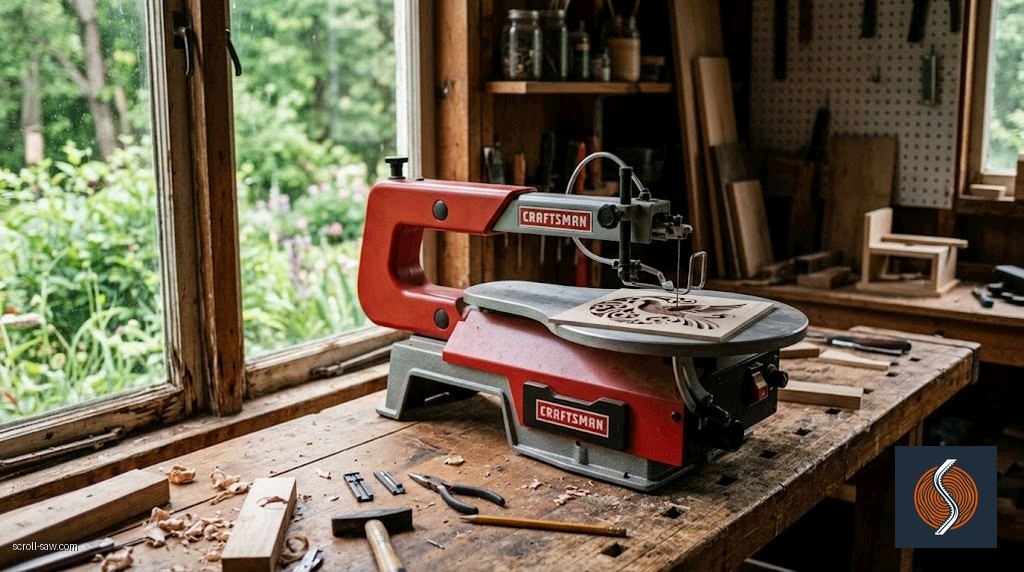
Craftsman 16 Scroll Saw Single Speed: Overview
Single-speed 16-inch Craftsman scroll saws were the standard offering from Sears through the 1970s and 1980s, before variable-speed became universal on Craftsman scroll saws. On today’s used market, single-speed 16-inch units are common and often less expensive than variable-speed equivalents from the same era.
This reference covers the typical specifications, blade system, and parts support for single-speed 16-inch Craftsman scroll saws.
Typical specifications
Throat depth: 16 inches.
Cutting capacity: usually 2 inches soft wood, 1 inch hardwood.
Speed: fixed at approximately 1,700 SPM. Some units may run slightly faster or slower depending on model.
Blade format: mostly pin-end on older units. Some later single-speed units are plain-end or convertible.
Motor: universal or induction motor in the 1/6 to 1/4 horsepower range.
Drive: belt-drive on many older 113-series units; direct-drive on others.
Table: cast iron or cast aluminum. Tilts left (some tilt both ways).
Blade change: two-clamp system (upper thumb-lever, lower access). Older units may require a wrench for both clamps.
Dust extraction port: on some units, absent on older ones.
Blower: present on many later single-speed units, absent on older ones.
Weight: 40 to 80 pounds depending on frame material.
Blade system
Single-speed 16-inch Craftsman scroll saws use standard 5-inch scroll saw blades.
Blade sizes: #2/0 through #12, with #5 as the workhorse size.
Blade formats:
-
Pin-end: most single-speed 113-series units.
-
Plain-end: some later 113 units and later 137 or 315 single-speed variants.
-
Convertible: some units accept both formats.
Blade geometries (in appropriate format):
-
Skip-tooth (workhorse)
-
Reverse-tooth (plywood work)
-
Standard tooth (older, less common now)
-
Precision-ground (hardwood, plain-end only)
-
Modified geometry (MGT, plain-end only)
-
Spiral (all-directions)
-
Metal-cutting (needs speed reduction on single-speed)
Blade change procedure varies by model. Typical for single-speed 113:
-
Unplug the saw.
-
Release tension via the tension mechanism.
-
Loosen the upper clamp screw or thumb lever.
-
Lift the top of the blade out of the upper clamp.
-
Loosen the lower clamp.
-
Remove the blade.
-
Insert the new blade in the lower clamp first (teeth pointing down toward table).
-
Insert the top end in the upper clamp.
-
Tighten both clamps.
-
Apply tension.
-
Verify with pluck test.
A dozen pack of Olson skip-tooth blades covers general work. Verify the correct format for your specific saw.
Working with fixed 1,700 SPM
Soft wood pattern work: matches well. Cut at normal feed pressure.
Hardwood: 1,700 SPM is slightly fast. Reduce feed pressure. Use coarser blade (#7 or #9) that runs cooler at high speed. Precision-ground blades tolerate high speed better than milled blades.
Plywood: works fine at 1,700 SPM.
Cast acrylic: too fast for typical cast acrylic work. Cutting wax generously helps. Aftermarket motor speed controller lets the saw slow down.
Thin non-ferrous metal: too fast. Metal-cutting needs 400 to 600 SPM. Aftermarket controller required.
Adding a speed controller
Aftermarket motor speed controllers work with brushed and universal motors. Basic wiring skill required.
Universal motor speed control: inline device that adjusts motor voltage. Provides variable speed roughly 30 to 100 percent.
Router speed controller: some router speed controls fit scroll saw motors of similar wattage.
Verify motor type: universal and brushed motors accept most controllers. Induction motors (in some very old scroll saws) may not tolerate all controller types.
Parts support
Sears Parts Direct: some parts still available for older 113-series single-speed units. Older parts more spotty than newer models.
Independent Craftsman parts specialists: sometimes carry older single-speed parts.
Bearing suppliers: universal by dimension.
Motor parts specialists: brushes and bearings.
Aftermarket universal parts: switches, power cords, blowers, table inserts.
Salvaged units: parts sources for hard-to-find components.
Shop-made replacements: table inserts, tension springs, small brackets, dust chutes.
Common wear on single-speed 16-inch
Arm bearings: play at pivot points.
Motor brushes (brushed motors): normal wear item.
Motor bearings: eventual replacement.
Belt (belt-drive models): crack and stretch over time.
Grooved clamps: set-screw clamps develop grooves.
Weak tension spring: some units use a spring that weakens over decades.
Loose motor mount: bolts loosen.
Dust-clogged mechanism: sawdust packs in.
Damaged power cord or switch: standard replaceable components.
Setup
Bolt the saw to a heavy bench or stand.
Check table square to blade after every blade change.
Unplug for every blade change.
Detension between sessions.
Brush clamps clean.
Connect dust extraction if the saw has a port.
Set up dedicated task lighting.
Small habits
Unplug for every blade change.
Detension between sessions.
Brush clamps clean.
Match blade to material.
Adjust feed to compensate for high fixed speed in hard material.
Break in new blades with a minute of light cutting.
Watch chip clearance.
Rotate partially worn blades to lighter work.
Store blades flat.
When a single-speed 16-inch is worth restoring
Yes: motor runs smoothly, arm has no significant play, castings intact.
Maybe: multiple worn components. Compare parts cost to a new saw.
No: motor burned, castings cracked, missing major parts.
FAQ
What speed does a single-speed Craftsman 16-inch run at? About 1,700 SPM.
Can I add variable speed? With an aftermarket motor speed controller.
Best blade? #5 skip-tooth in the correct format.
Cutting capacity? 2 inches soft wood, 1 inch hardwood.
Weight? 40 to 80 pounds.
Are parts available? Some, from multiple sources.
Blade format? Mostly pin-end. Some late single-speed units are plain-end.
References
-
Craftsman parts and manual archive via ManualsLib.
-
Olson Saw Company. Scroll saw blade catalog.
-
Scroll Saw Woodworking & Crafts forum. Single-speed Craftsman discussions.
Title tag: Craftsman 16 Scroll Saw Single Speed: Overview Meta description: Specifications, blade system, and parts support for single-speed Craftsman 16-inch scroll saws. URL slug: craftsman-16-scroll-saw-single-speed Excerpt: Specifications, blade system, and parts support for single-speed Craftsman 16-inch scroll saws. Working with fixed 1,700 SPM and options to add variable speed.


