
Craftsman 20 Scroll Saw: Is It Right for You?
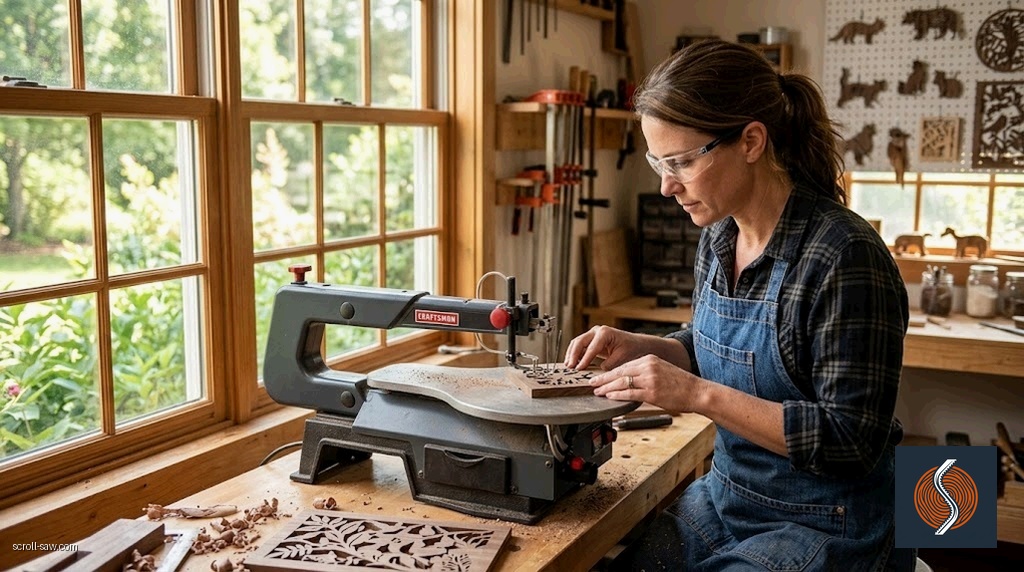
Craftsman 20 Scroll Saw: Is It Right for You?
The Craftsman 20-inch scroll saw represents the middle-to-upper range of Sears’ scroll saw offerings. Larger and heavier than the standard Craftsman 16-inch, less expensive and less specialized than the Contractor Series 20-inch, the Craftsman 20-inch is a common choice on the used market for scrollers who want more capacity than a benchtop 16-inch offers.
For a scroller evaluating a Craftsman 20-inch scroll saw, the practical question is whether the extra size and features match the kind of work planned.
Direct answer
The Craftsman 20-inch scroll saw is a good match for pattern work in stock up to 2 to 2.5 inches thick soft wood or 1.5 inches hardwood, with a 20-inch throat that handles larger panels than benchtop 16-inch scroll saws. It is not the right choice for scrollers who only work with small pieces in 1/4 to 1/2 inch stock (where a 16-inch is enough), and it is not a substitute for premium 20-inch machines like current Pegas 21 or Excalibur EX-21 for production-grade work.
Types of work the Craftsman 20-inch handles well
Thick pattern work: 1 to 2 inch soft wood cutouts. The extra throat depth and stronger motor handle this size well.
Larger portrait patterns: fretwork portraits in 12 to 18 inch panels.
Puzzle making in thicker stock: 3/4 to 1 inch puzzle pieces.
Intarsia in larger scale: shaped-piece wood pictures in larger sizes.
Sign making with interior cutouts: text and shape interiors in larger signs.
Baltic birch fretwork in thicker stock: 3/8 to 1/2 inch fretwork patterns.
Hardwood pattern work: the stronger motor handles hardwood better than lighter 16-inch scroll saws.
Plastic and thin metal work: variable-speed 20-inch units handle these materials as well as 16-inch variable-speed units.
Types of work it does not handle well
Small simple cutouts: a 16-inch is enough and easier to move.
Production output at high pace: premium machines like current Pegas 21 or Excalibur EX-21 are a step up for daily production use.
Absolute maximum precision fretwork: premium scroll saws have slightly smoother arm mechanisms.
Very large panels wider than 20 inches: cannot make interior cuts.
Rough carpentry: use a bandsaw or jigsaw.
Specifications and typical features
Throat depth: 20 inches.
Cutting capacity: 2 to 2.5 inches soft wood, 1.5 inches hardwood.
Speed range: usually 400 to 1,600 SPM on variable-speed units.
Motor: 1/4 to 1/3 horsepower.
Blade format: mostly plain-end on 137 and 315 series 20-inch. Older 113 may be pin-end.
Table: cast, tilts.
Blade change: usually tool-free upper clamp.
Dust extraction port and blower: standard.
Weight: 50 to 100 pounds.
Comparing to alternatives
Craftsman 16-inch variable-speed: less capacity, easier to move, less expensive on the used market.
Craftsman 20-inch Contractor Series: heavier motor and frame, more capacity, higher used price.
Current WEN 3922 (20-inch): new-manufacture 20-inch scroll saw, warranty, comparable capacity.
Current Rikon 10-600VS (20-inch): new, mid-range 20-inch, more expensive than WEN.
Current premium 20-inch (Pegas 21, Excalibur EX-21): significantly more expensive; smoother arm mechanism.
Used premium 20-inch (older Excalibur, used Hegner): excellent condition units on the used market often rival new premium saws at lower cost.
Blade selection
#5 skip-tooth (workhorse): general pattern work.
#3 skip-tooth or reverse-tooth (fine): fine fretwork.
#7 skip-tooth (thicker material): hardwood or thick soft wood.
#9 skip-tooth (aggressive): thick soft wood.
#12 skip-tooth (very thick): material near capacity.
Reverse-tooth in appropriate size: plywood work.
Precision-ground #5, #7, or #9: hardwood pattern work.
MGT: hardwood pattern work.
Spirals: sign interiors.
Metal-cutting: non-ferrous sheet.
A dozen pack of Olson skip-tooth blades covers general work.
Speed and material matching
Soft wood pattern work: 1,200 to 1,500 SPM.
Hardwood pattern work: 800 to 1,100 SPM.
Plywood fretwork: 1,100 to 1,400 SPM.
Plastic (cast acrylic): 500 to 800 SPM.
Thin non-ferrous metal: 400 to 600 SPM.
Very thick material near capacity: reduce speed slightly.
Setup for a Craftsman 20-inch
Bolt the saw to a heavy bench or stand.
Check table square to blade after every blade change.
Unplug for every blade change.
Detension between sessions.
Brush clamps clean.
Connect dust extraction port to a shop vacuum.
Ensure blower is functional.
Set up dedicated task lighting.
What to expect on a used Craftsman 20-inch
Age: 15 to 40 years depending on manufacture era.
Common wear: arm bearings, clamp faces, tension mechanism, motor bearings.
Restoration cost: usually less than a new comparable scroll saw.
Availability: less common than 16-inch but present in the used market.
Price range: varies. Working units without significant issues at moderate used-tool prices.
Small habits
Unplug for every blade change.
Detension between sessions.
Brush clamps clean.
Match blade to material.
Break in new blades with a minute of slow cutting.
Watch chip clearance.
Rotate partially worn blades to lighter work.
Store blades flat.
Inspect arm bearings periodically.
Empty dust extraction.
When to buy new instead of a used Craftsman 20-inch
Warranty desired: new saws have manufacturer warranty.
No time for restoration: new saws work out of the box.
Prefer newer features: some current saws have improved features.
Concerns about parts availability: newer saws have current parts networks.
When to choose a Craftsman 20-inch used
Budget constraint: used units cost less than new premium 20-inch machines.
Willing to service or restore: minor work returns a used unit to good working order.
Prefer heavier or older construction: some older 20-inch Craftsman units are heavier than current budget 20-inch machines.
Specific model preference: some scrollers prefer specific 113 or 137 or 315 models.
FAQ
Is a Craftsman 20-inch a good scroll saw? For pattern work in thicker stock and larger panels, yes.
Should I buy a used Craftsman 20-inch? If mechanically sound and reasonably priced, yes.
Cutting capacity? 2 to 2.5 inches soft wood, 1.5 inches hardwood.
Speed range? Usually 400 to 1,600 SPM.
Blade format? Mostly plain-end on newer models.
Best blade? #5 skip-tooth for general work.
Weight? 50 to 100 pounds.
References
-
Craftsman parts and manual archive via ManualsLib.
-
Olson Saw Company. Scroll saw blade catalog.
-
Scroll Saw Woodworking & Crafts forum. Craftsman 20-inch scroll saw discussions.
Title tag: Craftsman 20 Scroll Saw: Is It Right for You? Meta description: Is the Craftsman 20-inch scroll saw the right saw for your work? What it handles well and where it falls short. URL slug: craftsman-20-scroll-saw Excerpt: Is the Craftsman 20-inch scroll saw the right scroll saw for your work? What it handles well, where it falls short, and how it compares to alternatives.


