
Craftsman 23 Inch Scroll Saw: Buyer Checks
Craftsman 23 Inch Scroll Saw: Buyer Checks
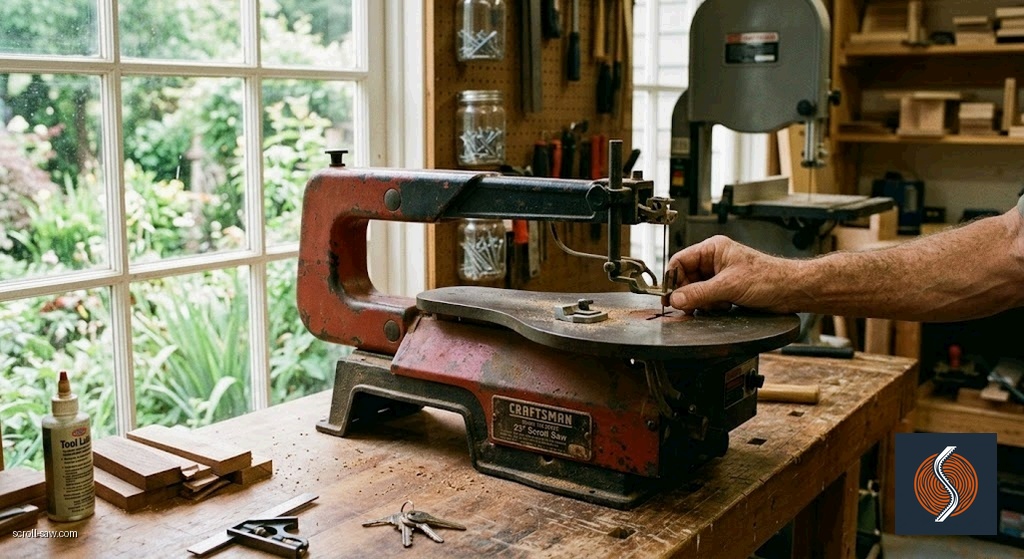
A 23-inch Craftsman scroll saw is uncommon compared to the standard 16-inch and 20-inch sizes. The larger throat depth positions the machine for scrollers who work with panels wider than 20 inches on a regular basis. Sears offered 23-inch Craftsman scroll saws in limited configurations, mostly in the 1990s and 2000s.
On the used market, 23-inch Craftsman scroll saws show up rarely. When one does appear, the machine represents an unusual scroll saw with capacity most benchtop and mid-range floor-standing scroll saws cannot match.
This guide covers what to check on a used 23-inch Craftsman scroll saw before buying, and what to check when repairing one already owned.
What to check before buying
Verify throat depth: measure with a tape from the blade to the rear of the arm. Verify it is actually 23 inches. Some scroll saws listed as 23-inch are actually 20 or 21 inches.
Motor condition: plug in and run the motor briefly. Start smooth, no unusual noise, no burning smell.
Arm mechanism: pivot the arm by hand with the power off. Smooth motion. No play at the pivot point. Larger arms on 23-inch scroll saws have more leverage to reveal bearing wear.
Table condition: flat, not warped. Tilts and locks reliably.
Clamps: gripping surfaces without deep grooves.
Tension mechanism: moves smoothly, holds firmly. Larger 23-inch scroll saws sometimes have upgraded tension mechanisms.
Power cord: not frayed or repaired with tape.
Switch: functions reliably.
Vibration: run briefly at operating speed. Larger scroll saws show more vibration if the motor mount or arm bearings are worn.
Speed controller function (variable-speed models): verify smooth speed adjustment through the full range.
Blower function: aim and airflow.
Dust extraction port: not clogged.
Missing components: table insert, blade guard, dust chute. Small components are replaceable; missing motor or castings are dealbreakers.
Stand condition: 23-inch scroll saws almost always shipped with dedicated stands. Verify the stand is present and sound.
Rare parts availability: parts for uncommon models like 23-inch Craftsman are harder to find than for 16-inch or 20-inch models. Missing parts on a 23-inch may be difficult to source.
What to check when repairing
Arm bearing wear: play at pivot indicates bearing replacement. Larger 23-inch scroll saws may use larger bearings than 16-inch or 20-inch units.
Clamp grooves: restore or replace.
Motor mount tightness: check bolts.
Motor brush wear: inspect and replace if worn.
Motor bearing condition: rough sound indicates wear.
Speed controller degradation: erratic speed adjustment indicates replacement.
Blower motor: aftermarket replacements available.
Tension spring or mechanism: weakness may indicate replacement.
Table tilt lock wear: bevel adjustment slipping indicates hardware replacement.
Belt condition (belt-drive models): cracking or stretching indicates replacement.
Power cord and switch: standard replaceable.
What a 23-inch Craftsman scroll saw offers
Throat depth: 23 inches. Handles interior cuts in panels up to 23 inches wide.
Cutting capacity: usually 2.5 to 3 inches soft wood, 1.5 to 2 inches hardwood.
Motor: 1/3 to 1/2 horsepower.
Speed control: variable-speed on most 23-inch models.
Speed range: typically 400 to 1,600 SPM.
Blade format: plain-end on newer 23-inch Craftsman.
Table: cast, tilts.
Blade change: usually tool-free upper clamp.
Dust extraction port and blower: standard.
Weight: with stand, often 100 to 150 pounds.
Blade selection for a 23-inch Craftsman
#5 skip-tooth (workhorse): general pattern work.
#3 skip-tooth or reverse-tooth (fine): fine fretwork.
#7 skip-tooth (thicker material): hardwood or thick soft wood.
#9 skip-tooth (aggressive): thick soft wood.
#12 skip-tooth (very thick): material near capacity.
Reverse-tooth in appropriate size: plywood work.
Precision-ground #5, #7, or #9: hardwood pattern work with clean finish.
MGT: hardwood pattern work.
Spirals: sign interiors and sculpted work.
Metal-cutting: thin non-ferrous sheet.
A dozen pack of Olson skip-tooth blades covers general work.
Speed and material matching
Soft wood pattern work: 1,200 to 1,500 SPM.
Hardwood pattern work: 800 to 1,100 SPM.
Plywood fretwork: 1,100 to 1,400 SPM.
Plastic (cast acrylic): 500 to 800 SPM.
Thin non-ferrous metal: 400 to 600 SPM.
Very thick material near capacity: reduce speed slightly.
Setup for a 23-inch Craftsman
Bolt to the dedicated stand or a very heavy shop-built stand.
Check table square to blade after every blade change.
Unplug for every blade change.
Detension between sessions.
Brush clamps clean.
Connect dust extraction port to a shop vacuum.
Ensure blower is functional.
Set up dedicated task lighting.
Use zero-clearance table insert for thin material.
Where a 23-inch shines
Large panel interior cuts: 20 to 23 inch panels with interior cutout requirements.
Large fretwork panels: portrait patterns, decorative screens, large sign work.
Thick hardwood work: the 23-inch’s stronger motor handles hardwood better than 16-inch and 20-inch scroll saws.
Semi-production work: better sustained-use capacity than benchtop scroll saws.
Where a 23-inch is overkill
Small pattern work: a 16-inch is enough.
Occasional hobby work: the extra size is not needed.
Very tight shop space: 23-inch scroll saws take significant floor space with their stands.
Small habits
Unplug for every blade change.
Detension between sessions.
Brush clamps clean.
Match blade to material.
Break in new blades with a minute of slow cutting.
Watch chip clearance.
Rotate partially worn blades to lighter work.
Store blades flat.
Inspect arm bearings periodically.
Empty dust extraction.
Parts availability for a 23-inch Craftsman
Sears Parts Direct: some parts available. Coverage is thinner for uncommon 23-inch than for standard 16-inch or 20-inch.
Rexon or Ryobi service networks: for 23-inch units made by those manufacturers.
Independent Craftsman parts specialists: variable coverage.
Bearing suppliers: universal by dimension.
Aftermarket universal parts: switches, cords, blowers.
Salvaged units: rare. When a 23-inch shows up salvaged, it can be a good parts source for another 23-inch owner.
When a 23-inch Craftsman is worth acquiring
Yes: work regularly includes large panels with interior cuts. Willing to service or restore. Space to house the machine.
Maybe: general pattern work in various sizes. A 20-inch offers most of the capability at wider parts availability.
No: small hobby work only. A 16-inch is enough and much easier to move.
FAQ
How rare is a Craftsman 23-inch scroll saw? Uncommon. Less common than 16-inch or 20-inch.
Cutting capacity? 2.5 to 3 inches soft wood, 1.5 to 2 inches hardwood.
Speed range? Usually 400 to 1,600 SPM variable.
Blade format? Plain-end on newer 23-inch.
Best blade? #5 skip-tooth for general work.
Weight? With stand, 100 to 150 pounds.
Are parts available? Some, though harder to find than for 16-inch or 20-inch.
References
-
Craftsman parts and manual archive via ManualsLib.
-
Olson Saw Company. Scroll saw blade catalog.
-
Scroll Saw Woodworking & Crafts forum. Larger Craftsman scroll saw discussions.
Title tag: Craftsman 23 Inch Scroll Saw: Buyer Checks Meta description: What to check before buying or repairing a Craftsman 23-inch scroll saw. Rare-model considerations and blade selection. URL slug: craftsman-23-inch-scroll-saw Excerpt: What to check before buying or repairing a Craftsman 23-inch scroll saw. Uncommon large-throat Craftsman scroll saw considerations and blade selection.


